Listening
ADHD Sleep Music: Steady, Predictable Sound for a Busy Brain
What to listen for when your head is still busy at 1am, three setups worth testing for a few nights, and where the evidence actually stands.

Good ADHD sleep music is predictable. No lyrics, no sudden changes, a slow steady pace and a volume low enough that you stop noticing it after a few minutes. If your brain keeps picking up every new sound at bedtime, the aim is to give it one dull, steady thing to rest on.
None of this is a treatment for ADHD. It's a way to make bedtime calmer, and it costs nothing to try for a week.
What ADHD sleep music should sound like
The Sleep Education site from the American Academy of Sleep Medicine puts it well: researchers say the familiarity and predictability of the music is important. That fits an ADHD brain at night. A surprise key change or a voice coming in is something new to follow, and following things is the problem.
So the checklist is short:
- No lyrics. Calm's ADHD sleep sounds guide recommends music without lyrics so it doesn't engage the brain's language centers.
- A slow pace. Calm's sleep music guide suggests tracks around 60 to 80 beats per minute. Sleep Education mentions the same range and adds that what works for one person may not work for another, so take it as a starting point.
- No jumps. The same Calm guide says to avoid abrupt volume changes, songs that end suddenly and sudden upticks in rhythm.
- Low and steady volume. Low but audible, and the same all the way through. For a sense of scale, one lab study on relaxing music and sleep played its music at 45 to 50 dB through loudspeakers.
- Familiar. The same track every night beats a new playlist every night.
ADHD sleep music and sound types compared
There's no single right sound. Here is how the main options stack up for a busy brain:
| Sound | What it is | Why it may suit ADHD sleep | Watch out for |
|---|---|---|---|
| Instrumental lofi | Soft beats and warm keys, no singing | A gentle, familiar groove with nothing to decode | Drum hits and samples can keep you listening |
| Ambient music | Slow pads and drones with little rhythm | Almost nothing changes, so there's little to follow | Some tracks swell loudly |
| Rain and nature sounds | Rain, waves, wind, leaves | Covers background noise, and Calm calls it soothing for an ADHD brain | Thunder and bird calls are sudden |
| Brown noise | Deep, rumbly noise | Calm says it is good at masking lower-pitched sounds | Can feel heavy to some ears |
| Pink noise | A blend of white and brown noise | Steady masking, a middle ground between the two | Still a shaped noise, not music |
| White noise | Even, static-like hiss | Calm says it can mask other disruptive noises | Can sound harsh at volume |
| Binaural beats and 8D audio | A different tone in each ear, or sound moving around you | Some listeners find it absorbing | Needs headphones, and moving sound is the opposite of predictable |
If noise is the direction you're leaning, there's more on each in brown noise for sleeping and pink noise for sleep, and binaural beats have their own guide in binaural beats for sleep.
Three ADHD-friendly sleep setups to test
Pick one, use it for a few nights in a row, and only then judge it. One night tells you very little, because a bad night can have nothing to do with the sound.
Setup 1: instrumental lofi with rain underneath
Slow lofi with no vocals, with steady rain mixed under it. The beat gives your mind something soft to follow, and the rain fills the gaps between tracks so the room never goes suddenly quiet. This is the classic late-night YouTube sound, and our lofi for sleeping guide goes further into it.
Setup 2: ambient music over brown noise
A slow ambient track with a low bed of brown noise under it. The noise covers footsteps, traffic and a fridge humming, and the music sits on top with almost no movement. If you want more ideas in this lane, see deep sleep music.
Setup 3: slow minimal piano or synth
A few soft notes with lots of space between them. This one is for people who find even a lofi beat too busy. Keep it instrumental, keep it slow, and pick something you already know so there's no new melody to track.
Whichever you choose, check it against this list before you commit:
- No words at any point, including a vocal sample halfway through.
- One volume from start to finish, set low.
- No hard cuts between tracks. A long mix or a single long video is easier than a shuffled playlist.
- Long enough to outlast you falling asleep, or set to fade out on a timer.
- Loud enough to cover the noises that usually wake you, and no louder.
Then repeat it. Put the same setup on at the same point in your evening and keep it the same for a week. When the sound is familiar, there's nothing new for your brain to chase, and that's the whole idea. If you want something more varied for the nights you can't settle, nature sounds for sleep and the best sleep music for insomnia have plenty more to try.
Where to find ADHD sleep music
These are the places I'd look, from free to paid. Treat any app's ADHD claims as marketing until your own nights back them up.
YouTube
Search for "adhd sleep music" and you'll find long uploads, some of them 8 hours or more, in every style from rain-backed lofi to 8D mixes. It's free and the variety is huge.
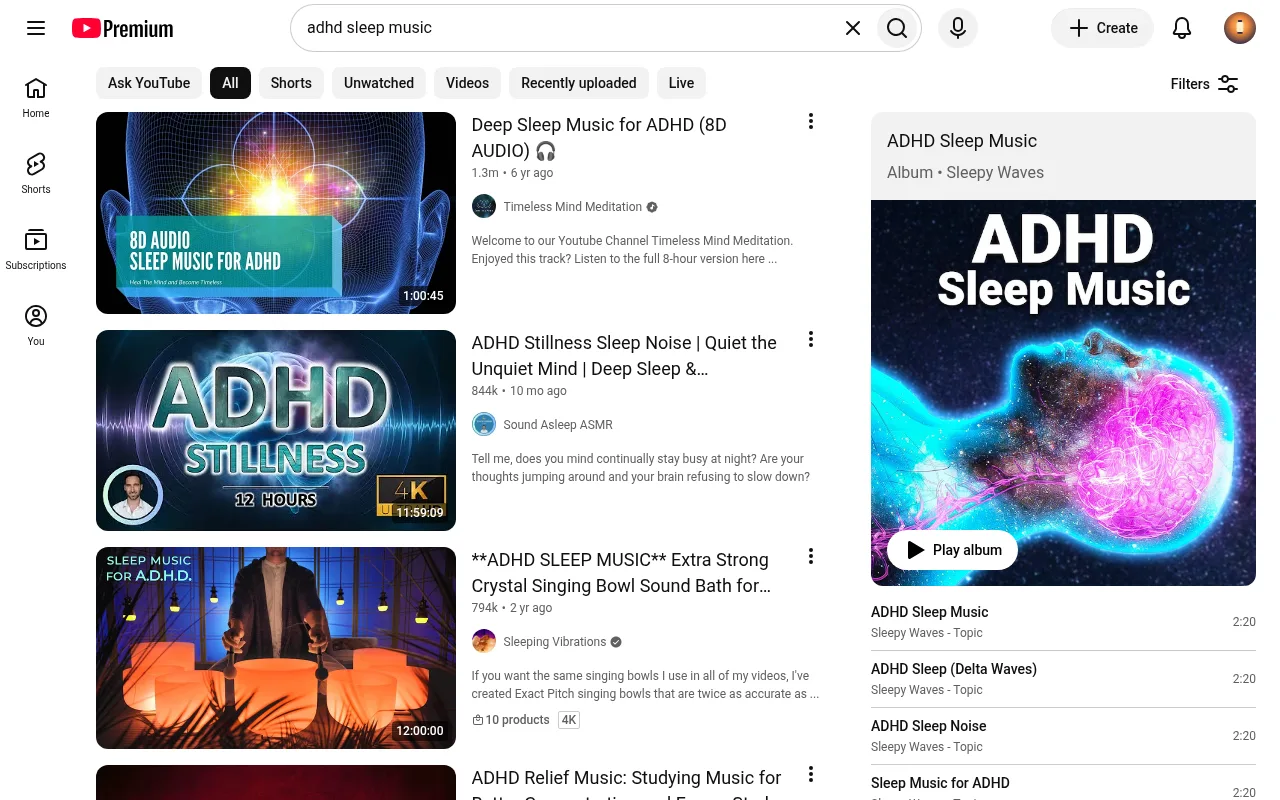
Two tips. Turn autoplay off so a different video doesn't start in the middle of the night, and pick one video you like and keep coming back to it, so it stays familiar. Creators can turn on ad breaks in the middle of videos 8 minutes or longer, so on a free account an ad can cut in partway through, which is worth knowing before you pick one for bedtime.
Calm
Calm has a guide to the best sleep sounds for ADHD that links six tracks from its app: white noise, brown noise, pink noise, nature sounds, soft music and binaural beats. It's a tidy way to try each type back to back.
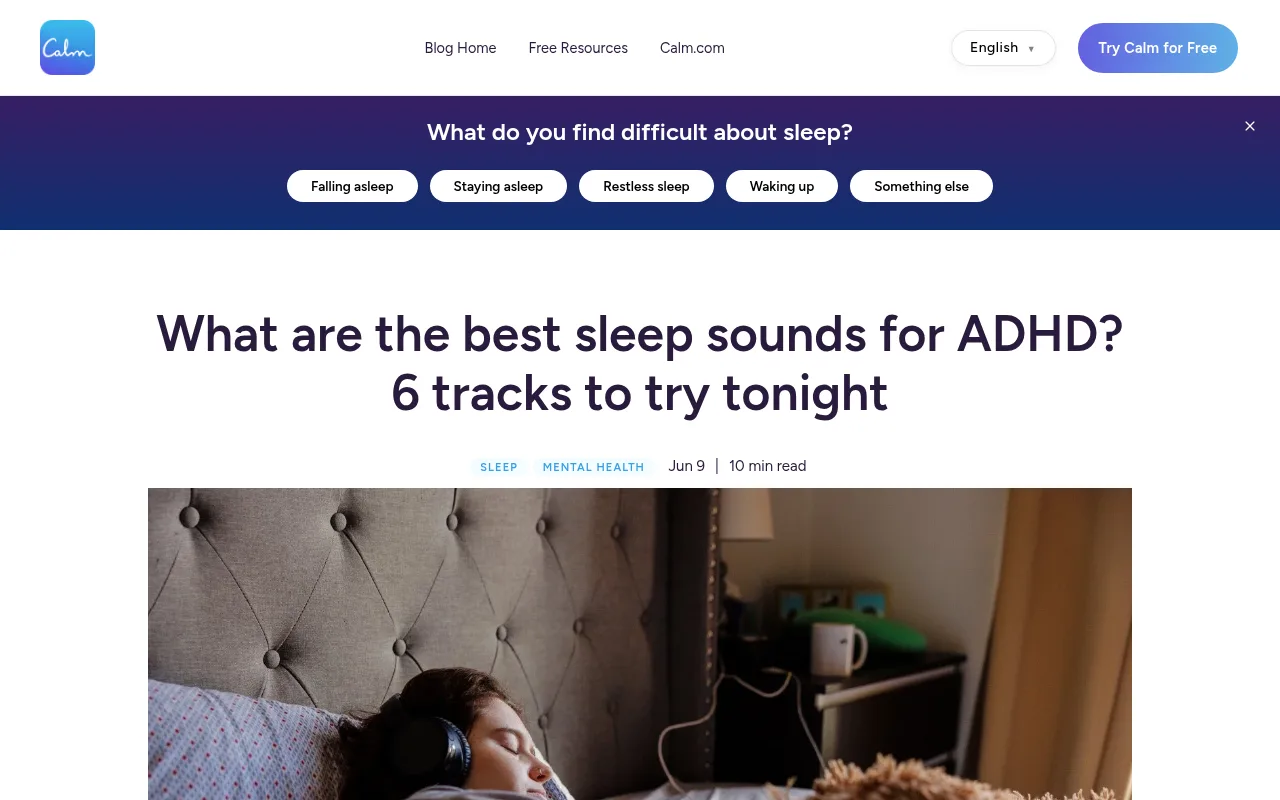
It also suggests setting a timer so the sound fades out after you fall asleep. I like that the page is upfront that the research on sleep frequencies is still catching up to how popular they are.
Headspace
Headspace doesn't have an ADHD section, but its sleep music is designed as a soundtrack for falling asleep, with not much variation, and it also masks sounds inside or outside the room.
Some tracks blend instruments with nature or noise, like white noise with violins or rain with organ, which is close to setup 2 above.
Endel
Endel has a page of sound tools for ADHD. The one that fits bedtime best is its colored noise tool, which Endel describes as steady noise to tune out brain chatter and outside distractions.
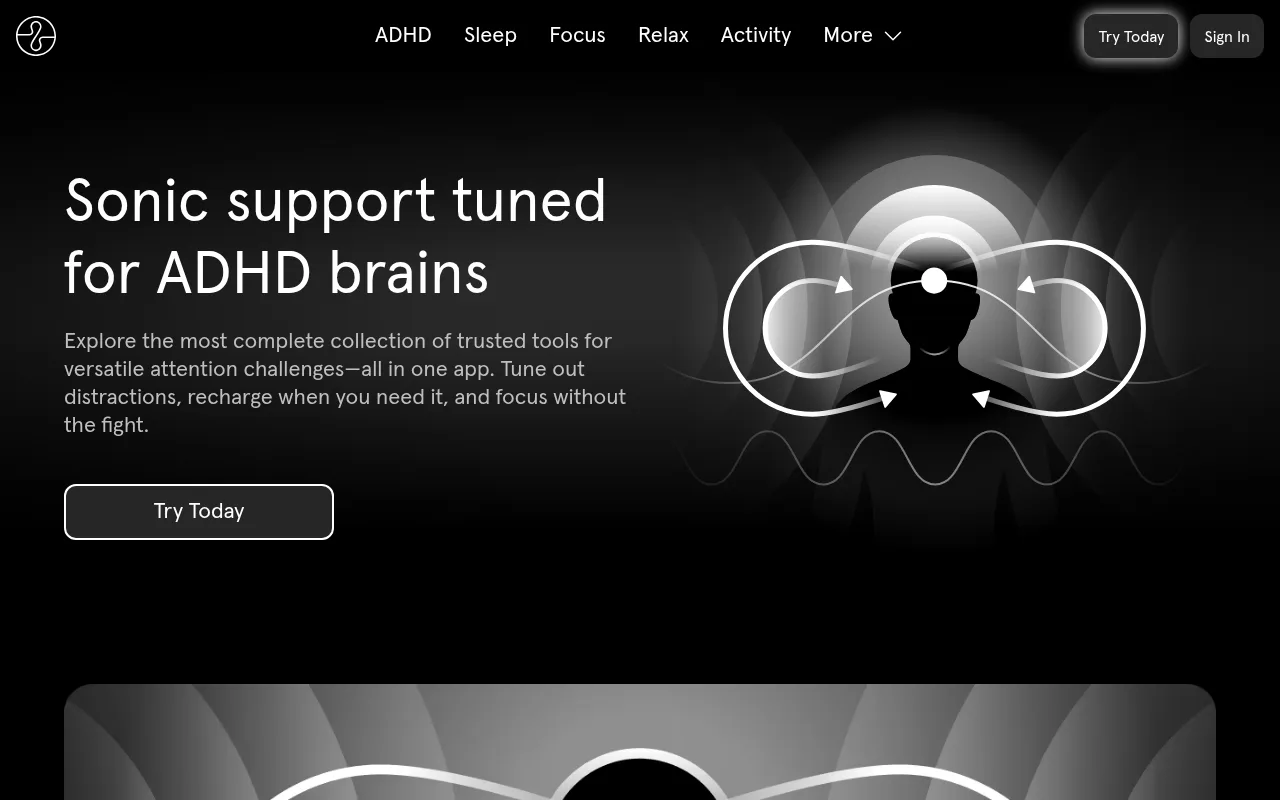
The same page lists 8D Odyssey and Solfeggio Tones, and Endel has a separate Sleep section for winding down. Much of the ADHD page is about attention and focus, so for bed I'd start with the colored noise or the Sleep sounds.
Brain.fm
Brain.fm calls itself the first music made for ADHD, and its main app has music for sleep alongside focus and relaxing.
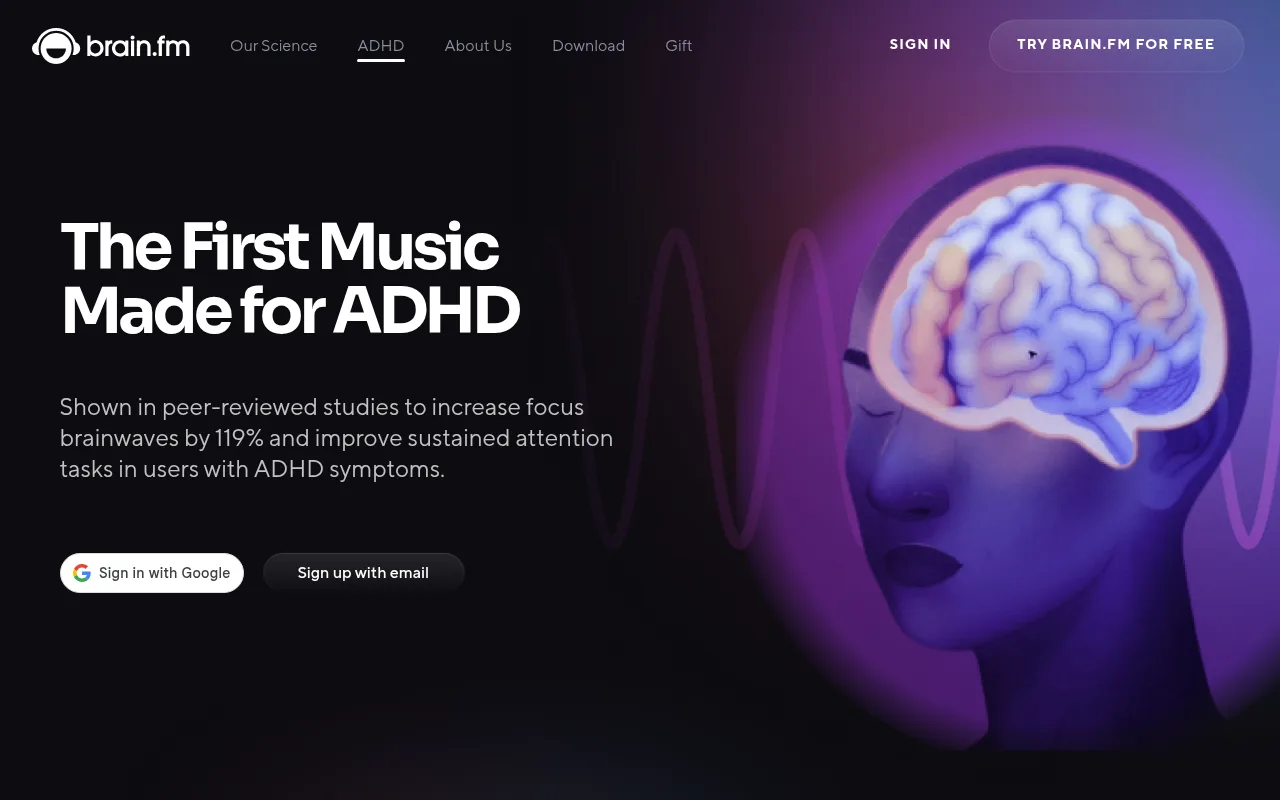
Its ADHD music is built to give extra stimulation so you can focus. That's the opposite of what you want at 1am, so keep it for the daytime and use the sleep music at night.
What the research shows, and where it stops
Music for sleep has a decent body of research behind it. A 2019 paper in Scientific Reports, Effects of relaxing music on healthy sleep, pulls a few findings together:
- In an online survey, 62% of 651 people said they had used music to help them sleep at least once.
- A meta-analysis of six studies with 314 patients found music improved how well people with insomnia felt they slept.
- Another meta-analysis of 20 studies found bedtime music helped people with primary insomnia on sleep quality scores, time taken to fall asleep and sleep efficiency.
Here's where it stops. None of those studies was about ADHD. They show relaxing music can help sleep in general, which is a good reason to try it, but they don't prove that any particular ADHD playlist works for everyone.
The ADHD-specific research is thinner. A 2025 paper in PLOS One, The role of music in ADHD, looked at how people with ADHD talk about music online. It doesn't measure sleep at all. Its authors suggest, as an interpretation rather than a finding, that the predictable structure of a song stuck in your head may give a sense of control and a calming effect when you feel wound up. That lines up with the predictability advice above, and it's still an idea to test on yourself.
Put together, music is a low-risk thing to try, steady and familiar sound is the sensible place to start, and your own nights are the real test. If sleep is hard most nights, a doctor or another qualified clinician is the right next step.
Build an ADHD sleep music channel with Chillframe
People who search for ADHD sleep music know what they want: steady sound with no words and no sudden changes. That makes it a good niche for a faceless channel, and the checklist above already tells you what to make.

Chillframe makes those videos and posts them to your YouTube channel: original music or the sound of the scene, a picture to go with it, and the finished video.
Here is how I'd match each point on that checklist:
- For no words, choose Instrumental, which is original music with no singing. Or choose Ambience only, which is the sound of the scene, such as rain, with no music at all.
- For a calm screen, make Lite videos. They are still pictures, so nothing moves in a dark bedroom. The Deep Sleep style suits this, and so do looks like Moonlit Ridge and Anime Rainy Bedroom. You can also describe your own scene.
- For a steady routine, put the videos on a Series at one fixed time, say 10pm every day of the week. Your listeners then know when the next one comes out.
The first video is held for you to review. Once you approve it, the Series automatically makes and posts every video after it, each with an optimized title, description and tags. From then on it's fully hands-off.
One limit matters here. Each video has either music or the sound of the scene, never both, so setups 1 and 2 above can't be made as one Chillframe video. For lofi over rain, or ambient music over brown noise, you'd put the two tracks together yourself in an editor. Music on its own, or rain on its own, is one video.
A still picture is what this niche asks for anyway, and still Lite videos are what the Starter plan makes, at $19 a month.
ADHD sleep music FAQ
Does music actually help people with ADHD sleep?
Nobody has tested that directly yet. The bedtime music studies, including two meta-analyses on insomnia, weren't about ADHD, but they do show relaxing music can help sleep in general. That makes it a cheap, low-risk thing to try for a week and judge on your own nights.
Is brown noise better than music for ADHD sleep?
Neither wins for everyone. Brown noise is steadier and good at covering low sounds like traffic, while slow instrumental music gives your mind something soft to follow. If you can't decide, setup 2 above layers the two.
What tempo should ADHD sleep music be?
Around 60 to 80 beats per minute is a good place to start. Calm and Sleep Education both point to that range, and Sleep Education adds that what works for one person may not work for another.
Are binaural beats good for ADHD sleep?
Some people find them absorbing, but they need headphones, and 8D mixes move the sound around you, which is the opposite of predictable. Calm's own guide says the research on sleep frequencies is still catching up. I'd try steady music or noise first.
Should I leave sleep music playing all night?
You don't have to. Calm suggests a timer so the sound fades out after you fall asleep. If noises usually wake you in the night, a long video or mix at one low volume is the other way to go.