Listening
Meditation Music for Sleep: Guided, Unguided and Breath-Paced
Guided or unguided, breath-paced or body scan, and how long to let it run once the light is off.

The best meditation music for sleep asks nothing of you. On most nights that means unguided music: slow, instrumental and even, with no voice and no sudden changes. On the nights your head won't quiet down, start with a short guided track and let plain music take over when the voice stops. Press play once you're lying down with the light off, keep it quiet, and let it fade or stop on a timer.
This guide is for the person in bed tonight. If you'd rather build a meditation channel than listen to one, my guide to meditation music on YouTube covers that side.
Guided and unguided meditation music for sleep
Meditation music for sleep comes in two kinds: guided, with a voice, and unguided, with music alone.
Guided tracks have a teacher's voice leading you: noticing your breath, relaxing each part of your body, counting you towards sleep. They help when your thoughts are racing, because the voice gives your attention somewhere to go. The cost is that you're still listening to something, and a voice that changes pitch or pace can pull you back up.
Unguided music is music on its own. There's nothing to follow, so it suits nights when you can settle yourself and want a soft backdrop while you do. It's also what you want playing once you're nearly asleep.
You don't have to pick one for good. A pattern that works well is a 10 to 20 minute guided track first, then unguided music after it. Check how a guided track ends before you use it at night. A daytime meditation often finishes by asking you to open your eyes and come back to the room, which is the opposite of what you want at 11pm. Look for ones made for sleep, which trail off instead.
Three kinds of track to try
Once you've picked guided or unguided, these are the styles I'd try first. They all share what matters for sleep: slow, steady and without a big moment in the middle.
Breath-paced music
These tracks rise and fall on a slow cycle so you can breathe along. With Calm's breath-paced soundscapes, you breathe in as the volume swells and out as it fades. The swell gives you a slow pace to breathe at, with no counting. They're good for the first part of the night, before you stop paying attention to anything.
Body-scan music
A body scan moves your attention slowly from your feet to your head, letting each part relax. Guided versions talk you through it. If you know the routine, you can do it yourself over plain ambient music. Calm lists body scans as one use for ambient music, which it describes as spacious and slow, often with no clear rhythm or melody. That lack of a tune is the point: there is nothing to hum along to. My guide to ambient sleep music goes further into this style.
Steady instrumentals
Soft piano, slow strings or gentle acoustic guitar, with no drums and no vocals. This is the easiest place to start if ambient feels too shapeless. The Sleep Foundation suggests music at around 60 to 80 beats per minute and points out that most sleep studies chose music in that range. Treat that as a guide for choosing, not a rule.
I've left two things out on purpose. Singing bowls and chanting are their own world, and my guide to Tibetan music for sleep covers them. Tracks sold on a frequency, like 432 Hz music for sleep or 528 Hz music for sleep, make claims I'd rather look at separately.
When to press play and how long to let it run
Start the music when you lie down, not while you're still brushing your teeth, and do it the same way each night.
There's no set length, but two studies the Sleep Foundation reports give a sense of it:
- In one study, adults listened to 45 minutes of music before going to sleep and reported better sleep quality from the very first night. The benefit seemed to build the more nights they did it.
- In a study of women with insomnia symptoms, each played an album of their own choice when getting into bed for 10 nights in a row. Before the music, they took 27 to 69 minutes to fall asleep. With it, they took 6 to 13 minutes.
Those numbers belong to those studies, not to everyone. What they suggest is to give the music a long run, and to keep it up for more than one night before you judge it.
For the end of the track, you have two options. Calm says the ideal sleep track either plays all night or fades out gently so it doesn't wake you. If you'd rather it stopped, a timer does it. Set it for longer than you think you need, because music cutting out when you're halfway asleep can bring you back.
Where to find meditation music for sleep
These four have the most to choose from. All of them mix guided and unguided tracks, so check which one you're opening.
| Where | Cost | What it has for sleep | Stands out for |
|---|---|---|---|
| Insight Timer | Free | Thousands of free sleep music tracks, plus guided sleep meditations in their own section | A length filter, with Extended for music that runs past the point you fall asleep |
| Calm | Paid, with a free try first | Sleep stories, meditations, music and soundscapes | Sleep Rhythm, a ready-made breath-paced track |
| Headspace | Paid, free for the first 14 days | Sleepcasts, sleep music, soundscapes and wind-down meditations | Wind-downs for the guided-then-unguided pattern, and SOS exercises for waking in the night |
| YouTube | Free, with ads | Long unguided videos, often 8 hours or more | A sleep timer, and dark scenes that keep the room dark |
Insight Timer
Insight Timer is the one I'd try first if you don't want to pay. Its sleep music library says it has thousands of free tracks, and the list runs from a 3-minute song to a piece over 7 hours long.
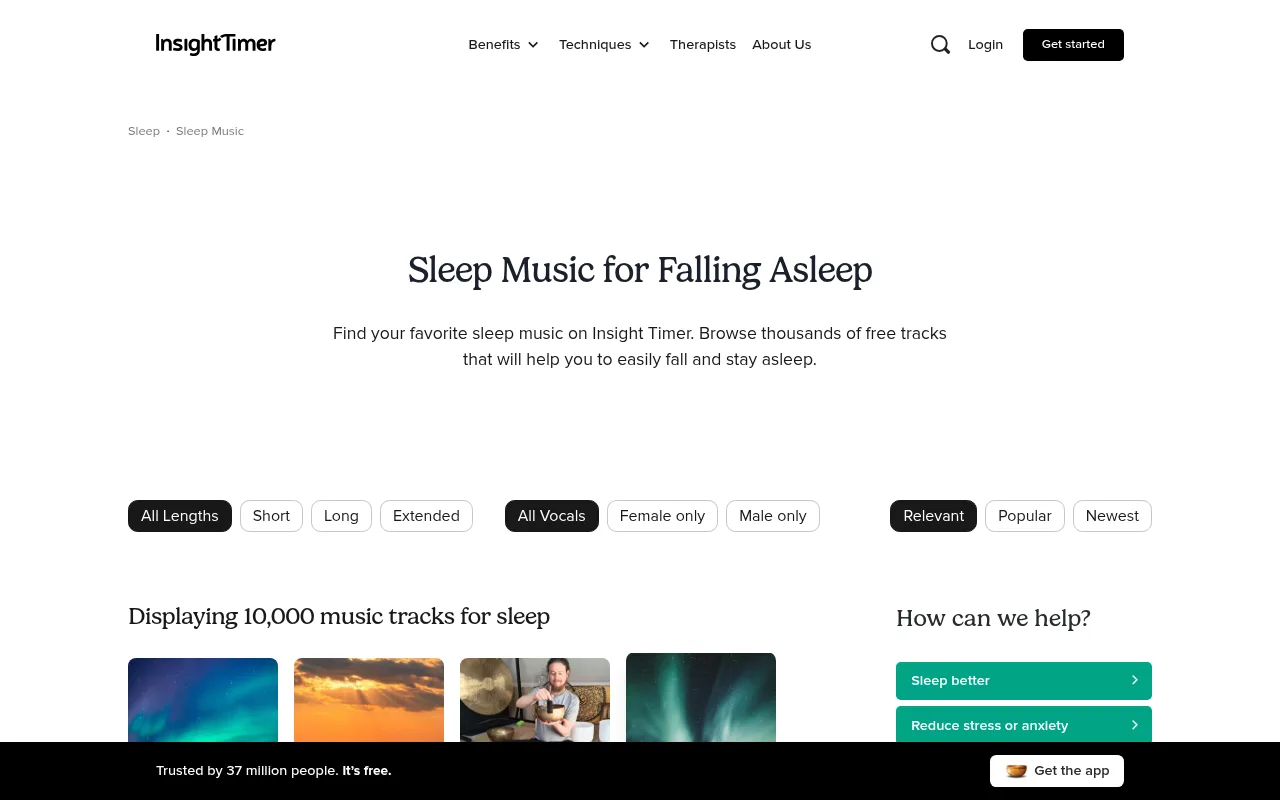
The length filter is the useful part: Short, Long and Extended. Pick Extended for music that runs past the point you fall asleep. Guided sleep meditations sit in their own section, so you can find a short guided track and a long piece of music in the same app.
Calm
Calm is a paid app with a large sleep library of sleep stories, meditations, music and soundscapes. You can try it free before you pay.
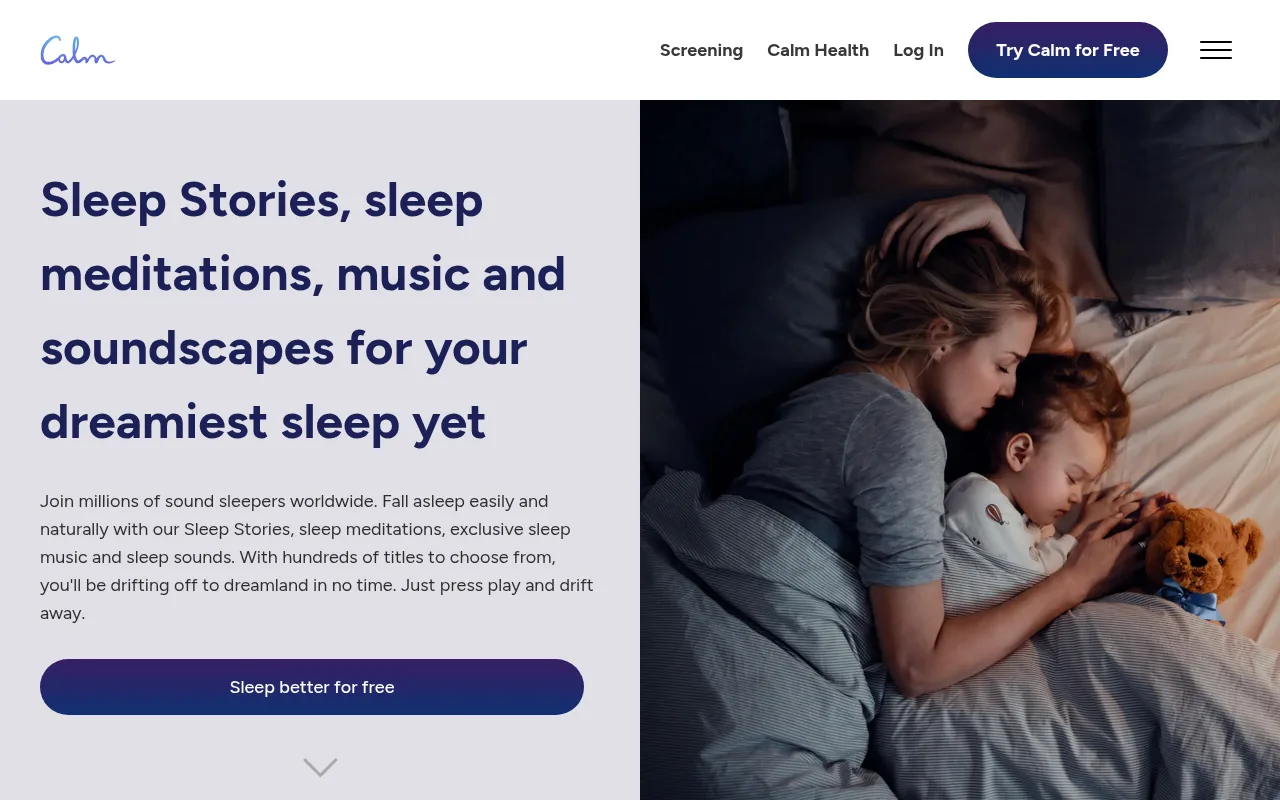
For this guide, the interesting one is Sleep Rhythm: Rising and Falling, a meditation that matches your breathing to the sound. It's a ready-made breath-paced track. Calm also has soundscapes, like Rain on Leaves, if you want something unguided after it.
Headspace
Headspace is also a paid app, and you can try it free for the first 14 days. Its sleep section covers sleepcasts (slow spoken stories set in quiet places), sleep music and soundscapes, and wind-down meditations with calming breathing exercises.
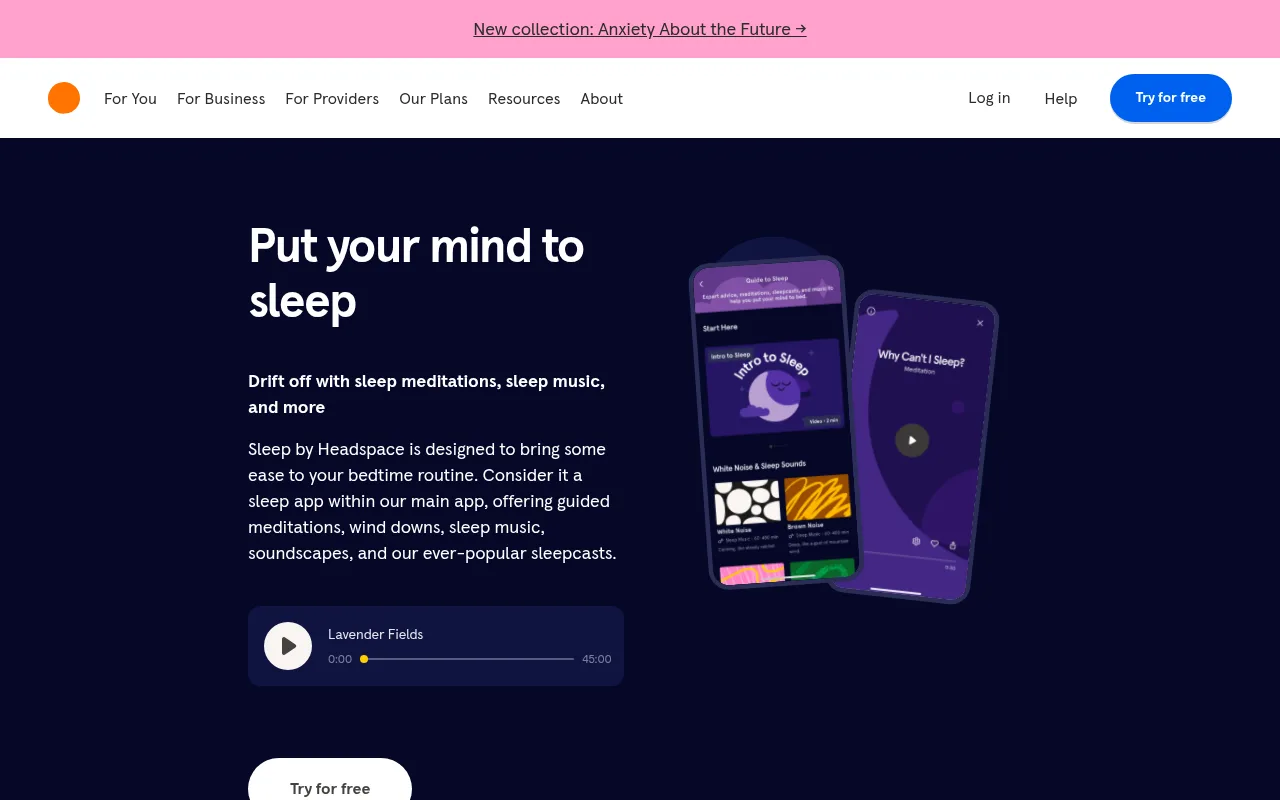
The wind-downs suit the guided-then-unguided pattern well: a short guided track to move you from an active mind to rest, then sleep music after it. There are also SOS exercises for when you wake in the middle of the night.
YouTube
YouTube is where the long unguided videos live, often 8 hours or more of music over a calm scene, like this 12-hour relaxing sleep and meditation music video.
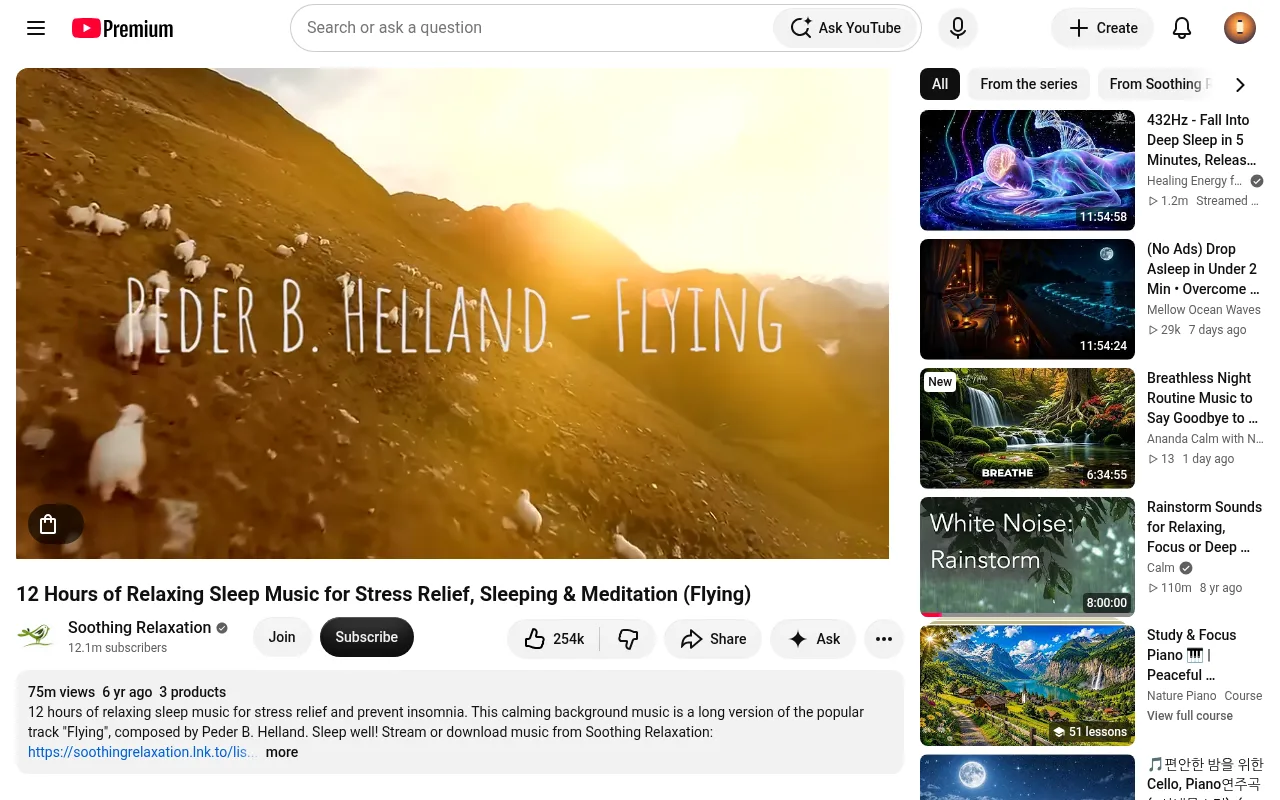
Two things make YouTube work better at night. First, choose a video with a dark scene so the screen doesn't light up the room. Second, use the sleep timer: in the YouTube app on Android, open the video, tap Settings in the player, tap Sleep timer and choose how long it plays. Ads can cut in at a different volume, and YouTube Premium removes them.
Volume, speakers and headphones
Keep it quiet. The Sleep Foundation's advice is to find a volume that is soothing and not disruptive, and it's easy to set it too loud while you're still awake and alert.
A small speaker near the bed is better than earbuds for a whole night. The Sleep Foundation warns that headphones and earbuds can damage the ear canal while you sleep if the volume is too high, and that sleeping in earbuds can lead to a build-up of earwax and raise the risk of ear infections. If you need headphones for a guided track, take them out before you drift off and let a speaker carry the music.
The one exception is binaural beats, which only work through headphones. My binaural beats sleep guide covers how they work and what the studies found.
What the research says about music and sleep
People who listen to relaxing music at bedtime tend to say they slept better. Measured sleep, in the lab, shows a more mixed picture.
A 2019 study in Scientific Reports by Cordi, Ackermann and Rasch is a good example. It cites a meta-analysis of six studies with 314 patients in which music improved how well people with insomnia rated their sleep. In the study's own experiment, 27 women listened either to a 14-minute piece of sleep-inducing music or to a spoken text before a 90-minute nap. Music improved how well they rated the nap, and it increased slow-wave sleep, the deepest stage, but only in the participants who scored low on suggestibility.
So it was a nap, not a full night, and the deep-sleep effect showed up in some people and not others. That's a reason to try a few styles and keep the one that works for you, not to expect one track to do the same for everyone. If you struggle to sleep most nights, the guide to the best sleep music for insomnia is a good next read, and a doctor is the right person to talk to.
Make unguided meditation videos for YouTube with Chillframe
Many of the long meditation and sleep videos on YouTube come from faceless channels: calm music, a still or slowly moving scene, and no one on camera. It's a growing space, and a calm one to build a channel in.

Chillframe makes the unguided half of the pattern in this guide: original music made fresh for each video, a scene to match and the finished video, published to your YouTube channel. There's nothing to edit and no stock music to track down.
I'd keep the schedule calm, with two evenings a week rather than every night. Start with the scene: Moonlit Ridge is a near-black night with a full moon low behind a ridgeline, and Foggy Forest and Snow Cabin are softer. You can also describe your own in plain words, and a dark one suits a bedroom, for the same reason as the YouTube tips above. For the sound, Instrumental is steady music with no singing, and Ambience only is rain or fire with no music. Then put it on a Series for Sunday and Wednesday at 9pm.
You review the first video. Once it's approved, the Series automatically makes and publishes every one after it, and the channel runs fully hands-off.
One limit to plan around: videos run up to 1 hour on every plan, so Chillframe won't make the 8-hour files you see on YouTube. A library of hour-long videos on a Series fills that space well, and you can join hours in an editor if you want one long upload.
The Starter plan, at $19 a month, makes still scenes in 4K. Moving scenes, where the mist drifts and the stars twinkle, start on the Creator plan at $49, which can also finish a moving video in 4K. To see what works for sleep listeners, lofi for sleeping is a good place to look. I'm happy to help you get the first one out.
Meditation music for sleep FAQ
Is guided or unguided meditation music better for sleep?
Unguided is better on most nights, because there is nothing to follow and nothing to pull you back up. Guided helps when your thoughts are racing and need somewhere to go. You can have both: a 10 to 20 minute guided track made for sleep, then plain music after it.
What tempo should meditation music for sleep be?
Slow. The Sleep Foundation suggests around 60 to 80 beats per minute, and most sleep studies chose music in that range. Treat it as a way to narrow your choices, not a rule, and keep the track that actually relaxes you.
Should meditation music play all night or stop on a timer?
Either works, as long as it doesn't end with a jolt. Calm says a good sleep track either plays all night or fades out gently. If you use a timer, set it longer than you think you need, because music cutting out while you're halfway asleep can wake you.
Is it safe to fall asleep with earbuds in?
It's better not to. The Sleep Foundation warns that earbuds can damage the ear canal at high volume and that sleeping in them can lead to earwax build-up and ear infections. Use a small speaker near the bed for the long stretch, and take headphones out once a guided track ends.