Listening
Best Sleep Music for Insomnia: What to Play and How to Test It
For people who have tried everything: falling asleep versus waking at 3am, what the insomnia studies found, and a two-week way to find out what works for you.

The best sleep music for insomnia is slow, steady, mostly instrumental music that you find calming and that doesn't stick in your head. No single genre has been shown to beat the others. What the research does show is that music helps many people feel they sleep better, it's low-risk, and it works best when you test it properly rather than switching playlists every night.
Falling asleep and waking at 3am are different problems
Insomnia isn't one thing. Some people lie awake for an hour before they drop off. Others fall asleep fine and then wake at 3am with their mind running. Plenty of people get both.
Waking in the night is common. The Sleep Foundation cites a US study where 35.5% of people woke in the middle of the night on three or more nights a week. It also says that waking for 30 minutes or more at a time is a hallmark symptom of insomnia.
This matters for music because the two problems need different sounds:
- Trouble falling asleep: music as you get into bed, there to relax you and give your thoughts somewhere to rest.
- Waking in the night: a low, steady sound that covers the noises that wake you, or nothing at all. A tune you start at 3am can just as easily keep you listening.
Most of the research is about the first problem. Start with the one you have on most nights, because it decides the sound.
The studies on music and insomnia
The research is summarised best in a Cochrane review from 2022. It pulled together 13 studies with 1,007 adults who had insomnia symptoms. People listened to recorded music every day, usually at bedtime, for anywhere from 3 days to 3 months.
The main results:
- Self-rated sleep quality improved. Across 10 studies and 708 people, sleep quality scores improved by 2.79 points on a 0 to 21 scale where lower is better. The reviewers rated that moderate-certainty evidence.
- The sleep measured by machines didn't clearly change. In 3 studies with 136 people, the time to fall asleep, total sleep, sleep efficiency and waking in the night, measured objectively, may not have improved.
- Insomnia severity scores showed no clear difference, though only 2 small studies measured it.
- None of the studies reported any harm.
For falling asleep in particular, the Sleep Foundation describes a study where women with insomnia symptoms played an album of their choice at bedtime for 10 nights in a row. Before, they took 27 to 69 minutes to fall asleep. With the music, it took 6 to 13 minutes.
So music is well worth trying, and the gain shows up mostly in how well people feel they slept. That's real, but it isn't the same as fixing the insomnia itself.
The best sleep music for insomnia to try first
The full review on PubMed Central lists the music the studies used: Western and Chinese classical music, new age, ambient, jazz, lullabies, traditional music and popular oldies. The review didn't test one kind against another, so it can't name a winner. Four studies described their music, and it was slow, 52 to 85 beats per minute, with an even volume and no strong beat. The Sleep Foundation gives a similar starting point of 60 to 80 beats per minute, and suggests avoiding songs that cause strong emotional reactions.
That gives you a shortlist rather than one answer:
| Type | Worth trying because | Watch out for |
|---|---|---|
| Solo piano or soft instrumental | Nothing to follow, easy to fade into | A catchy melody you start humming |
| Gentle classical | Slow movements are often in the right tempo | Big crescendos and dramatic endings |
| Ambient | Very little change from minute to minute | Tracks that build or shift suddenly |
| A favourite album you find calming | Familiar music can relax you quickly | Songs tied to strong memories |
| Rain, pink noise or brown noise | Covers traffic and house noise, good for 3am | Sharp sounds, like thunder cracks |
Lyrics aren't banned, but words give your mind something to follow, so instrumental music is the safer first choice. Whichever you pick, play one long track or album rather than a shuffled playlist, so a new song doesn't start at a different volume halfway through. Try it in the daytime first. If it doesn't relax you on the sofa, it won't do much in bed.
There are guides to piano music for sleep, classical music for sleeping and ambient sleep music if one type suits you. For a steady sound with no melody at all, see pink noise for sleep.
When instrumental music backfires: earworms
This is the finding that surprised me most. A 2021 study by Scullin and colleagues looked at earworms, the songs that keep playing in your head after they stop.
In a survey of 199 adults, people who listened to more music got more earworms at bedtime, and those earworms went with worse sleep. Then, in a sleep lab, 48 young adults heard popular songs before bed, either the normal versions or instrumental versions. More people in the instrumental group reported earworms in the night, 52% against 28%, though that gap only just missed statistical significance. The instrumental group also took longer to fall asleep and slept less efficiently. People with earworms woke more often and spent less time in deep sleep.
These were catchy pop songs, not slow sleep music, but the lesson carries over. Lyric-free isn't automatically safe. The thing to avoid is a tune that sticks. If you'd hum it the next day, it's probably too memorable for bed.
If a track keeps replaying in your head:
- Switch to something less memorable, like ambient music, rain or noise.
- Try silence for a few nights.
- If a tune is stuck at bedtime, the researchers suggest a light task, like writing a to-do list or writing down your worries, rather than something demanding like a game.
A two-week listening test
Changing the music every night tells you nothing. A short, steady test does. The 10-night album study showed results inside two weeks, so that's a fair length.
- Pick one thing. One album or one long track, slow, calm and not catchy. Don't change it for the first week.
- Play it as you go to bed. The Sleep Foundation notes that adults who listened for 45 minutes before sleep reported better sleep quality, starting on the first night. Sessions in the Cochrane review ran from 25 to 60 minutes, with an average of 36.
- Use a speaker at a low volume. The Sleep Foundation warns that earbuds can damage your ear canal if the volume is too high while you sleep, and can build up earwax. Set a timer for about 45 minutes, or leave it on if silence wakes you. YouTube has a sleep timer in the player settings, and Spotify has one in the Now Playing menu.
- Keep a one-line log each morning. Note a rough guess at the minutes it took to fall asleep, the times you woke, and your alertness by midday out of 5. A line like "40 minutes, woke twice, 3 out of 5" is plenty. Don't check the clock in the night.
- Change one thing in week two. If week one did nothing, try a different type from the table. If falling asleep got easier but you still wake at 3am, add a steady night sound instead.
- Compare the two weeks. Keep whatever made a difference. Drop whatever didn't, including the music itself if silence was better.
The log is for you, not a diagnosis. It stops you judging the music on one good or bad night.
If nothing helps after two weeks, that's useful to know too, and a good reason to ask about CBT-I.
Sleep music for waking at 3am
For waking in the night, quieter and duller is better. Starting a fresh, melodic playlist at 3am can wake your mind up more than it settles it.
Three things tend to suit night waking:
- A steady sound already playing. Rain, pink noise or a very plain ambient track, left on low from bedtime, covers the small noises that wake you. There's a guide to 10-hour rain sounds if you want a long one.
- No bright screen in the night. Set the sound up before bed, so restarting it is one tap.
- Getting up if you realise you're wide awake. National Jewish Health's advice for insomnia is that if you can't sleep after 15 to 20 minutes in bed, leave the bedroom and come back only when you feel drowsy. Until then, they suggest something restful in dim light, like reading, with no electronics.
Places to find sleep music for insomnia
Spotify
Spotify has its own Sleep playlist, and searching for sleep or insomnia brings up many more. For the test, play one album, or turn shuffle off so the playlist runs in order.
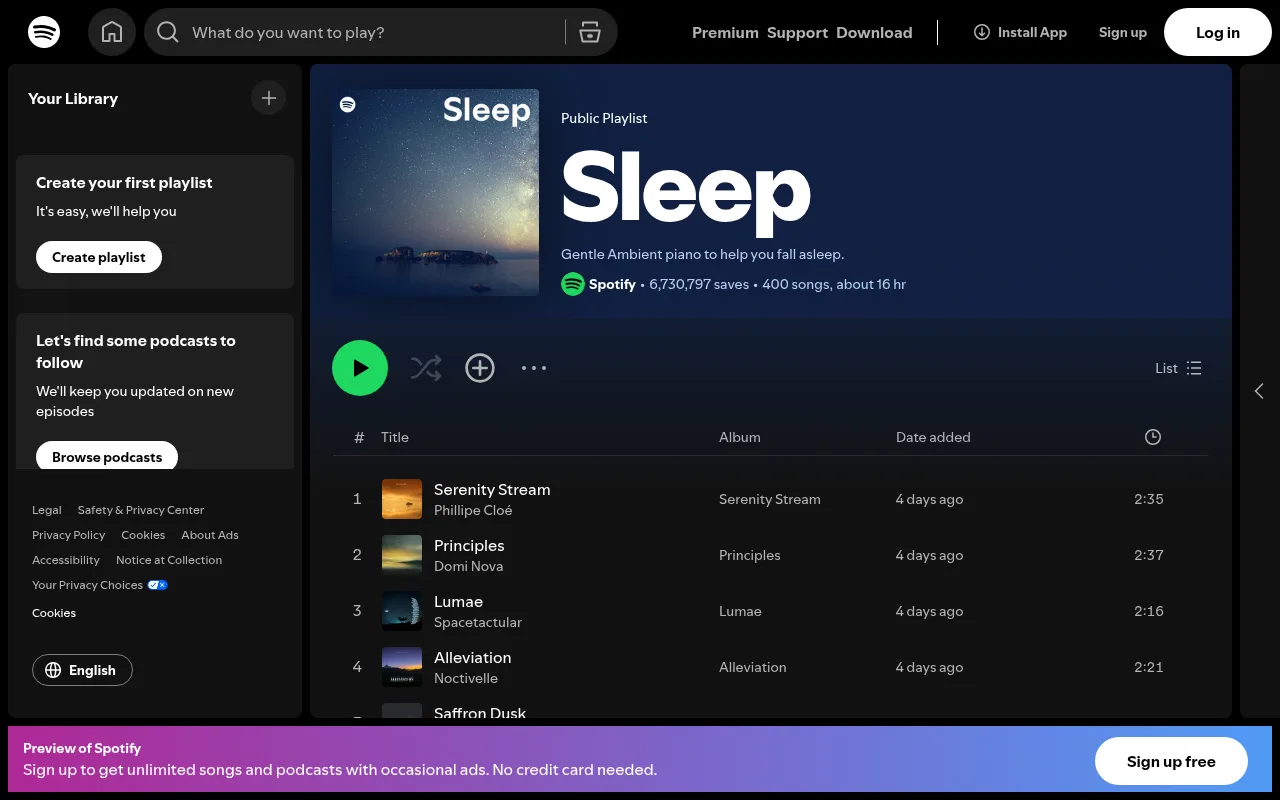
The free tier has ads. Spotify Premium removes them and lets you download music, so a weak signal won't cut it off in the night.
YouTube
YouTube is the place for really long sleep music, with single videos that run for 10 hours. Yellow Brick Cinema's 10 hours of deep sleep music is a typical example: slow, even and made to run all night.
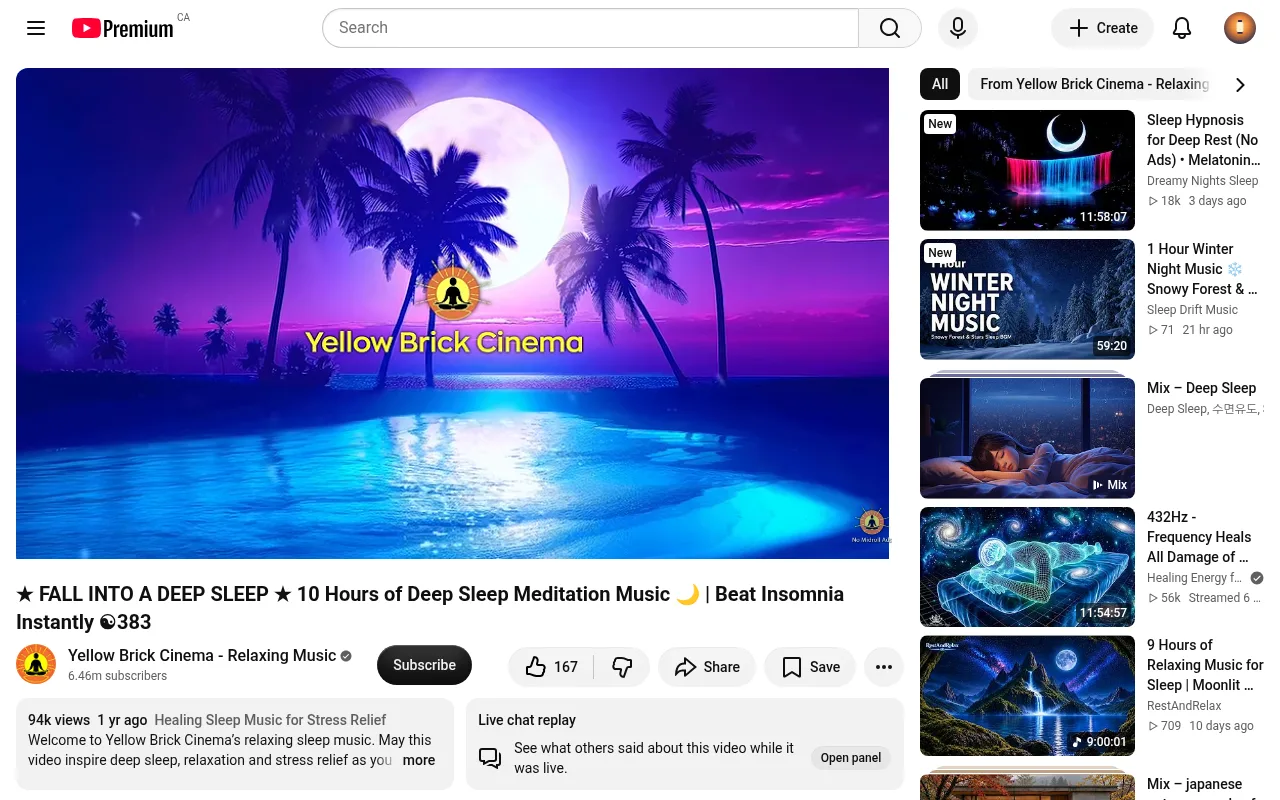
Some titles promise to beat insomnia instantly. Treat that as a title, not a result. Ads can play during free videos, and YouTube Premium removes them.
Insight Timer
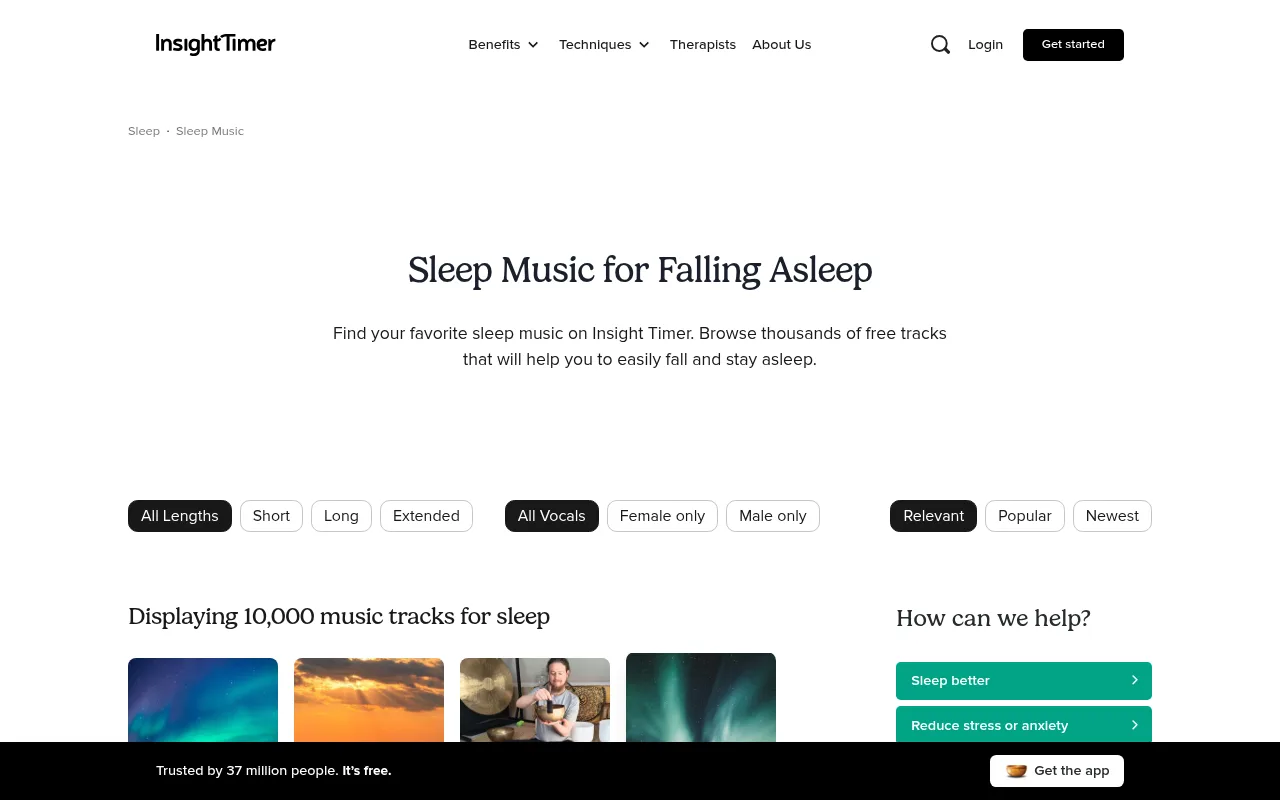
Insight Timer is a meditation app with a large free sleep music library. Its page shows 10,000 sleep music tracks, and you can filter by length, which helps when you want one long piece for the test.
Calm
Calm is a subscription sleep and meditation app. Alongside its Sleep Stories, it has sleep music playlists and soundscapes, so you can keep music for bedtime and a soundscape for the night in one place.
Headspace
Headspace is another subscription app. Its sleep music blends instruments with steady sounds, like white noise with violins or rain with organ. Headspace says it masks other sounds, inside or outside, which makes it a fit for the 3am problem.
CBT-I, the first-line treatment
If insomnia has gone on for months, music on its own is unlikely to be enough. The American Academy of Sleep Medicine recommends cognitive behavioural therapy for insomnia (CBT-I) as the first-line treatment for chronic insomnia in adults.
CBT-I runs over several weeks. It combines sleep habits, sleep restriction (matching your time in bed to the sleep you actually get), stimulus control (keeping the bed for sleep, like the 15 to 20 minute rule above), relaxation and work on the thoughts that keep you awake. It's available as a programme with a therapist, or through websites and apps.
Music sits comfortably alongside it as part of winding down, and the guide to relaxing music for sleep and anxiety has a 20-minute routine for that. If poor sleep is affecting your days, see a doctor and ask about CBT-I.
Start an insomnia sleep music channel with Chillframe
People who can't sleep search YouTube every night, and many of the long, quiet videos they find come from faceless channels: calm music, a dark scene and no one talking. Those listeners come back night after night, and you don't need to be a musician to make something for them.

Chillframe writes original music for each video, makes the scene to go with it, masters the audio to YouTube's loudness target and publishes the finished video to your channel. For someone lying awake, the Deep Sleep style is the place to start. Moonlit Ridge is a near-black night sky over a ridge, dark enough to sit on a phone in a dark bedroom, with a sub-bass drone, slow pads and one distant piano note. Orbital Bunk is a dim sleeping cabin aboard a space habitat, with a low drone and no beat at all.
The setup comes down to four choices:
- The scene: Moonlit Ridge, Orbital Bunk or one you describe yourself.
- The sound: Instrumental, the default, fits the advice above. Ambience only suits the 3am listener who wants rain or fire and no music.
- The length: 1 hour.
- The schedule: a Series every night, published late in the evening, so a new video is waiting for the people still awake.
You check the first video before anything goes live. Once you approve it, with auto-publish on, Chillframe makes and posts every one after it automatically, each with a title, description, tags and a thumbnail, fully hands-off.
One limit matters in this niche. Every video runs up to 1 hour, on every plan, so Chillframe doesn't make the single 10-hour file you see on YouTube. A Series of hour-long videos builds a library instead, and for one all-night file, join several hours together in an editor.
The Starter plan, at $19 a month, includes one Series and still scenes in 4K, which covers a single insomnia channel. The guide to sleep music on YouTube covers the creator side, and lofi for sleeping a softer style.
Best sleep music for insomnia FAQ
Is classical music the best sleep music for insomnia?
Not necessarily. The Cochrane review covered classical, new age, ambient, jazz, lullabies, traditional music and oldies, and it didn't test one against another. What the studies' music had in common was a slow tempo of 52 to 85 beats per minute, an even volume and no strong beat, so pick whichever slow music you find calming.
Is it bad to fall asleep to music with lyrics?
It isn't banned, but words give your mind something to follow, so instrumental music is the safer first choice. The bigger risk is a tune that sticks. In the earworm study, instrumental versions of pop songs still got stuck in people's heads, so if you'd hum it the next day, save it for the daytime.
How long should you listen to sleep music before bed?
About 30 to 45 minutes is a good place to start. Sessions in the Cochrane review ran from 25 to 60 minutes, with an average of 36, and the Sleep Foundation notes that adults who listened for 45 minutes reported better sleep quality. Set a sleep timer, or leave it on low if silence wakes you.
Does white or pink noise count as sleep music?
Not quite. The insomnia studies were about recorded music, and steady noise does a different job: it covers the small sounds that wake you. That makes it a good fit if your problem is waking at 3am. You can use both, music as you get into bed and a low, steady sound through the night.
Can music cure insomnia?
On its own, probably not. In the studies, music improved how well people felt they slept, but the sleep measured by machines didn't clearly change. For insomnia that has lasted months, the American Academy of Sleep Medicine recommends CBT-I as the first-line treatment, and music fits alongside it as part of winding down.