Listening
Nature Sounds for Sleep: Which One Suits You, and How to Mix Two
A sound-by-sound guide to the quieter nature sounds, how to layer them, and where to find good long recordings.

The best nature sounds for sleep are the steady ones: a stream running over stones, wind moving through a wood, a cricket chorus. Eventful sounds like frogs, owls and birdsong are lovely for winding down but more likely to wake you. Below I go through six nature sounds that don't get their own page, who each one suits, how to mix two together and where to find good recordings.
Why nature sounds for sleep work
They do two jobs: they cover the noises that wake you, and for a lot of people they are calming in their own right. The noises are the usual ones: a car door, a neighbour, the boiler. Earth.fm's piece on nature sounds and well-being notes that sound over 30 dB is generally enough to disturb sleep, and that intermittent noise makes waking more likely. A steady layer of sound makes those sudden changes stand out less.
Nature sounds also seem to calm people down on their own. The same Earth.fm article cites research linking natural soundscapes with a sense of calm and stress relief, and its sleep playlist page points to a University of Sussex study that found nature sounds affect the nervous system in a way that helps people relax.
None of this works the same for everyone. Some people find any sound distracting, and a few find certain sounds (birds, for one) wake them up rather than send them off. Treat it as something to try for a week, not a cure.
The sounds that have their own guides
Rain, waves, rainforest and fire each have a full guide of their own, so here they get one line each:
- Rain: steady, broad and easy to sleep through. See the rain sounds guide, or rain and thunder sounds for sleeping if you like a storm.
- Ocean waves: a slow rise and fall that some people match their breathing to. See ocean sounds for sleep.
- Rainforest: dense, warm and full of insects. See rainforest sounds for sleep.
- Fire: a crackling hearth or campfire. See fireplace sounds for sleep.
The rest of this page is about the six I think get overlooked.
Six nature sounds for sleep, and who each one suits
What matters most is how steady a sound is. A steady sound covers noise and gives your brain nothing to follow. An eventful one (a bird call, a frog croak) gives you more to listen to, which helps while you wind down and works against you once you are asleep.
| Sound | How steady it is | Best for |
|---|---|---|
| Stream or creek | Very steady | Light sleepers, covering household noise |
| Wind in trees | Steady, with slow swells | People who find water sounds make them restless |
| Crickets | Steady pulse | Summer nights, people who like a rhythm |
| Forest at night | Mostly steady, with the odd owl or rustle | Falling asleep, people who like a sense of place |
| Frogs | Rhythmic but uneven | Winding down, deep sleepers |
| Birdsong at dawn | Eventful | Naps, early mornings, waking up gently |
A stream or creek
Running water over stones is one of the steadiest nature sounds there is. It sits close to pink noise in how it fills the room, but with a little movement in it, so it doesn't feel like a machine. If you need to cover a partner's snoring or a noisy street and you find plain noise too flat, start here.
The one thing to check is the size of the water. A small brook is soft and high, and a fast river is closer to a roar. I'd start with the smaller one at a low volume.
Wind in the trees
Wind through leaves is a soft hush that swells and fades over several seconds. It suits people who find water sounds make them restless, or who want something softer than a stream.
Watch for recordings where the wind gusts hard. A sudden loud gust can wake you the same way any other sudden noise does.
Crickets
A cricket chorus is a steady, high pulse that sounds like a warm summer night. It is rhythmic without being musical, which makes it easy to tune out once you are drowsy. If a pure noise feels clinical and rain feels gloomy, crickets are a good middle ground.
Some recordings are pitched quite high and bright. If it starts to feel shrill, turn it down rather than off, or pair it with something lower (more on that below).
Forest at night
A forest at night is mostly a low, wide hush with the occasional owl, rustle or distant creature. It is less about covering noise and more about feeling somewhere else, away from the room you are lying in. That sense of place can be what helps you stop thinking about the day.
The trade-off is the odd sudden sound. A good night-forest recording keeps those events rare and quiet. If one recording keeps waking you, try another before giving up on the idea.
Frogs
Frogs sound like a pond on a warm evening: a rhythmic croak and chirp that rises and falls in waves. They are more eventful than crickets, so they work best for deep sleepers, or as something to fall asleep to with a timer set.
Birdsong at dawn
Birdsong is the most eventful sound on this list. Each call is a small burst, and that is exactly what tends to wake people. I'd keep it for afternoon naps, for reading in bed, or as a gentle way to wake up rather than something to sleep through all night.
If you love it anyway, set it far below a steady bed, so it becomes a faint detail rather than the main thing you hear.
How to mix two nature sounds for sleep
Mixing two sounds lets you have a steady sound and an interesting one at once. The rule I'd follow: one steady bed, and one quieter detail on top. The bed does the work of covering noise, and the detail makes it feel like a real place.
- Pick the bed from the steady end of the table: a stream, wind in the trees or crickets.
- Pick one detail from the eventful end: frogs, a distant owl, soft birdsong.
- Set the bed at the volume you'd sleep to on its own.
- Bring the detail in well below it. You should notice it when you listen for it, and not otherwise.
- Listen for five minutes with your eyes closed. If any sound makes you flinch, turn it down or swap it.
Pairs that work well:
- Stream and crickets: a summer night by the water. The stream covers noise and the crickets add warmth.
- Wind in pines and a distant stream: a soft, cool mountain feel with no sudden sounds at all.
- Forest at night and light rain: the rain smooths over any rustles or owl calls.
- Frogs and a slow stream: a pond at dusk, best for falling asleep with a timer on.
Avoid pairing two eventful sounds, like frogs and birdsong. They compete for your attention, which is the opposite of what you want.
If you're not sure where to begin, play a stream on its own at a low volume for a few nights. Once that feels normal, add crickets or a faint night forest underneath and see if you like the place it makes.
Where to find good nature sounds for sleep
myNoise
myNoise is a free website of sound generators built from real field recordings, and its forest and water generators are a good place to start. Each generator splits a recording into separate sliders, so you can push the stream up and pull the birds down.
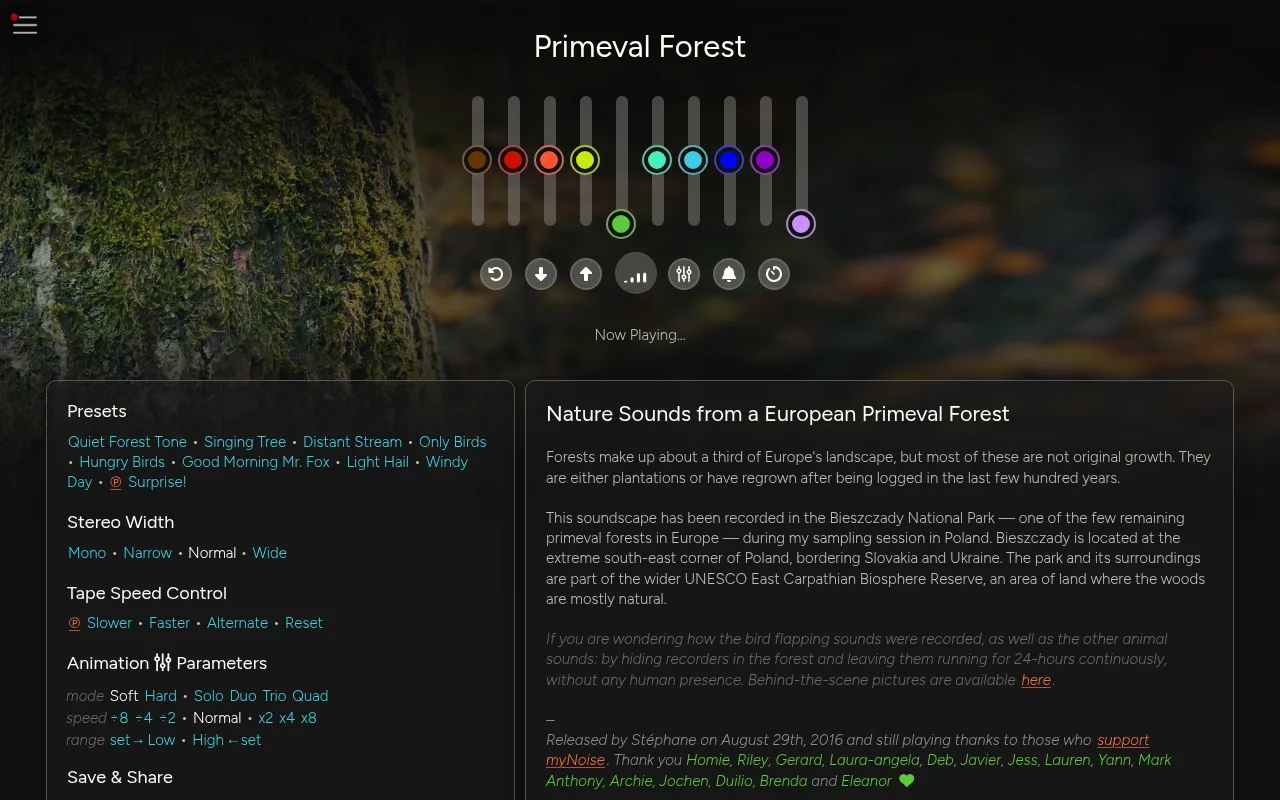
The Primeval European Forest generator was recorded in Bieszczady National Park in Poland, with recorders left running unattended for 24 hours. It has presets like Distant Stream, Only Birds and Windy Day. For water, the Healing Water generator was recorded on a Slovenian mountainside and has Creek and Babbling Brook presets. myNoise is funded by donations, and some extras are for patrons only.
Ambient Mixer
Ambient Mixer is a free, community-built site where people make and share sound mixes. Each mix is a set of channels you can adjust, so it is the easiest place to try the "steady bed plus one detail" idea.
The Warm Summer Forest mix, for example, layers nightingale song, woodpeckers and two kinds of wind in the trees. Channels can be set to play at random intervals, which keeps a detail like birdsong occasional rather than constant. You can open any mix and change it, and this one is released under a Creative Commons licence.
BetterSleep
BetterSleep is a sleep app where you build a mix by tapping sound icons. Its library includes river, forest, birds, wind in trees and campfire, alongside rain, ocean and coloured noise.

Some content is free, and the full library, including its soundscapes and SleepTales, needs a paid subscription. It suits you if you want everything in an app on your phone rather than a browser tab.
Calm
Calm is better known for meditation, but its sleep section is large. Its App Store listing describes calming music, nature sounds and sleep sounds such as ocean waves, heavy rain and campfire, plus more than 100 Sleep Stories.

It is the right pick if a nature sound on its own leaves your mind wandering and you'd rather have a calm voice reading to you.
Endel
Endel is different from everything else here. It doesn't play nature recordings; it makes soundscapes that change in real time with the time of day, the weather, your heart rate and where you are.
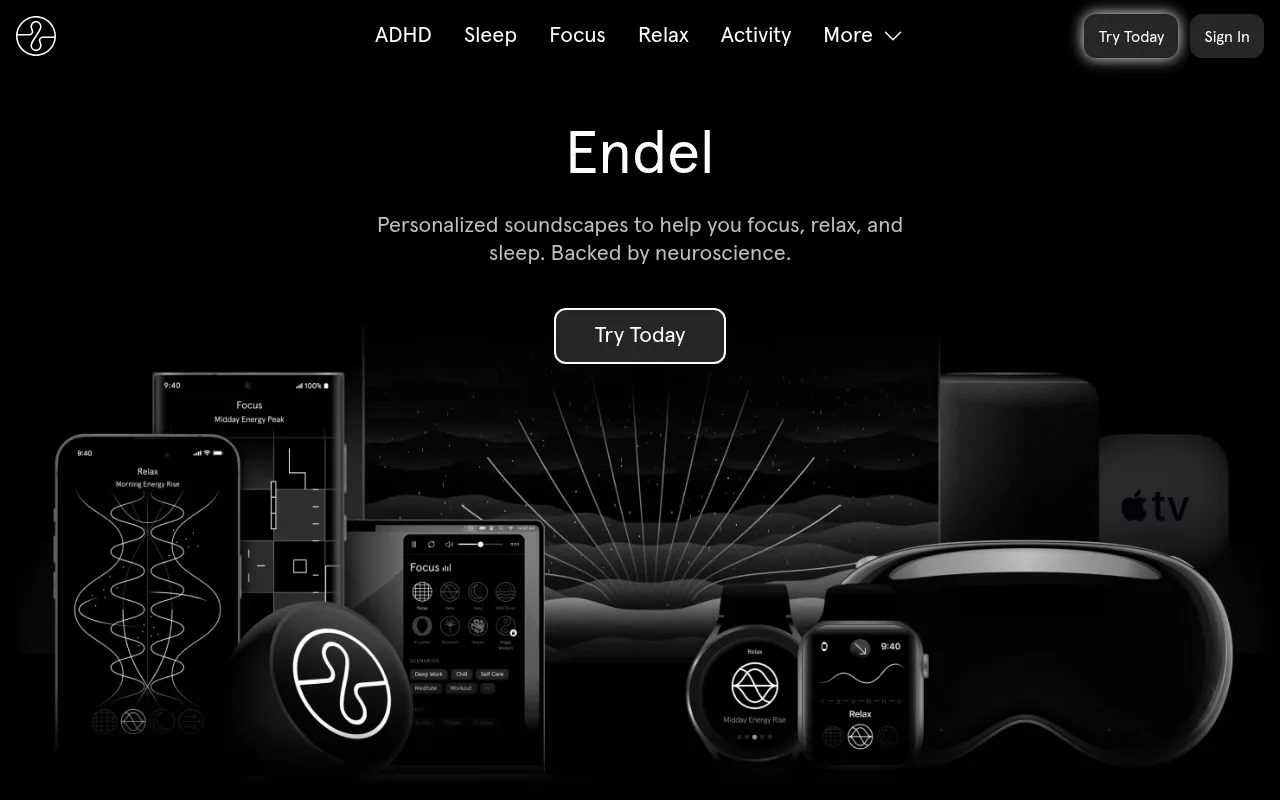
Endel describes its Sleep mode as soothing you into deep sleep with soft, gentle sounds. I'd point you to it if you like the idea of nature sounds but find real recordings too eventful. It runs on phones, Apple Watch, Alexa devices, Mac and the web.
Spotify
Spotify has a lot of nature sound playlists, and searching "forest sounds" or "night sounds" turns up a long list. Filtr Sweden's Forest Sounds playlist, for example, is pitched as falling asleep to crickets, night birds, running water and thunderstorms.
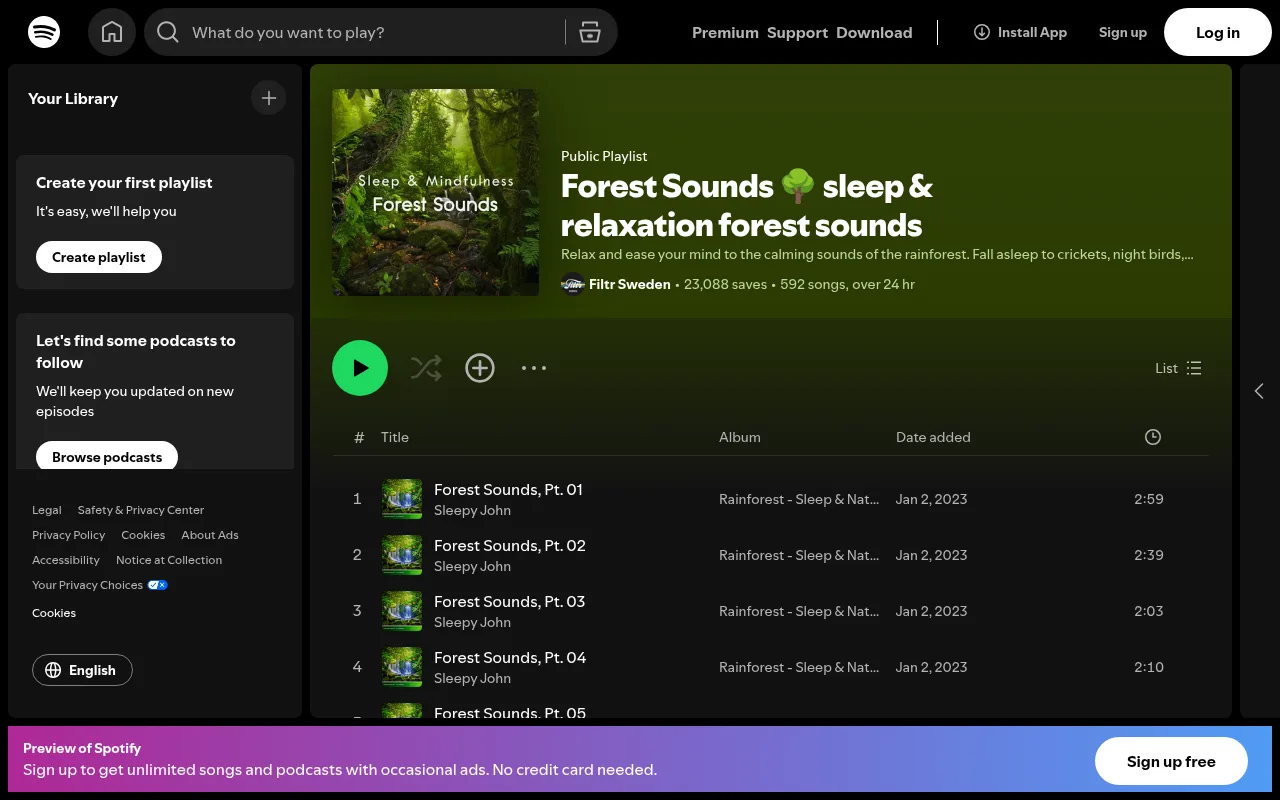
It also shows what to watch for: its tracks run two to three minutes each, so there is a change every few minutes, and each change is a chance to wake. Look for playlists of long tracks instead. Earth.fm's own nature sounds for sleep playlist is a good model: 10 recordings and about four hours in all, from crickets in a Vietnamese jungle to a windy day in an Italian beech forest.
How to listen through a whole night
A few small things make a big difference:
- Keep it quiet. The sound should be just loud enough to blur the noises you want to cover. If you can follow every detail, it is too loud.
- Use a long recording or a generator. Generators like myNoise never end, and 10-hour tracks are easy to find. Wild With Nature, for one, publishes free, uninterrupted 10-hour nature tracks.
- Set a sleep timer if you only need help falling asleep. There is no reason to play sound until morning if you sleep through once you're off.
- Put the speaker across the room. A sound coming from a distance feels more like real surroundings and less like a device by your ear.
- Be careful with headphones. Earbuds are uncomfortable on your side and easy to turn up too loud. A soft headband or a small speaker is usually kinder.
Nature sounds vs white noise and sleep music
These three overlap more than people expect.
White, pink and brown noise are completely steady. Nothing changes, so they are the strongest at covering noise and the least interesting to listen to. If that is what you need, the pink noise guide goes into the differences.
Sleep music adds slow melody, often over a nature bed. Headspace describes its sleep music as mixing live instruments with nature sounds like chirping crickets or falling rain. If a melody helps you switch off, lofi for sleeping is worth a listen.
Nature sounds sit in between: steadier than music, more alive than noise. A stream or cricket chorus behaves almost like noise, while birdsong behaves almost like music.
Run a nature sounds channel with Chillframe
Long stream, forest and cricket videos are made for a faceless channel: a scene, its sound and nobody on screen. Rain and waves get most of the attention, so a channel built around the quieter sounds on this page has a clear place of its own to grow.

Chillframe makes the scene, the sound of that scene, the finished video and the upload to your YouTube channel. Choose Ambience only and you hear the place itself with no music on top. A video carries either that or Instrumental music, not both.
Each sound on this page suits a different listener, so I'd give each one a Series of its own rather than mixing them on one schedule. A nature channel could run:
- Foggy Forest, a night in the woods, on Saturdays and Sundays at 10pm
- a mountain creek you describe in plain words, like a birch wood beside a moonlit stream, every Monday and Thursday
- a summer field full of crickets, also described your own way, on Wednesdays
Each Series automatically makes a fresh video for every slot. You approve the first post of each one, and after that all three run fully hands-off. The analytics in your dashboard show retention and audience for every video, so you can see which place people stay with and make more of it.
The limit to know here is length. Each video runs up to 1 hour on every plan, so Chillframe doesn't make the 10-hour tracks I mentioned above. You can join hours together in an editor, or let a Series build a library of hour-long nature videos.
Three Series side by side is the Creator plan, at $49 a month. The Starter plan, at $19, runs one, which is plenty to start with a single sound, and the sleep music YouTube guide covers the rest of running a channel like this.
Nature sounds for sleep FAQ
Can nature sounds help you sleep?
For a lot of people, yes. A steady sound like a stream or wind in the trees blurs the sudden noises that wake you, and Earth.fm notes that sound over 30 dB is generally enough to disturb sleep. Many people also just find nature sounds calming. It isn't the same for everyone, so give one sound a week before you decide.
Which nature sound is best for sleep?
The steadiest ones: a stream or creek, wind in the trees, or a cricket chorus. They cover noise and give your brain nothing to follow. Frogs, owls and birdsong are lovely for winding down, but they are more likely to wake you once you're asleep.
Is it OK to play nature sounds all night?
Yes, as long as the volume is low, just loud enough to blur the noises you want to cover. Use a generator or a long track so there are no breaks or sudden changes in the night. If you only need help falling asleep, a sleep timer does the job.
Are nature sounds better than white noise for sleep?
Neither is better for everyone. White, pink and brown noise are completely steady, so they cover noise best but can feel flat. Nature sounds are a little more alive, and a stream or cricket chorus behaves almost like noise anyway. If plain noise feels clinical, a stream is the easiest swap.
Where can I find free nature sounds for sleep?
myNoise is free and funded by donations, and its generators never end, so there are no breaks in the night. Ambient Mixer is free too, and you can change any mix. Wild With Nature publishes free, uninterrupted 10-hour nature tracks.