Guides
The Science of Brown Noise for Sleeping: How Deeper Sounds Improve Your Night
A deep, bass-heavy rumble is capturing millions of listeners on YouTube. Here is how brown noise masks noise, calms the brain, and how to harness it tonight.
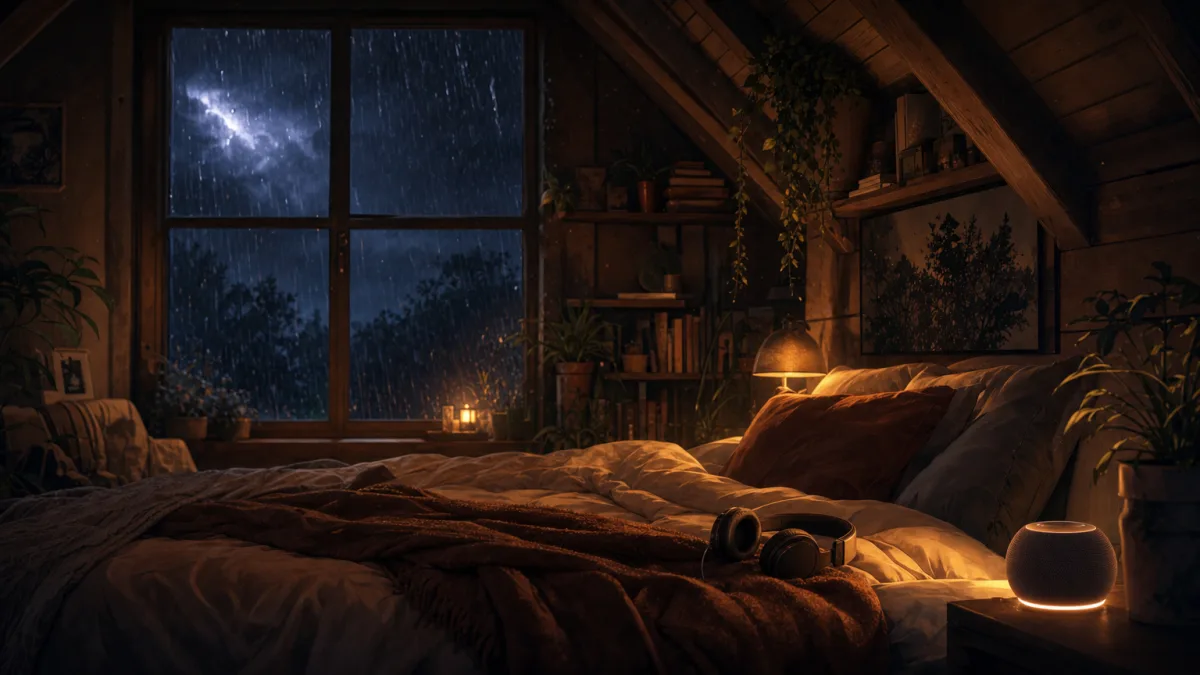
If you struggle to fall asleep because of urban traffic or a snoring partner, using brown noise for sleeping can provide a deep, low-frequency acoustic blanket. While standard white noise can sound like a harsh hiss, brown noise offers a rich, low-frequency rumble that mimics a heavy waterfall or distant thunder. This deeper profile is highly effective at masking disruptive environmental sounds, helping your brain settle into a state of deep, uninterrupted rest.
What Is Brown Noise?
Brown noise, also known as red noise or Brownian noise, is a type of auditory signal characterized by a power spectral density that is inversely proportional to the square of the frequency (1/f²). This mathematical distribution means that brown noise concentrates its energy in the lower frequencies, rolling off steadily as the pitch increases. Unlike white noise, which contains equal energy across all audible frequencies and sounds like static hiss, brown noise sounds like a deep, heavy rumble. Listeners often compare its acoustic profile to the roar of a massive waterfall, the low drone of distant thunder, or heavy rain hitting a metal roof. It is a canonical colored-noise variant frequently studied alongside white and pink noise for its ability to mask environmental sounds and promote relaxation.
Despite the name, brown noise has nothing to do with the color spectrum. It is named after Robert Brown, the Scottish botanist who discovered Brownian motion, which refers to the random mathematical drift of particles suspended in a fluid. In audio engineering, this random-walk algorithm generates a signal where each sample is slightly offset from the last, resulting in a deeper, more organic sound. This mathematical property is why the scientific community often refers to it as red noise or Brownian noise in peer-reviewed literature.
Because of this low-frequency focus, listeners find that brown noise sounds warmer and less harsh than other colored options. While white noise can sound piercing, the deep frequency curve of brown noise blends naturally into the background, mimicking the ambient textures of the physical world.
How Does Brown Noise Compare to White Noise and Pink Noise for Sleep?
Brown noise differs from white and pink noise in its spectral density and perceived warmth. White noise has a flat power spectrum with equal energy per hertz, producing a high-pitched, hissy sound like a television static screen. Pink noise rolls off more gently (1/f), creating a balanced, natural sound like rustling leaves or steady rain. Brown noise rolls off far more steeply (1/f²), concentrating energy in deep, bass-heavy frequencies, making it the warmest and least harsh option for sleep loops. Brown noise is highly effective for masking low-frequency environmental sounds like highway traffic or snoring, whereas pink noise suits mid-frequency masking, and white noise is typically used to manage tinnitus or block office chatter.
To understand how these sounds function in a bedroom setting, it helps to compare their acoustic properties directly. Each color of noise has a distinct power spectrum that dictates how well it masks specific disruptive sounds.
| Noise Color | Spectral Density | Acoustic Profile | Best Sleep Use Case | Source |
|---|---|---|---|---|
| White Noise | Flat (constant energy) | High-pitched hiss, television static | Tinnitus masking, office chatter | WebMD |
| Pink Noise | 1/f (gentle roll-off) | Balanced rumble, steady rain, rustling leaves | Mid-frequency environmental sound masking | WebMD |
| Brown Noise | 1/f² (steep roll-off) | Deep bass rumble, distant thunder, heavy waterfall | Low-frequency masking (snoring, traffic) | PMC Journal |
For sleepers who find white noise too harsh or piercing, brown noise provides the deepest, warmest, and most soothing auditory blanket. It is ideal for masking low-frequency interruptions like a partner snoring or rumble from a nearby highway. If you want to build a channel around this kind of ambient sound, read our guide to starting a white noise channel.
What Does the Research Actually Say About Brown Noise and Sleep?
Scientific research on brown noise for sleeping shows that while anecdotal support is massive, clinical evidence remains limited. A systematic review of 38 studies published in 2020 concluded there is only limited high-quality evidence that continuous noise improves sleep quality. However, the physical mechanism of auditory masking is well-supported. Brown noise acts by raising the ambient acoustic floor, which prevents sudden environmental sounds like a car horn or a slamming door from triggering micro-arousals in the brain. Additionally, the ADHD community reports significant subjective benefits. Online platforms like the r/ADHDwomen community and reports from ADD.org highlight that the deep, steady drone of brown noise helps quiet a hyperactive mind, making it a low-risk, low-cost sleep hygiene tool.
The 2020 systematic review examined various forms of continuous noise, emphasizing that while many individuals swear by their sound machines, large-scale clinical validation is still developing. This honest appraisal is crucial for anyone looking to incorporate sound therapy into their nightly routine. Rather than acting as a chemical sedative, brown noise functions primarily as an acoustic shield.
By raising the baseline sound level in your bedroom, brown noise reduces the delta (the difference in volume) between a quiet room and a sudden noise. If a car alarm sounds outside, your brain is less likely to notice the spike in volume because the deep rumble of the brown noise has already occupied your auditory cortex.
This mechanism is particularly valuable for individuals with neurodivergent minds. On platforms like Reddit, users in the r/ADHDwomen forum share that brown noise acts as a wall of sound that stops internal racing thoughts. Organizations like ADD.org note that this auditory stimulation can help soothe the executive dysfunction that often keeps ADHD brains awake past midnight. While not a clinical cure, it represents a safe, non-pharmacological sleep aid. To explore other sleep-inducing sounds, read our pillar guide to sleep music on YouTube, or see how rain sounds on YouTube help calm a busy mind.
How Do You Use Brown Noise for Sleeping Safely and Effectively?
To use brown noise for sleeping safely, you must manage volume, duration, and hardware setup. Audiologists recommend keeping the volume below 50 decibels at your ear to prevent long-term hearing damage during an 8-hour sleep cycle. The sound should be loud enough to mask disruptive environmental noise but quiet enough to allow conversational speech. To avoid sudden awakenings, use a continuous 8-hour to 12-hour audio loop rather than a track that cuts off abruptly. Sleepers can choose between dedicated bedside sound machines, mobile apps, or high-quality YouTube loops. Side sleepers should use low-profile, sleep-specific earbuds, while couples may prefer a bedside speaker. For safety, keep speakers away from the head of your bed and set a smart-home routine to gradually fade the volume during your final hour of rest.
Safeguarding your hearing is the most important consideration when playing continuous audio all night. Using a decibel meter app on a secondary smartphone can help you calibrate your bedside speaker to ensure it remains below the 50-decibel limit.
The continuity of the audio is another critical factor. A sudden pause in a sleep track can immediately trigger a micro-arousal, defeating the purpose of the sound mask. This is why many sleepers prefer a dedicated bedside sound machine like the LectroFan, which ships with a bank of colored-noise settings, including a dedicated brown noise option.
If you prefer using a smartphone or tablet, consider using low-profile, silicone earbuds designed specifically for side sleepers to avoid ear canal irritation. Alternatively, a bedside Bluetooth speaker positioned on a nightstand can fill the room evenly. For a fully optimized sleep environment, you can integrate your speaker with a smart-home routine that automatically triggers the sound at bedtime and slowly fades it out as your alarm approaches. For a wider look at the ambient wellness niche and the audience it reaches, read our guide to meditation music on YouTube.
What Are the Best Ways to Listen to Brown Noise Tonight?
The best ways to listen to brown noise tonight depend on your budget, device preferences, and sensitivity to screen light. For a free, immediate option, YouTube hosts massive multi-hour loops, such as a 12-hour deep smoothed brown noise video that has gained over 20.8 million views. However, free-tier YouTube ads can disrupt sleep. Streaming platforms like Spotify offer curated brown noise playlists with built-in sleep timers, though they require a premium subscription to avoid ads. Dedicated sleep apps like Sleep Jar provide highly customizable, timer-equipped sounds, but keep many options behind a paywall. For a completely screen-free, subscription-free setup, a physical sound machine like the LectroFan offers high-fidelity, looping colored noises that are ideal for heavy sleepers.
Each listening method has clear tradeoffs. If you choose to use YouTube, look for channels that offer dark or black screens to minimize blue light exposure, which can suppress melatonin production and disrupt your circadian rhythm.
For those already subscribed to music streaming services, Spotify's curated brown noise playlist provides a quick, ad-free solution on premium accounts. The built-in sleep timer on iOS and Android can be configured to stop playback after a set period if you only need help falling asleep rather than staying asleep.
If you want a dedicated physical device, the LectroFan remains a benchmark in the consumer sleep-audio category. It requires no internet connection, emits no light, and won't be interrupted by incoming phone calls or software updates. If you are exploring various auditory options, weigh each method against your budget, your bedroom setup, and how sensitive you are to screen light late at night.
How Can You Create Your Own Brown Noise Sleep Video for YouTube?
Chillframe turns a brown noise sleep channel into one that runs itself. You choose the vibe, and it generates the original audio and the matching visuals, then delivers each finished episode ready to publish to YouTube, no camera, no editing, no face. While standard black-screen audio loops are common, they are often closed when viewers wake briefly. Adding a slow, dark ambient visual loop keeps the tab open all night, boosting watch-time and signaling strong viewer engagement to the YouTube algorithm. With Chillframe, you select a theme like ambient-sleep, which weaves a soft crackling fire texture into the sound. Chillframe generates studio-quality original audio and a dark, motion-loop visual, then delivers one finished, ready-to-publish video with no editing timeline for you to touch. A Series schedules it on a recurring cadence of 1 to 7 episodes per week and publishes each one straight to your connected YouTube channel on autopilot, so you can build a faceless channel without any editing experience.
The demand for sleep content on YouTube is enormous. A single 12-hour continuous loop video has accumulated over 20.8 million views, demonstrating how much overnight watch-time this niche attracts. Chillframe builds you a catalog rather than one monolith. Every video runs up to 1 hour, the same on every tier, and a Series keeps landing new episodes on your cadence, so your watch-time compounds across a growing library instead of resting on a single upload.
Instead of spending hours wrestling with video editing software, exporting massive files, and manually uploading to YouTube, Chillframe handles the entire process. You connect your YouTube channel in a single click and set up a Series. This Series keeps your channel fed with fresh content on a schedule you set, generating and publishing 1 to 7 videos per week on chosen days and times.
Every episode generated by Chillframe features original, studio-quality audio tracks that blend into a gapless, continuous soundtrack. This soundtrack is paired with matching looping visuals. The visual tier you pick sets the look: Lite generates a static image loop, while Plus and Ultra add rich, dark motion. Every visual tier delivers 1080p, and the Ultra visual tier steps up to 4K (3840x2160) for the sharpest possible sleep loop. To make your uploads click-ready, Chillframe automatically generates optimized thumbnails and titles, so you never have to spend time on graphic design.
You can customize your channel's vibe using Chillframe's seven distinct themes. Choose ambient-sleep to weave a soft crackling fire texture into the audio, opt for rainy-tokyo or future-garage to add a soothing rain texture, or pick jazzhop for a warm cafe hum. The remaining themes, study-boombap, synthwave, and citypop, play clean with no ambient layer, giving you a diverse catalog to attract different segments of the sleep and relaxation community.
As your channel grows, you can monitor growth signals and performance metrics directly from the built-in creator analytics dashboard. Long-form sleep videos lend themselves to YouTube's mid-roll ad placements, channel memberships, and Super Thanks from appreciative listeners who play your videos night after night, formats that reward the extended watch-time these videos naturally generate. To get started, Chillframe offers a card-required-upfront 3-day trial with $0 due today: 45 credits, Lite-only, a 30-minute maximum, one video, plus 2 track re-rolls. That is enough to take a finished sleep episode all the way through the automated publishing workflow and see the channel start building itself.
Frequently Asked Questions
Is brown noise the same as red noise? Yes, brown noise is also called red noise or Brownian noise. The name comes from Robert Brown, the botanist who discovered Brownian motion (random mathematical drift), rather than the color brown.
Can brown noise help with ADHD? Yes, many individuals in the ADHD community, including users on the r/ADHDwomen forum, report that brown noise helps quiet mental chatter, improve focus, and make falling asleep easier.
What is the safest volume for sleep noise? Keep the sound level below 50 decibels at your ear. This level is loud enough to mask sudden environmental sounds but quiet enough to protect your hearing over an 8-hour night.
Does YouTube allow monetization for sleep channels? Yes, sleep channels can monetize through the YouTube Partner Program, with revenue from mid-roll ads, channel memberships, and Super Thanks, especially when using original audio and engaging visual loops that increase viewer retention.
By combining the deep, therapeutic frequencies of brown noise with engaging visual loops, you can create a highly effective sleep aid for yourself or build a valuable resource for millions of listeners online. Whether you use a bedside sound machine or launch your own automated sleep channel on YouTube, incorporating these low-frequency sounds is a reliable, science-backed way to upgrade your nightly rest.