Explainer
Can You Monetize AI Music on YouTube? The 2026 Rules for Lofi, Ambient and Sleep Channels
What YouTube's own policy pages say about AI-made lofi, ambient and sleep music, and how to build a channel that stays monetized.

Can you monetize AI music on YouTube? Yes. YouTube does not ban AI-made lofi, ambient or sleep music. It judges an AI music channel by the same rules as any other: each video has to be your own, varied and not mass-produced, and when AI music is the main focus of a video you tick YouTube's AI disclosure, which on its own does not affect what the video earns.
That's good news for anyone building a music channel without a studio, and it's the kind of channel Chillframe makes: original music and a new scene in every video, with YouTube's AI label on by default when it publishes. Below I go through what YouTube's own policy pages say, line by line, with the date of each change, and what a channel needs to stay monetized.
The short answer, rule by rule
YouTube has four separate sets of rules that touch an AI music channel. They are easy to mix up, so here they are side by side.
| Rule | What it asks of an AI music channel | YouTube source |
|---|---|---|
| Inauthentic content (monetization policy) | Videos must not be "mass-produced, generic, repetitive, or manipulative." Each video should be "materially varied." | Channel monetization policies, renamed July 15, 2025 |
| Reused content (monetization policy) | No "collections of songs from different artists" and no songs only sped up or pitched. | Channel monetization policies |
| Spam policy | No using AI "to churn out high volumes of similar content with minimal changes." | Spam policy |
| AI disclosure | Disclose AI content that "creates music that's the main focus of the video." Disclosing doesn't change earnings. | Disclosing use of GenAI content |
Copyright sits on top of all four. You need the rights to the music, whoever or whatever made it.
What changed in July 2025: "inauthentic content"
On July 15, 2025, YouTube renamed its "repetitious content" policy to "inauthentic content." In its own words on the monetization policies page, this was "a minor update" to "better clarify this includes content that is repetitive or mass-produced," and "this type of content has always been ineligible for monetization." The same note says there was "no change to our reused content policy."
So the rename did not ban AI music. It spelled out a rule that already existed. The page now says your content should:
- "Be your original creation."
- "Not be mass-produced, generic, repetitive, or manipulative."
Under the heading "Generic or Repetitive Content," YouTube lists what it won't monetize. Three lines matter most for music channels:
- "Similar or repetitive content with low educational value, commentary, narratives, or minimal variation across videos"
- "Image slideshows, templated storylines, or scrolling text with minimal or no narrative, commentary, or educational value"
- "AI-generated content made with generic or unoriginal templates giving the impression of mass production without adding the creator's original, authentic insights or perspective"
And what it does allow: "the substance of each video should be materially varied." The same page also gives "using AI to edit your video scripts or generate a unique background visual for your content" as an example of AI use that is fine to monetize.
For a lofi or sleep channel, the takeaway is concrete. A channel where every video is the same image over the same kind of track, with only the title changed, looks interchangeable. A channel where each video has its own scene, its own music and its own mood does not.
The reused content rules for music channels
Reused content is a different policy, and it is about other people's work. YouTube's page lists several examples that hit music channels directly:
- "Collections of songs from different artists (even if you have their permission)"
- "Songs modified to change the pitch or speed, but are otherwise identical to the original song"
- "Content uploaded many times by other creators"
This is why the old "lofi mix of popular tracks" format struggles to earn, and why slowed or sped-up versions of hit songs can't be monetized. Original AI music avoids this rule entirely, because it isn't anyone else's song.
The reused content rule also "applies to your channel as a whole." YouTube says that if "we cannot clearly tell that you made the content, monetization may be removed from your entire channel." Reviewers look at your main theme, most viewed videos, newest videos, titles, thumbnails, descriptions and the About section. Saying plainly how you make your videos helps them tell.
The spam policy line on AI mass production
YouTube's spam policy has one rule written with AI channels in mind. It bans "automated or synthetic mass-production," which it defines as "using automated tools or AI to churn out high volumes of similar content with minimal changes."
Its own example reads like a description of a low-effort AI channel: "Channels that use the exact same background music and repetitive AI generated imagery across many videos, with each video reading out an AI-generated script."
The same rule also says "testing out new creation tools or posting a few variations of a video is ok." The line is volume plus sameness. Posting often is fine. Posting the same thing often is not.
Can one looping scene run for a whole video?
Nothing in YouTube's monetization policies rules out one scene looping under the music for the length of a relaxation or sleep video. The rules look across your videos instead. YouTube describes generic or repetitive content as content that "may feel repetitive to viewers after watching several videos in a row from the same channel," and says "the substance of each video should be materially varied." It also lists "image slideshows, templated storylines, or scrolling text with minimal or no narrative" among what it won't monetize.
So a one-hour video with a single looping scene sits within the rules, while the same loop and the same kind of track in every upload is the pattern YouTube flags. YouTube reviews each channel itself, so give every video its own scene and its own music. For making a clip that loops cleanly, see the guide to the AI video loop generator. A Chillframe Series makes the visuals and the music different for each video by default.
When YouTube requires the AI label on music
YouTube requires it when the music is the point of the video. Its disclosure page says creators must disclose AI content that "creates music that's the main focus of the video." A lofi, ambient or sleep video is a music video, so tick AI use in YouTube Studio when you upload it.
Three more facts from the same page:
- It doesn't cost you money. "Disclosing AI content alone won't limit a video's audience or impact its eligibility to earn money."
- The visual may not need it. Clearly unrealistic content, like animation, doesn't need disclosure on its own. YouTube said so when it introduced the label on March 18, 2024, giving "animation or someone riding a unicorn through a fantastical world" as examples. The music still does.
- Skipping it has a cost. Creators "who consistently choose not to disclose" may get a label added for them, content removed or a suspension from the YouTube Partner Program. YouTube can also apply a label itself when its systems detect AI content.
On October 14, 2026, YouTube Music started showing labels on tracks "created primarily using generative AI," using its own detection tools, and said the labels will expand to the main YouTube app. Labeling your own uploads keeps you ahead of that.
Copyright and Content ID for AI music
The AI label and copyright are separate questions. The label is about telling viewers. Copyright is about whether you have the right to use the track.
With AI music, your rights come from the terms of the tool that made it, often only on a paid plan. Check that before you monetize. If a track you have rights to gets a Content ID claim, YouTube's claims page says "copyright claims affect videos, but usually don't impact your channel or account," and the most common result for music is that the claimant earns the ad money on that video. You can dispute a claim in YouTube Studio when you have the license to show for it.
For licensed tracks made by people, our guide to copyright free lofi music for YouTube videos compares the sources.
YouTube Partner Program thresholds, now and from 2027
Monetization starts with joining the YouTube Partner Program. The eligibility page and the YouTube Blog post of August 10, 2026 set out these numbers:
| Path | Until January 31, 2027 | New applicants from February 1, 2027 |
|---|---|---|
| Ad revenue, long-form | 1,000 subscribers and 4,000 watch hours in 12 months | 8,000 watch hours in 365 days |
| Ad revenue, Shorts | 1,000 subscribers and 10 million Shorts views in 90 days | 20 million Shorts views in 90 days |
| Fan funding and Shopping | 500 subscribers, 3 uploads in 90 days, and 3,000 watch hours or 3 million Shorts views | Unchanged |
YouTube says the 2027 change "won't impact creators already in YPP." Long music videos suit the watch-hour path well: one listener who keeps a one-hour video playing adds a full hour. Videos of 8 minutes or longer can also carry mid-roll ads.
What makes an AI music channel safe to monetize
Put the rules together and a safe channel looks like this:
- New music in every video. Original tracks made for that video, not the same track under a new image.
- A different scene each time. Its own visual, mood and title, so no two videos feel interchangeable.
- No other artists' songs. No compilations, no slowed or sped-up versions, even with permission.
- The AI label ticked on every video where the music is the focus.
- Rights you can show. Keep the license terms for every track and every visual.
- An About section that says how you make it. It helps a reviewer see the work is yours.
- A steady schedule, not a flood. Regular uploads build watch time without tripping the mass-production rule.
Do that and AI music is a real opportunity. Lofi, ambient and sleep channels earn from long watch sessions, and AI makes it possible for one person to publish the variety that keeps a channel growing. For what that's worth in money, see how much a lofi YouTube channel earns or run your numbers in the YouTube money calculator.
Build a monetizable AI music channel with Chillframe
Chillframe is made for exactly this kind of channel. It makes the music, the visual and the finished video, then publishes to YouTube on the days you pick, and it's built around the variety YouTube's rules ask for.
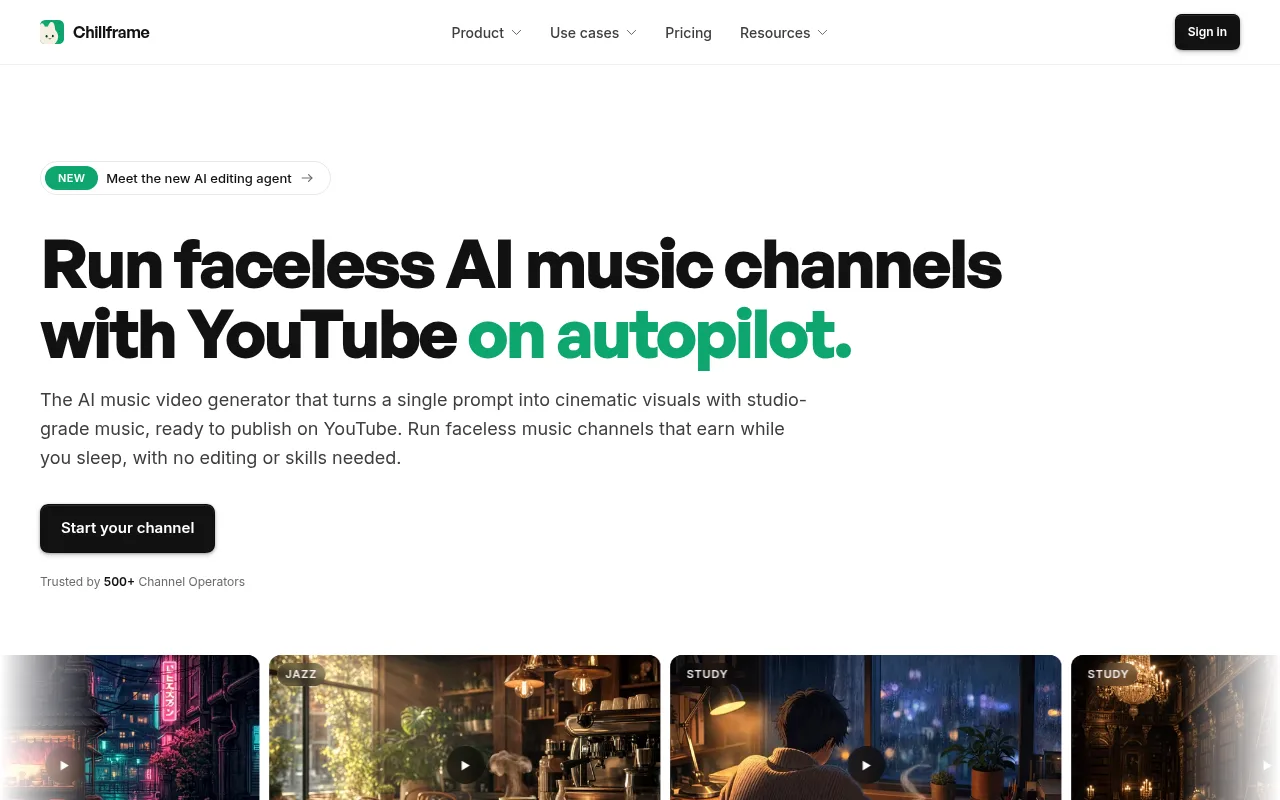
How each video lines up with the rules:
- Original music for every video. Tracks are made for that video, and when there's more than one, they crossfade into one continuous soundtrack. Or choose Ambience only for rain, fire or cafe sound with no music.
- A new scene each time. Pick a look like Rainy Tokyo, Snow Cabin or Campfire Night, or describe your own scene. A Series makes the visuals and music different for each video by default, and you can set them to stay similar or the same.
- The AI label handled. When Chillframe publishes to YouTube, YouTube's AI disclosure is on by default, and you can change it per video.
- Its own title and description. Chillframe writes a title and description for each video and takes its thumbnail from the video's own scene.
To run the channel on a schedule:
- Connect your YouTube channel.
- Pick a look and choose music or Ambience only.
- Set a Series cadence, from 1 to 7 videos a week, on the days and times you choose.
- Approve the first video. From then on it's fully hands-off: each new video publishes straight to your channel.
One limit to know: a single video is at most 1 hour long on every plan, so an all-night sleep channel posts a run of hour-long videos rather than one 8-hour file. Chillframe starts at $19 a month on Starter, which runs 1 Series. Creator, at $49 a month, runs 3 and adds moving scenes.
Frequently Asked Questions
Can you monetize AI music on YouTube?
Yes. YouTube has no ban on AI music. A channel is monetized when it meets the YouTube Partner Program thresholds and its videos follow the monetization policies: original, varied from video to video, and not mass-produced. Tick the AI disclosure when the music is the focus of the video.
Does YouTube demonetize channels that use AI music?
Not for using AI. YouTube refuses or removes monetization for inauthentic content, meaning videos that are mass-produced, generic or repetitive, and for reused content like compilations of other artists' songs. A channel of AI music where every video has its own music and scene is judged like any other channel.
What is YouTube's inauthentic content policy?
It's the July 15, 2025 name for YouTube's old "repetitious content" policy. It covers content that is "mass-produced, generic, repetitive, or manipulative," including AI content made with generic templates that gives "the impression of mass production." YouTube called it a minor update, not a new rule.
Do I need to disclose AI-generated music on YouTube?
Yes, when the music is the main focus of the video, which it is in a lofi, ambient or sleep video. Use the AI use setting in YouTube Studio. YouTube says disclosing alone won't limit a video's audience or its eligibility to earn money.
Is AI lofi music reused content?
No, not when the music is original. The reused content rule covers other people's work: compilations of songs by different artists, songs only changed in pitch or speed, and content uploaded many times by other creators. Original AI tracks made for your video are not reused content.
How many subscribers do you need to monetize a music channel?
Until January 31, 2027, ad revenue needs 1,000 subscribers and 4,000 watch hours in 12 months, or 10 million Shorts views in 90 days. From February 1, 2027, new applicants need 8,000 watch hours in 365 days or 20 million Shorts views in 90 days. Fan funding opens at 500 subscribers.
Can long relaxation videos on YouTube use the same looping scene the whole time?
Yes, one scene can loop for the whole video. YouTube's monetization rules judge how varied your videos are from one to the next, saying the substance of each video should be materially varied, so the risk is reusing the same loop and the same kind of track across many uploads. Give each video its own scene and music.
Is AI-made lofi allowed on YouTube, or will my channel get demonetized?
AI-made lofi is allowed and can be monetized. Channels lose monetization for inauthentic content, meaning mass-produced, generic or repetitive videos, and for reused content like other artists' songs, not for using AI. Tick the AI disclosure, make each video's music and scene original, and keep the rights to every track.