Listening
Relaxing Music for Sleep and Anxiety: A 20-Minute Wind-Down
For the nights your body won't settle: what to play, how to breathe along to it, and what to leave out.

Relaxing music for sleep and anxiety works best when it gives your body a slower pace to follow. Pick slow, steady instrumental music around 60 to 80 beats per minute, play it low on a speaker, and spend the first few minutes breathing along to it. It isn't a cure for anxiety, but on a night when your heart won't slow down, it's one of the easiest things to try.
What the research says about music, sleep and anxiety
Music helps a lot of people settle, and plenty of them already use it. In one online survey, 62% of 651 people said they had used music to help them sleep at least once. In a survey of over 500 patients with sleep disorders, more than half used music as a sleep aid.
The evidence leans the same way. A meta-analysis of six studies, 314 patients in all, found that music improved how well people with insomnia felt they slept. Sleep Education, the patient site of the American Academy of Sleep Medicine, notes that studies report slow, soothing music can lower the heart rate, relax the body, reduce anxiety and stress, or distract from the thoughts that keep you awake.
The anxiety side is the part I find most interesting. The Sleep Foundation reports that listening to music lowers cortisol, a stress hormone, and that high stress hormone levels keep you alert when you want to sleep. Music also gives your attention somewhere to rest that isn't the worry going round in your head.
Two honest notes. Much of the evidence is about how people feel they slept, and Sleep Education points out that some researchers think the effect depends partly on what you expect. And people respond differently. In a 2019 nap study, music increased deep, slow-wave sleep by 46.18%, but only in people who scored low on suggestibility. The rest saw no comparable change. So treat everything below as a starting point and keep what works for you.
The "most relaxing song" claim
You may have seen Weightless by Marconi Union called the world's most relaxing song. The figure behind it comes from Mindlab International, which, according to Psychiatrist.com, monitored 40 people solving hard puzzles while they listened to 10 songs. Weightless reduced their stress and anxiety by 65%, more than any other track.
The song starts at 60 beats per minute, about the resting heart rate of an average adult, and slows to 50. It's worth a try. A music professor quoted in the same article doubts any one song suits everybody, though, and the researchers warned against listening to it while driving.
What makes music relaxing for sleep and anxiety
You don't need one perfect track. You need music with a few qualities that stop your brain from staying on guard.
- Slow tempo, around 60 to 80 BPM. Calm suggests this range to sync with your resting heart rate, and the Sleep Foundation says most studies used music in it. If you can't tell the tempo, pick what feels slow.
- No lyrics. Words give your mind something to follow. Calm suggests instrumentals, or songs in a language you don't speak.
- Predictable and familiar. Sleep Education says researchers find the familiarity and predictability of the music important. A track you know well, with no surprises, lets you stop listening for what comes next.
- Even volume. No build-ups, drops or sudden loud passages. Calm advises a low, consistent volume and no abrupt changes.
- Neutral feelings. The Sleep Foundation suggests skipping songs that stir up strong emotions at bedtime.
In practice, that points to a handful of styles: slow solo piano music for sleep, soft ambient pads, slow classical pieces, gentle lofi for sleeping with the drums pulled right back, and nature sounds like rain, ocean or crickets. If you'd rather have no music at all, nature sounds for sleep covers the best ones to try.
What to leave out at night
Some things undo the calm faster than the music can build it.
- Songs with lyrics you know. You'll end up singing along in your head.
- Sad or emotional songs. A breakup song or a track tied to a memory can bring up exactly what you're trying to set down.
- Shuffle and autoplay. One upbeat track in the middle of a calm mix is enough to wake you up again. Stay with one long track or a playlist you've checked.
- The news and your inbox. Reading the headlines in bed gives your worry fresh material. Put the phone down once the music is on.
- Earbuds all night. The Sleep Foundation warns they can damage your ear canal if the volume is high and can build up earwax. Use a small speaker by the bed instead.
A 20-minute wind-down routine with music
This is a simple routine for the evenings when your body feels wired. The breathing comes from the NHS guide to breathing exercises for stress, and the rest follows the advice above.
- Set up before you lie down. Dim the lights, choose one long track or a playlist, and set the volume low but clearly audible. If your signal is patchy, download it first so it doesn't cut out.
- Minutes 0 to 5: breathe with a count. Lie down with your arms a little away from your sides, palms up. Breathe in through your nose, gently, counting 1 to 5. Breathe out through your mouth, counting 1 to 5 again. The NHS suggests doing this for at least 5 minutes. Don't worry if you can't reach 5 at first.
- Minutes 5 to 15: let the music set the pace. Stop counting and let your breath slow down to match the music. When a worry turns up, notice it and bring your attention back to one sound in the track, like the piano or the rain.
- Minutes 15 to 20: lights out. Turn onto your side if that's how you sleep, and let the music carry on. Set a sleep timer to stop it after you drift off, or leave it playing if silence wakes you.
- Do it again the next night. In one study the Sleep Foundation describes, adults who listened to 45 minutes of music before bed reported better sleep, and the benefit grew with regular use. The routine works better once your body knows it means bedtime.
If you wake in the night with your heart racing, the same steps work again. Restart the track and go back to step 2.
If you only try one thing, make it this: one slow instrumental track on a speaker by your bed, breathing in for a count of five and out for five while it plays. Keep the same track and the same routine for a couple of weeks and see how your evenings feel.
Where to find relaxing music for sleep and anxiety
Each of these does the job in a different way, so pick by how much you want to choose and how much you want to be guided.
| Where | What you get | Watch out for |
|---|---|---|
| YouTube | A huge free library of long calming videos, many with dark screens, and a sleep timer | Ads on the free tier; YouTube Premium removes them |
| Calm | Sleep music, soundscapes, Sleep Stories and guided sleep meditations | Best if you want a guided start before the music |
| Spotify | Its own playlists, such as Stress Relief with gentle piano and ambient music | Turn shuffle off and check the playlist in the daytime |
YouTube
YouTube has a huge free library of long calming videos, from hours-long piano mixes to rain over soft music, many with dark screens so the light doesn't keep you up. Its sleep timer pauses a video after a set time, so a long video doesn't have to play all night.
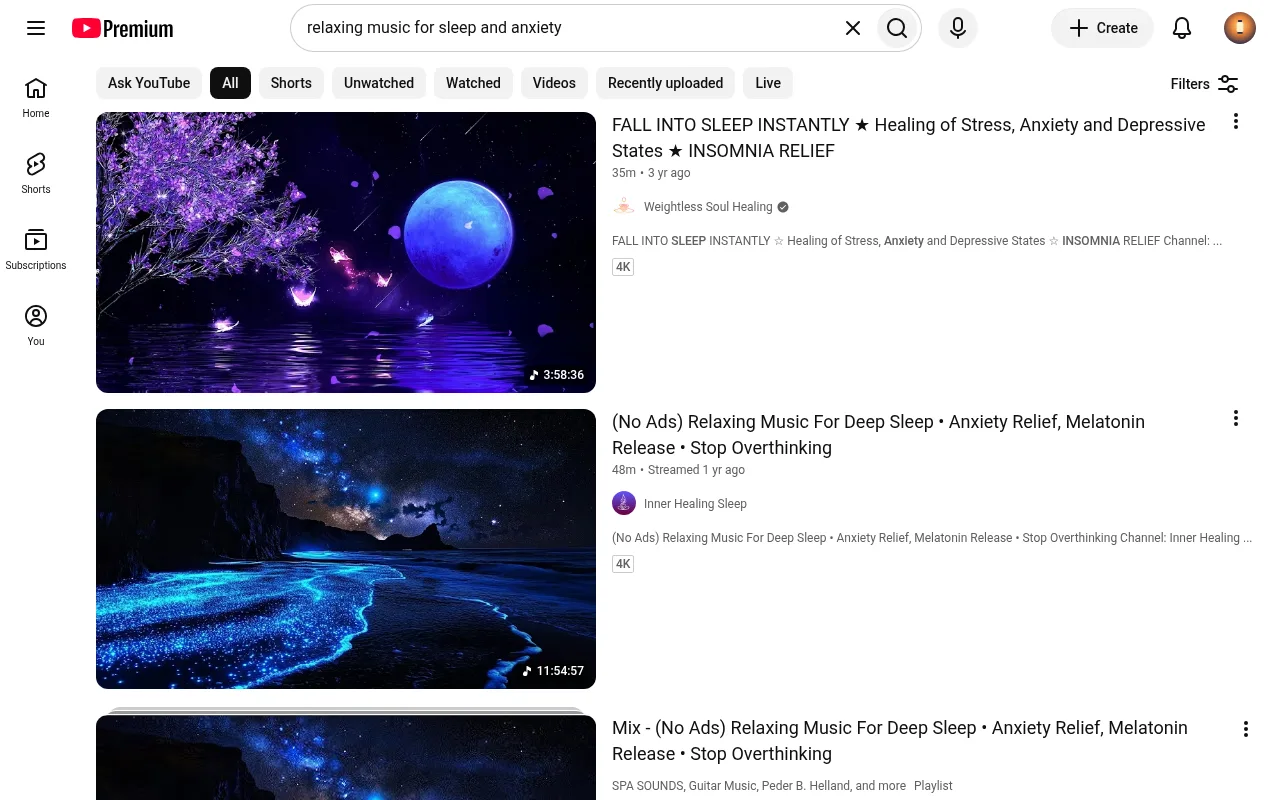
Long videos on the free tier can break for an ad, which is the last thing you want halfway through the routine. YouTube Premium removes them. If you'd like to know how these channels work from the other side, my guide to sleep music on YouTube goes into it.
Calm
Calm is a meditation and sleep app. Its sleep section has sleep music, including slow piano melodies, soundscapes like Rain on Leaves, Sleep Stories read aloud, and sleep meditations built around breath work and body awareness.
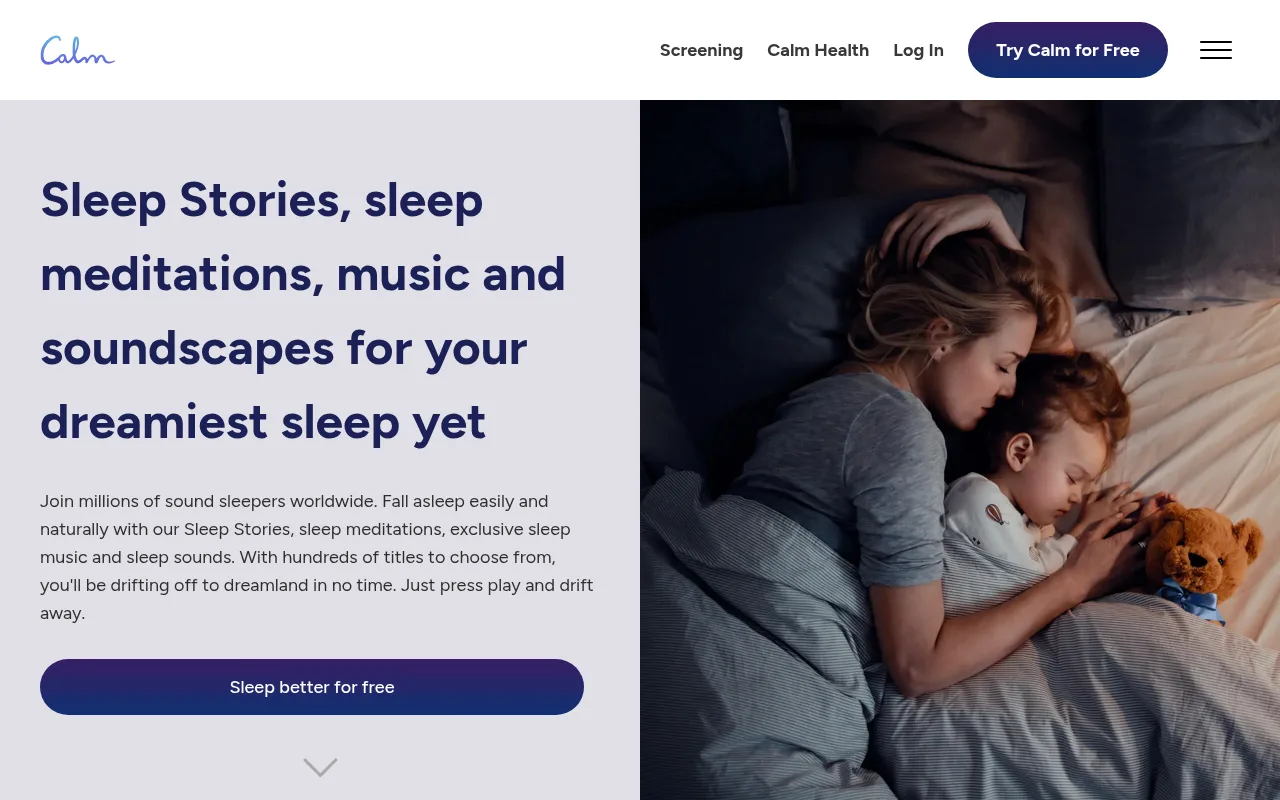
It suits you if you'd like a guided meditation for the first few minutes and music after that. There's more on pairing the two in the guide to meditation music for sleep.
Spotify
Spotify makes its own playlists for this. Stress Relief describes itself as gentle piano and ambient music to calm your mind from anxiety.
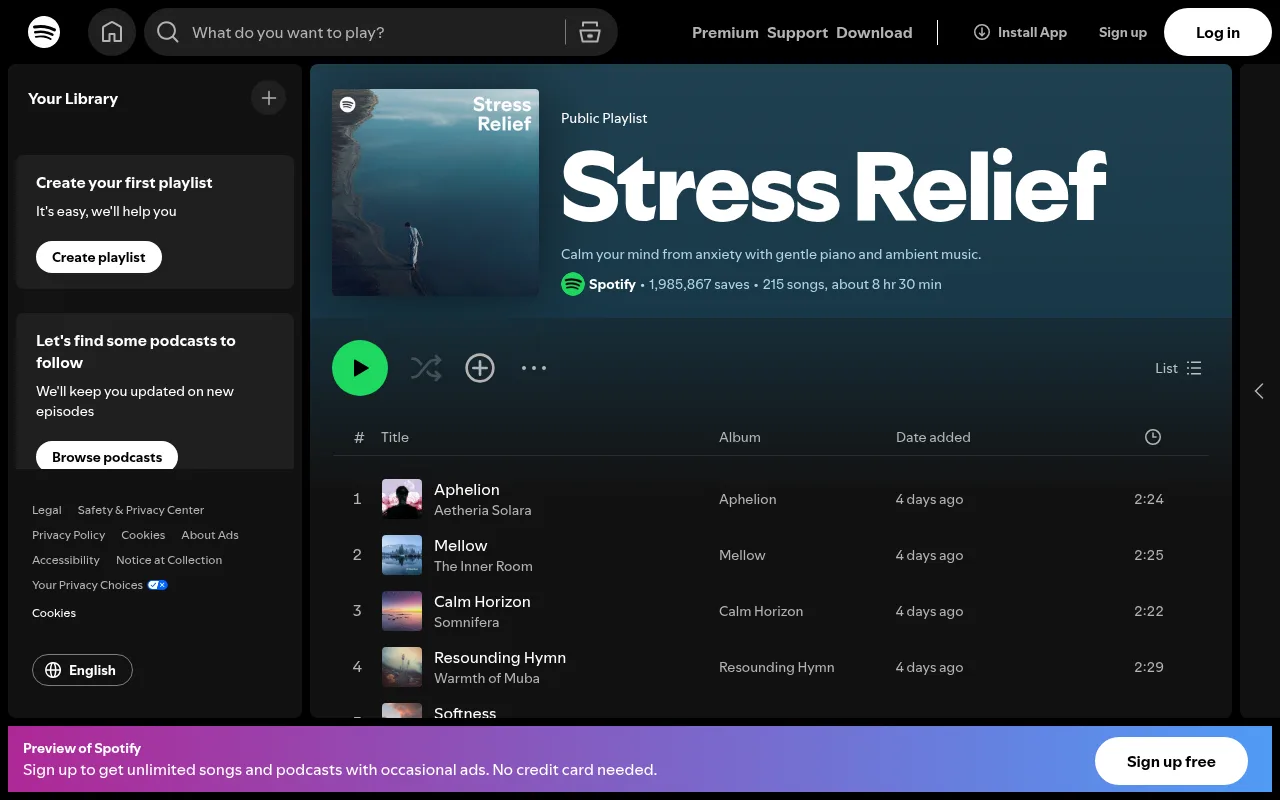
Turn shuffle off and check the playlist through once in the daytime, so nothing in it surprises you at midnight.
When anxiety needs more than music
Music is a good tool for a hard evening. It isn't a treatment for an anxiety disorder or for sleep problems that keep going.
The NHS suggests seeing a GP if you think you might have generalised anxiety disorder, or if you've been diagnosed and treatment isn't helping. In England, adults can also refer themselves to NHS talking therapies without going through a GP. Elsewhere, your own doctor is the place to start. If you need someone to talk to in the UK or Ireland, Samaritans answer on 116 123.
If the problem is mainly lying awake night after night, the guide to the best sleep music for insomnia covers that side in more depth.
Run a calming sleep music channel with Chillframe
Many of the long calming videos on YouTube come from faceless channels: a slow piece of music, a quiet scene and no presenter. People reach for them on exactly the nights this guide is about, and it's a growing niche you can run without being a musician or an editor.

Chillframe makes the music, the scene and the finished video, then publishes it to your YouTube channel. For a calming channel, the useful thing is a new video every night at the hour people go to bed. The setup for that is short:
- Moonlit Ridge, from the Deep Sleep presets, is the look. It's a near-black moonlit night, made to sit comfortably on a phone in a dark bedroom, with a slow ambient soundtrack and one distant piano note. A scene you describe yourself works too.
- The audio stays on Instrumental: original music with no singing, written fresh for each video. Ambience only swaps the music for rain or fire.
- The Series runs all 7 nights of the week, at 11pm.
The first video waits for you to approve it. With auto-publish on, Chillframe then automatically makes and posts a fresh one every night, fully hands-off.
One limit matters here, because rain under soft music is such a popular sound for anxious nights. Each video has one kind of audio: music or ambience, not both mixed together. If you want piano with rain underneath, you'd layer the two yourself in an editor.
Videos run up to 1 hour on every plan. A still Moonlit Ridge is on the Starter plan at $19 a month, and its dark frame suits a still image well. A cloud drifting across the moon makes it a Plus video, which starts on the Creator plan at $49.
Relaxing music for sleep and anxiety FAQ
What BPM is best for relaxing music for sleep and anxiety?
Start with 60 to 80 beats per minute, which Calm suggests because it sits close to your resting heart rate. Weightless, the song often called the most relaxing ever, starts at 60 and slows to 50. If you can't tell the tempo of a track, go by feel and pick the slowest one you like.
How long should I listen to relaxing music before bed?
Twenty minutes is enough for the routine above, and the NHS suggests at least 5 minutes of slow breathing on its own. In the study the Sleep Foundation describes, adults listened for 45 minutes before bed. If you fall asleep before the track ends, a sleep timer will switch it off for you.
Is it OK to fall asleep to music every night?
Yes, and it may work better the longer you keep it up, since the benefit in that Sleep Foundation study grew with regular use. Play it on a small speaker rather than earbuds, which can hurt your ears at high volume and build up earwax. Keep it low and steady so it doesn't wake you later in the night.
Is lofi good for sleep and anxiety?
It can be, as long as it's slow and the drums are soft. Pick lofi with no vocals, an even volume and no sudden drops, and skip mixes with busy, punchy beats. Lofi with rain underneath is a nice middle ground if plain piano feels too quiet.