Listening
Classical music for sleeping: 18 calm pieces and how long to listen
Which Satie, Debussy, Chopin, Bach and Holst pieces stay soft all the way through, and why 45 minutes at bedtime is a good place to start.

Classical music for sleeping works best when you pick the right pieces, not the right genre. A slow Chopin nocturne will help you drift off. The last movement of a Beethoven symphony will wake you up. This guide names 18 pieces that stay soft from start to finish, sorted into piano, orchestral and chamber paths, and suggests how long to listen each night.
Why classical music helps you wind down
The best evidence comes from a 2008 study at Semmelweis University in Budapest. Ninety-four students with sleep complaints were split into three groups. One listened to relaxing classical music for 45 minutes at bedtime, one listened to an audiobook for the same time, and one did nothing. After 3 weeks, sleep quality had improved significantly in the music group, but not in the other two. Depressive symptoms also dropped in the music group, but not in the audiobook group.
The authors suggest why: music can lower heart rate, breathing rate and anxiety, and it can relax your muscles and give your mind something gentle to follow instead of the day's thoughts.
It's a small study, and music is a help at bedtime, not a treatment. If you've struggled to sleep for weeks, a doctor is the right next step, and there's more on that in the guide to sleep music for insomnia.
What makes a piece good for sleep
NapLab's guide puts it in one line: the best music for sleep is calming, steady and free of sudden changes. That rules out a lot of famous classical music, because so much of it is built on contrast. Here is what I look for:
- Slow and steady. Calm suggests around 60 to 80 beats per minute, and NapLab notes that many classical works hover around 60.
- Quiet all the way through. No crashing cymbals, no sudden loud chord three minutes in.
- One movement, not the whole work. A concerto's slow middle movement is perfect. The fast finale that follows it is not.
- Familiar, but not too exciting. A piece you know well gives your mind nothing new to chase. A piece that stirs strong feelings does the opposite.
The pieces below fall into four paths. If you're not sure where to start, pick one from this table and try it for a few nights.
| Path | Start with | Why it suits sleep |
|---|---|---|
| Solo piano | Satie, Gymnopédie No. 1 | One instrument, soft from start to finish |
| Orchestral | Holst, Venus, the Bringer of Peace | A fuller, warmer sound that stays quiet |
| Chamber and strings | Amy Beach, Berceuse | Strings and piano without big swells |
| All night | Max Richter, Sleep | Written to play while you sleep, for 8.5 hours |
Best classical music for sleeping: the solo piano path
Solo piano is the gentlest way in. One instrument means nothing changes colour under you, and every piece below stays soft.
- Satie, Gymnopédie No. 1. Slow and in 3/4 time, it moves like a gentle sway. Classic FM puts it first in its list of sleep pieces, and it's the one I'd start with.
- Debussy, Clair de lune. The third movement of his Suite bergamasque, and probably the best-known quiet piano piece there is. It swells a little in the middle, then settles.
- Debussy, Rêverie. A short solo piano piece that Classic FM calls perfectly suited to falling asleep. It's less famous than Clair de lune, with the same soft, floating feel.
- Chopin, Nocturne in E-flat major, Op. 9 No. 2. A nocturne is a night piece, and this is one of the best known. A singing melody over a rocking left hand.
- More Chopin nocturnes. NapLab also suggests the nocturnes in C-sharp minor, D major and F minor. With the E-flat one, that is four nocturnes, enough for a whole Chopin playlist.
- Beethoven, Moonlight Sonata, first movement. Slow, low and steady. Stop at the end of the first movement, because the third movement is fast and stormy.
- Bach, Prelude No. 1 in C major. Nothing but broken chords, one after another, from the first book of The Well-Tempered Clavier. It's short, so it suits the start of a playlist.
- Bach, Goldberg Variations. An aria and 30 variations. Classical Music magazine notes they are often said to have been written as a lullaby, though the historical evidence for that is weak. It still works as a long night piece, especially played slowly.
Most of what I'd call modern soft piano, the Einaudi style of neo-classical, is a different family. I've covered that side in the guide to piano music for sleep.
Orchestral pieces and slow movements for sleep
Orchestral music needs more care, because an orchestra can go from a whisper to full volume in a bar. These are the slow movements and short pieces that stay quiet.
- Holst, Venus, the Bringer of Peace. The second movement of The Planets. Classic FM singles out its solo passages for horn and violin as exquisitely tranquil. Skip the movement before it, Mars, which is loud.
- Ravel, Piano Concerto in G major, second movement. Classic FM calls it serene. It opens with the piano alone, like a solo piece, until a flute quietly brings in the orchestra.
- Mozart, Piano Concerto No. 21, Andante. A slow piano melody over soft strings. It earned the nickname "Elvira Madigan" after a 1967 film used it.
- Mozart, Concerto for Flute and Harp, second movement. Flute and harp together, light and airy, at a calm tempo.
- Massenet, Méditation from Thaïs. A reflective interlude from his opera, with a flowing solo violin melody over soft, steady chords.
- John Luther Adams, Become Ocean. A modern orchestral work where, as Classical Music magazine describes it, the piano rumbles, the waves of sound rise and fall and the strings shimmer. It swells slowly, so keep the volume low.
Chamber music, strings and lullabies
Smaller groups sit between solo piano and a full orchestra. They're warmer than piano alone, without the sudden swells.
- Amy Beach, Berceuse. Berceuse means lullaby. It's written for violin and piano, and the violin plays with a mute to keep everything soft.
- Caroline Shaw, The Orangery. A movement for string quartet from her work Plan and Elevation, with a soft broken-chord bass line that has a gentle rocking motion.
- Brahms, Wiegenlied. Better known as Brahms' Lullaby, a song for voice and piano. Instrumental versions are easy to find if you'd rather have no words. There's more in the guide to lullaby music.
Max Richter's Sleep, the all-night option
One modern work was written for this exact job. Max Richter wrote Sleep, an 8.5-hour piece, with advice from the neuroscientist David Eagleman, to be played overnight while its audience sleeps. Its overnight premiere ran from midnight to 8am, with the audience on beds instead of seats.
Richter calls it a "personal lullaby for a frenetic world", and it's long and slowly paced on purpose. If you want sound that lasts the whole night with no gaps between tracks, this is the one to try.
How long to listen before sleep
Start with 45 minutes. That's how long the students in the 2008 study listened each night. Here is a simple setup:
- Build a 45-minute playlist. Start with Bach's Prelude No. 1 and Satie, move to the Chopin nocturnes, and end on something slow and long like Venus or the Goldberg aria.
- Put it on as you get into bed. The study's students listened at bedtime, not earlier in the evening.
- Keep the volume low. Loud enough to hear, quiet enough to fade into the room.
- Set a sleep timer. Spotify's phone app and YouTube both have one, so the music stops on its own.
- Keep the same playlist for a week. Familiar music gives your mind less to follow, and that helps more with each night.
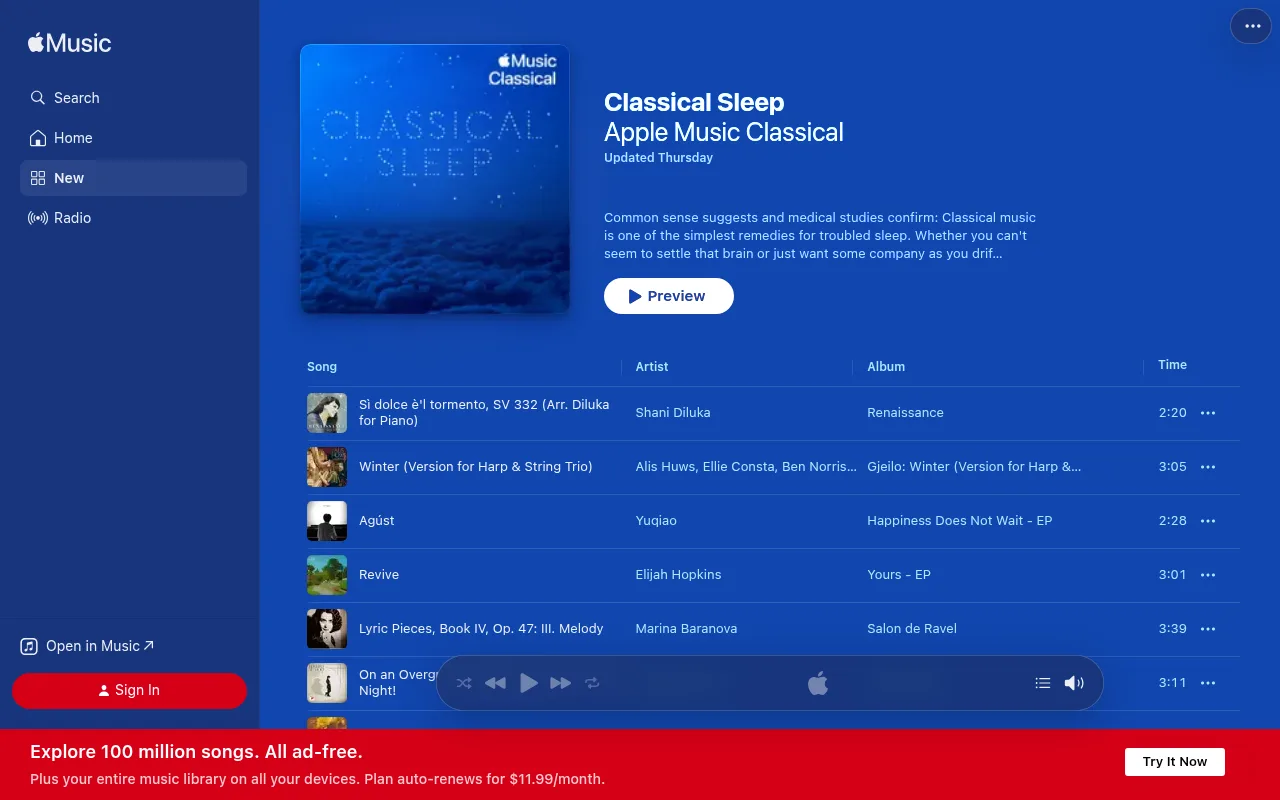
If you wake up in the night and want sound there when you do, go longer. Apple Music's Classical Sleep playlist runs for almost 6 hours, one classical sleep video on YouTube runs for 2 hours 52 minutes, and Max Richter's Sleep runs all night.
Where to listen to classical music for sleeping
All four of these have classical music for sleep ready to go. They differ in how much choosing they leave to you.
Spotify
Spotify has a huge range of classical sleep playlists made by record labels and listeners. Search "classical sleep" or "classical for sleeping" and pick one with pieces you recognise from the lists above.
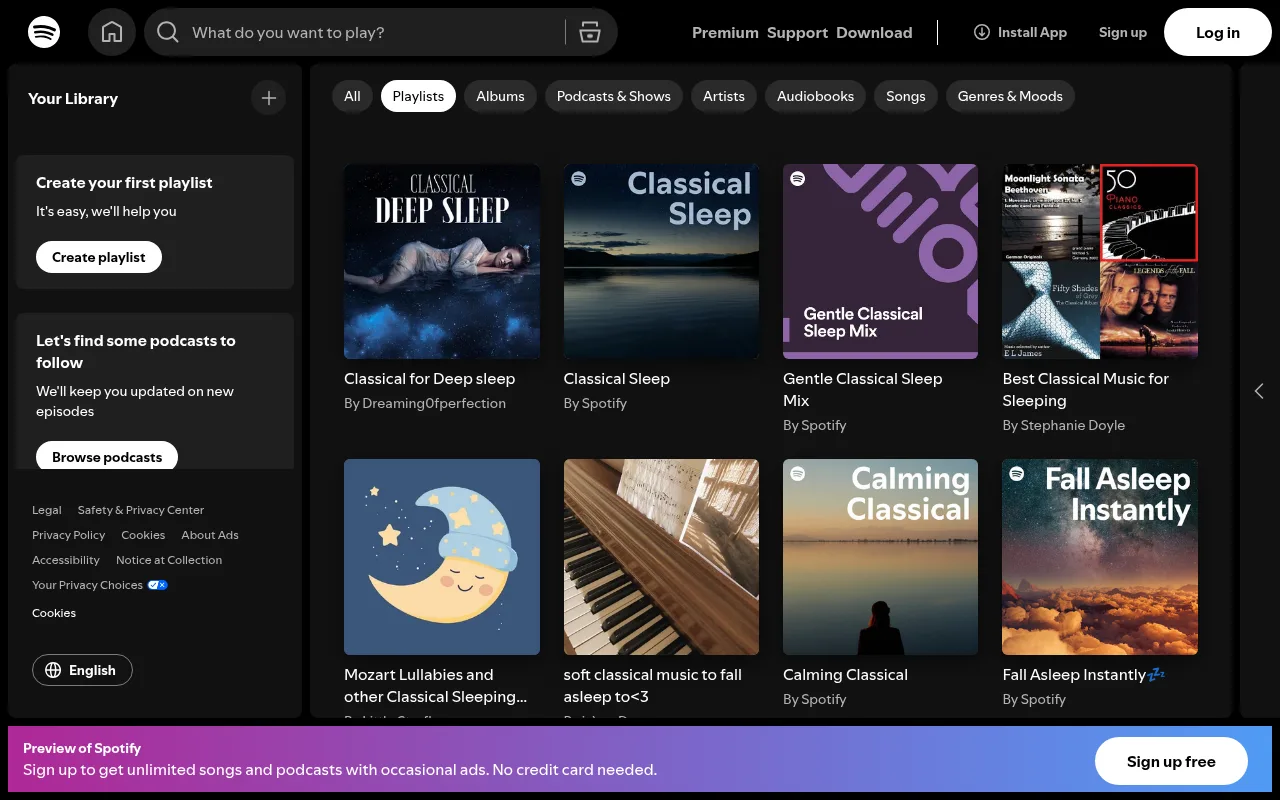
The phone app's sleep timer sits in the menu on the Now Playing screen, so you can set it once the first piece starts.
Apple Music Classical
Apple Music Classical is Apple's separate app for classical music, and it comes with an Apple Music subscription. It lets you search by composer, work, conductor or performer, which helps when you want a specific nocturne rather than a playlist. Its own Classical Sleep playlist has 108 pieces running for just under 6 hours.
YouTube
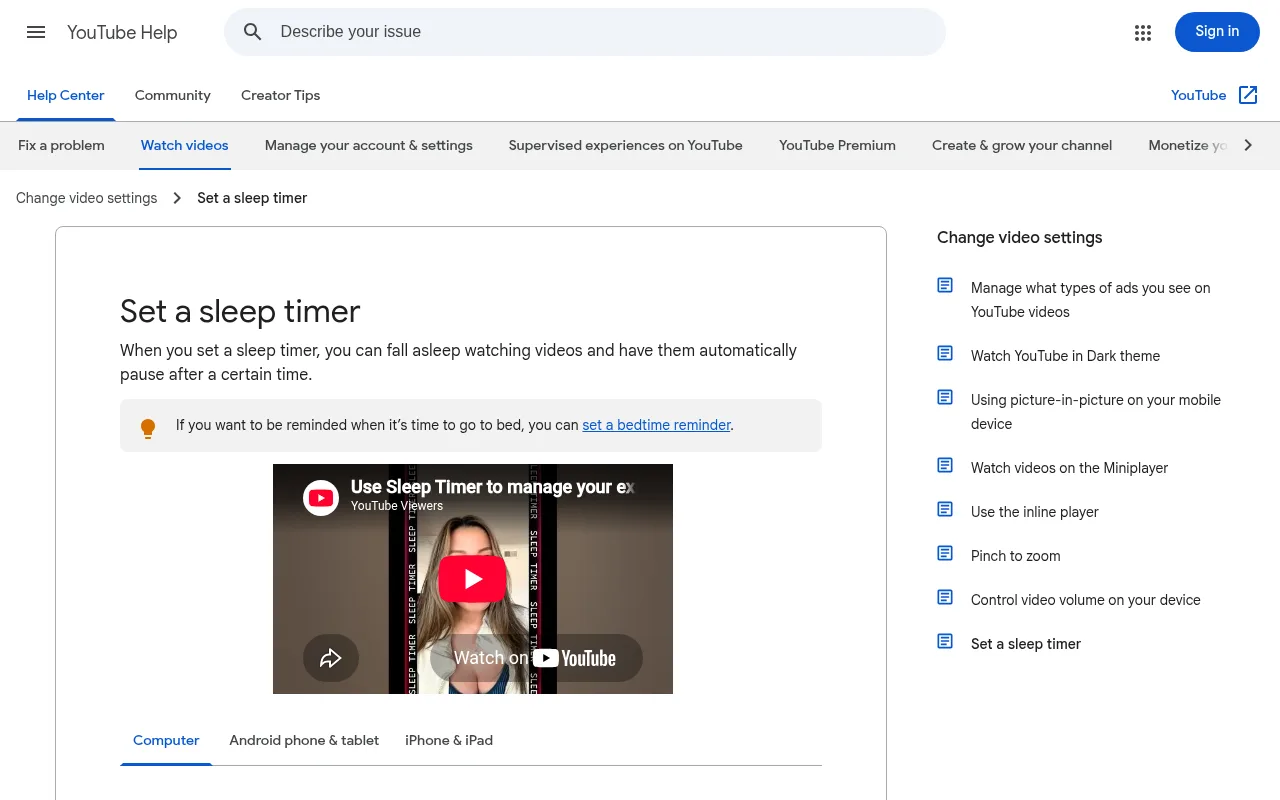
YouTube has free long-form classical sleep videos. Pick one with a dark or still picture, so the screen doesn't light up the room. Its sleep timer pauses the video after a time you choose. Open the video, tap the Settings icon in the player, tap Sleep timer and pick how long it should run.
Calm
Calm is a meditation and sleep app. Alongside its Sleep Stories and soundscapes, its own guide points to a classical playlist that mixes piano-led arrangements with orchestral harmonies, plus piano collections and Cello in the Rain.

It suits you if you like a guided wind-down before the music takes over.
Make classical-style sleep videos with Chillframe
A lot of the long sleep videos on YouTube come from faceless channels: calm music, a quiet scene and no presenter. People search for them every night, and you don't have to be a musician or an editor to make them. The guide to sleep music on YouTube covers the creator side, and jazz music for sleeping and lofi for sleeping show where else the same idea goes.

Chillframe writes the music, makes the scene, puts them together and publishes the finished video to your YouTube channel. Three of the Dark Academia looks fit this guide:
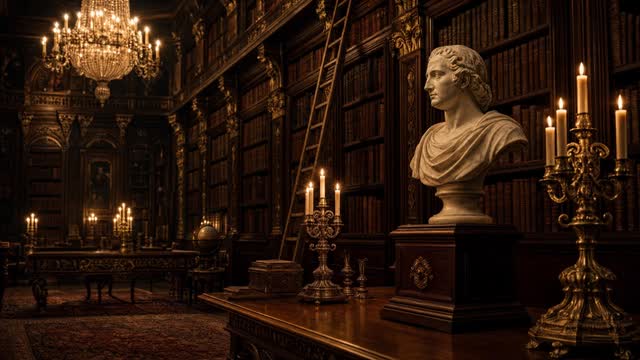
- Baroque Library Night: a candlelit library with a warm string quartet and light harpsichord.
- The Midnight Reading Room: a grand library hall at night with slow, low strings.
- Dark Academia Window: a cello melody over soft piano, with rain running down the glass.
For a classical sleep channel I'd choose one of those as the house look and stay with it, so a returning listener knows the channel at a glance. Leave the audio on Instrumental, so there's no singing to pull anyone awake, and set the length to 1 hour for a full wind-down. Then give it a schedule: a Series on Monday, Wednesday and Friday at 10pm writes a new piece and makes a new scene for every slot. You approve the first video, and with auto-publish on the channel runs fully hands-off from there.
The honest limit for this niche is what the music is. Chillframe writes original pieces in a classical mood, fresh for every video, so it won't give you a recording of Clair de lune or a Chopin nocturne. For a channel, that's the useful part: the music is new and yours, with full commercial rights on every plan.
Still library scenes are on the Starter plan at $19 a month. Candlelight that flickers in Baroque Library Night needs a Plus video, which starts on the Creator plan at $49 a month.
Classical music for sleeping FAQ
Does classical music help you sleep?
It can. In a 2008 study of 94 students with sleep complaints, the group who listened to relaxing classical music for 45 minutes at bedtime slept better after 3 weeks, while the audiobook and silence groups didn't. It's one small study, so treat music as a help at bedtime, not a treatment.
What is the most relaxing classical piece for sleep?
If I had to pick one, it's Satie's Gymnopédie No. 1. It's slow, soft from start to finish and moves like a gentle sway, and Classic FM puts it first in its list of sleep pieces. Debussy's Clair de lune and Chopin's Nocturne Op. 9 No. 2 are close behind.
Is classical piano music good for bedtime?
Yes, and it's the gentlest place to start, because one instrument means nothing changes colour under you. Stick to slow pieces like the Chopin nocturnes and the first movement of the Moonlight Sonata. Stop before any fast movement that follows.
Should I listen for 45 minutes or play classical music all night?
Start with 45 minutes and a sleep timer, since that's what the students in the 2008 study did. If you wake in the night and want sound there when you do, go longer. A multi-hour YouTube video works, or Max Richter's Sleep, which runs for 8.5 hours.
How is a classical sleep playlist different from a classical-style sleep video?
A playlist is recordings of real works by composers like Debussy and Chopin, played one after another. A classical-style sleep video is usually original music written in a classical mood and set to a quiet scene. That's the kind Chillframe makes, so you get new pieces rather than recordings of Debussy.