Listening
Soothing Dog Sounds: What to Play When Your Dog Is Anxious
Why an audiobook beat classical music in one shelter study, and the habit that makes a calming sound work on the night you need it.

Soothing dog sounds work best when they are slow, simple and quiet, and when your dog already knows them before the stressful moment arrives. Shelter studies have found that gentle classical music, soft rock, reggae and even an audiobook help dogs lie down and rest. Below is what the research found, what to play for each trigger (being left alone, fireworks, thunderstorms, car trips and crate time), how loud to play it, and how to get your dog used to it first.
What the shelter studies found
Most of the research on music and dogs comes from rescue centres and kennels. Four studies are worth knowing.
| Study | Dogs | What calmed them most |
|---|---|---|
| Wells, 2002 | Shelter dogs | Classical music, compared with heavy metal, pop and conversation |
| Kogan, 2012 | 117 kennel dogs | Classical music: more sleep, less vocalising |
| Brayley and Montrose, 2016 | 31 shelter dogs | An audiobook, ahead of classical, pop and music made for dogs |
| Bowman and colleagues, 2017 | 38 kennel dogs | Any music helped them lie down; soft rock and reggae lowered stress the most |
PetMD sums up the early classical studies: in Deborah Wells's shelter work, dogs spent more time resting and being quiet with classical music, and in Lori Kogan's study at Colorado State, dogs listening to classical music spent more time sleeping and less time vocalising.
The audiobook result is the surprise. In the Brayley and Montrose study, shelter dogs spent more time resting with an audiobook playing than with any of the other conditions, including classical music and music designed for dogs. They also spent less time sitting or standing on alert.
The 2017 study tried five genres over five days: soft rock, Motown, pop, reggae and classical. Dogs spent more time lying down and less time standing whenever music played, whatever the genre. Heart rate variability, a sign of lower stress, rose most with soft rock and reggae. The team varied the genre because dogs had already been shown to get used to classical music quickly, and the calming effect held across all five days.
These are small studies of kennelled dogs, and PetMD notes there hasn't been a lot of research in this area. Your dog at home may like something different. That's the useful part: you can test a few sounds on a calm afternoon and see for yourself.
What makes a sound soothing to a dog
Genre matters less than the shape of the sound. PetMD and Purina both point to the same four things: the tempo, the length of the notes, simple tones and a regular rhythm.
Tempo has numbers behind it. Chewy reports that in Kogan's comparison, the classical pieces averaged 121 beats per minute, heavy metal 131, and music made to relax dogs 95. Pooch & Mutt went through 13 Spotify playlists for calming dogs, over 500 songs and 24 hours of music, and the average came out at 95 BPM too. Every track it found was below 40 decibels, about the level of ordinary home noise.
What to look for:
- Slow and steady: around 95 BPM or slower, with long notes and no sudden changes.
- Simple: solo piano, acoustic guitar or a small group, rather than a full mix.
- Few or no vocals: Chewy suggests instrumental music with no lyrics. A calm spoken voice is the exception, going by the audiobook study.
- Soft percussion or none: Chewy says to avoid loud drums and any track with startling, random beats.
Nature sounds count too. Purina includes them as an option and says the calmer the noise, the more soothing the effect. Steady rain or gentle water fits that better than a forest track full of bird calls. My guides to nature sounds for sleep and rain sounds cover the steadier options.
Soothing dog sounds for each trigger
The same track won't suit every situation. Here's what to reach for, by what's upsetting your dog.
Being left alone
Long, quiet music or an audiobook, playing before you go. PetMD and Chewy both make the same point: play it while you're at home too, not only when you leave. If the music only ever starts as you pick up your keys, the sound itself can become a sign that you're going, and then it adds stress.
Make the track longer than your absence. In the 2017 study, dogs were more likely to bark after the music stopped, so a playlist that runs out an hour before you're back leaves your dog in sudden silence. Chewy says the same: make sure the playlist is long enough.
Music helps with separation stress, but it doesn't fix it. Purina describes it as one part of a wider plan for separation-related problems, alongside training. If your dog howls, chews doors or won't settle at all while you're out, ask your vet about a behaviourist.
Fireworks
On the night, music masks some of the bangs outside, and PetMD notes that a favourite tune can help distract your dog from them. A steady, continuous sound covers more of the gaps between bangs than something sparse with long silences.
The bigger win comes before the night. The Dogs Trust offers Sounds Scary, a free sound therapy programme developed by two vets who specialise in behaviour. It uses recorded firework sounds played very quietly at home and raised a little at a time over weeks, so your dog learns the noise isn't a threat. The Sounds Scary booklet says this desensitisation takes several weeks of daily sessions, and that if you only have a couple of weeks before an event, your first job is to prepare a safe hiding place for your dog.
Thunderstorms
Storms can't be scheduled, so the soothing sound needs to be something your dog already knows from ordinary evenings. Purina warns that if you only play music when your dog looks worried, your dog may link the music with feeling anxious. Play it on calm nights too, and it becomes the sound of a normal evening.
When a storm starts, put on the familiar track at a low to moderate level. It won't cover the loudest thunder, but it fills the quiet between claps with something your dog knows.
Car trips
PetMD notes that car travel can cause anxiety and suggests familiar music to help a dog relax. Purina adds that music masks engine noise and passing traffic. Use the same track you play at home, so the car has something in it your dog already knows. Keep it quiet, since a car is a small space and the speakers are close.
Crate time, bedtime and a new home
PetMD suggests calming music for time in the crate or safe space, and for a new dog or puppy settling into your home. Puppies are most open to new things between 5 and 16 weeks of age, so that's a good time to make a soothing sound part of bedtime. PetMD adds that you can do this at any age.
For bedtime, slow solo piano or soft classical is a good place to start. If your dog sleeps well with it, a low, steady track can play through the night. Pick one long enough that it doesn't stop at 3am, since dogs in the 2017 study were more likely to bark once the music ended. A dog that sleeps soundly in quiet doesn't need sound added. My guides to classical music for sleeping and piano music for sleep are written for people, but the slow, simple pieces in them fit the same rules.
How loud to play soothing sounds
Low to moderate, always. PetMD notes a dog's hearing is about four times as sensitive as ours, so what sounds quiet to you is plenty for your dog.
The one number worth knowing is a ceiling, not a target. Chewy says anything over 80 to 85 decibels can cancel out any relaxation, and a standard alarm clock is about 80.
You don't need a meter. Set the volume so you can hear it from across the room without it pulling your attention, then watch your dog. Purina suggests looking for signs of relaxation and calm in your dog's body language. Lying down, slow breathing and closing eyes are good. Pricked ears, pacing, panting or whining are your cue to turn it down or change the sound.
How to get your dog used to a soothing sound
This is the step that makes the rest work. A sound your dog has relaxed to many times is a much better tool on a hard night than a new one.
- Pick three to try. For example, a slow classical playlist, a soft reggae or soft rock playlist, and an audiobook read in a calm voice.
- Play one at a time on a calm day. Purina's advice is to start gradually, at home, where your dog feels comfortable, at a low volume.
- Watch for 20 minutes or so. Note which sound gets your dog lying down and resting, and which one leaves them alert.
- Keep the winner, and rotate a couple of others. The 2017 study suggests that changing the genre keeps the calming effect going, so having two or three that work is better than one.
- Make it part of ordinary days. Play it during naps, quiet evenings and short spells alone, not only on bad days.
- Use it on the hard night. Start it before the fireworks or before you leave, and let it run past the end, so it doesn't stop suddenly.
If a sound makes your dog more alert or upset, turn it off and try another on a different day: quieter, a different genre, or an audiobook. If your dog panics at loud noises or when left alone whatever you play, talk to your vet, who can refer you to a behaviourist. Sound works best alongside a safe space and training, not in place of them.
Where to find long soothing dog sounds
You want long tracks with no sudden ads. For an audiobook, any calm story you already own works: pick a reader with a steady, even voice. For music, two of the easiest places to start are below.
Spotify
Spotify has plenty of calming albums and playlists made for dogs, and Pooch & Mutt's playlist study above drew on Spotify's own playlists. A good one to start with is Relaxmydog's album of music for anxious dogs.
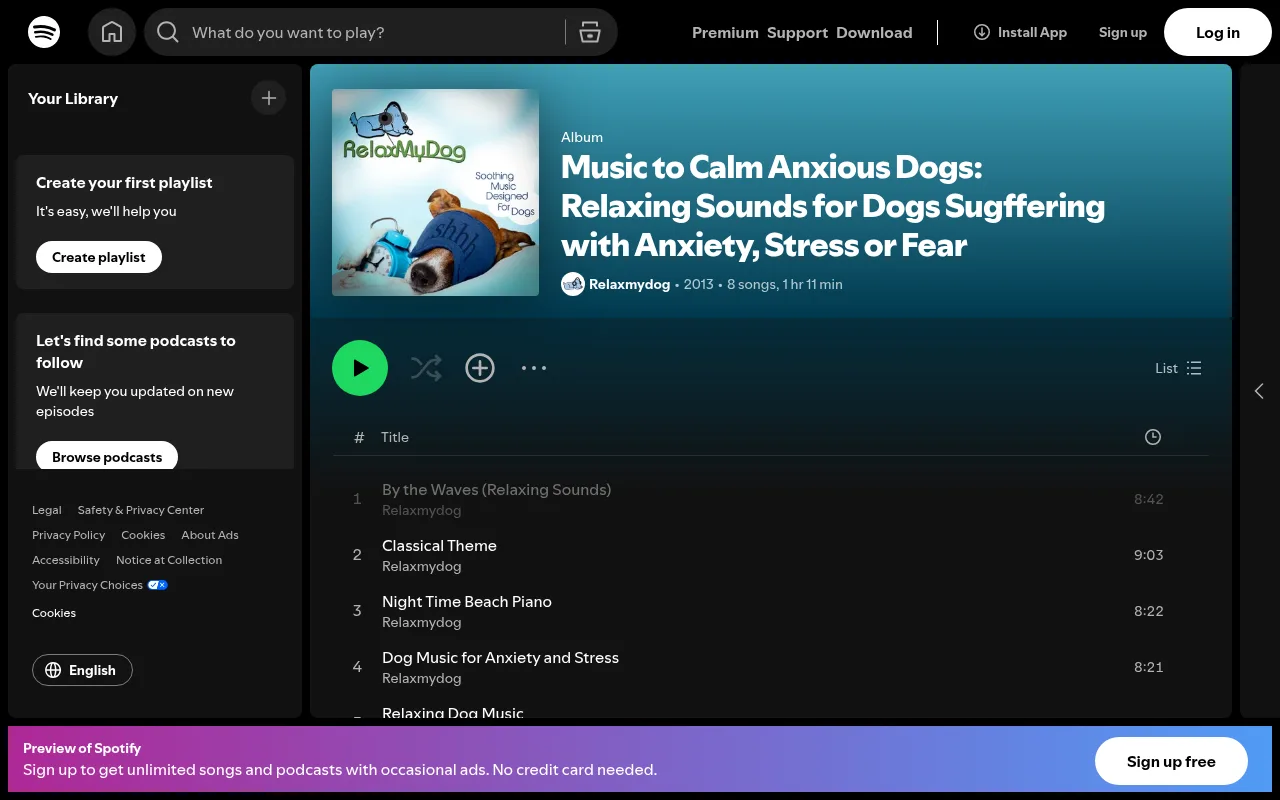
The free tier plays ads between tracks. Spotify Premium removes them and lets you download music, so a dropped signal doesn't cut the sound while you're out.
YouTube
YouTube has very long videos of calming music for dogs, some running all day. Relax My Dog has a 20-hour video of relaxation tones for dogs, long enough to cover a whole working day.

Two settings matter here. Turn off autoplay so a different video doesn't start when yours ends. And on the free version, ads can play during a video. YouTube Premium removes them and lets you download videos to play offline.
Build a calming channel for dogs with Chillframe
Long calming videos for dogs are a category of their own on YouTube: slow music or steady rain, a calm picture, hours of runtime and nobody talking. Relax My Dog has built a channel on exactly that, and there's plenty of room for new channels with their own look and sound.

These searches have a daily rhythm. Owners want something to leave playing as they head out to work, so a channel that posts on weekday mornings is there at that moment.
Chillframe makes the whole video: the music or the ambience, the picture and the finished video, published to your YouTube channel. The music is new for every video, which suits owners who rotate a few sounds the way the 2017 study suggests.
Here's how I'd set one up. Start from a calm look like Cozy Window, a sunlit window seat with slow solo piano, or describe the room you have in mind in plain words. Keep the audio on Instrumental, or switch to Ambience only for steady rain or fire sound with no music. Then make a Series for Monday to Friday at 7am. It automatically makes a fresh video for each of those mornings and posts it with a title, description and tags. The first one waits for you to watch it, and once you approve it, with auto-publish on, the channel runs fully hands-off.
Length is the limit to plan around. Videos run up to 1 hour on every plan, so one video won't cover a working day. For a longer upload, join several hours together in an editor first.
The Starter plan includes one Series, which is all a weekday channel like this needs, and it costs $19 a month. My guide to faceless YouTube channels covers the rest of running it, and lofi for relaxing shows the slow instrumental style in more detail.
Soothing dog sounds FAQ
Do dogs prefer classical music or reggae?
It depends on the dog, and the studies point both ways. The early shelter studies found classical music calmed dogs, while the 2017 study found soft rock and reggae lowered stress the most. Try one of each on a calm afternoon and keep whichever gets your dog lying down.
Can nature sounds help calm an anxious dog?
They can, as long as they're steady. Purina says the calmer the noise, the more soothing the effect. Continuous rain or gentle water is a better pick than a track full of bird calls or sudden splashes.
Is it OK to play calming music for my dog all night?
Yes, if your dog sleeps well with it and it stays low and steady. Choose a track long enough to run until morning, because dogs in the 2017 study were more likely to bark once the music stopped. If your dog already sleeps soundly in quiet, you don't need to add anything.
Do dogs get used to calming music over time?
They can. Dogs had already been shown to get used to classical music quickly, which is why the 2017 study changed the genre each day, and the calming effect held across all five days. Rotating two or three sounds that work keeps them fresh.
What should I do if calming music makes my dog more anxious?
Turn it off and try something else on a different day: quieter, a different genre, or an audiobook. If your dog still panics at loud noises or when left alone whatever you play, ask your vet about a behaviourist.