Listening
Rainforest Sounds for Sleep: Which Mixes Help and Where to Find Long Ones
Rain on leaves, insects, frogs, a river out of sight: which rainforest layers help you sleep, which keep you up, and where the long recordings are.
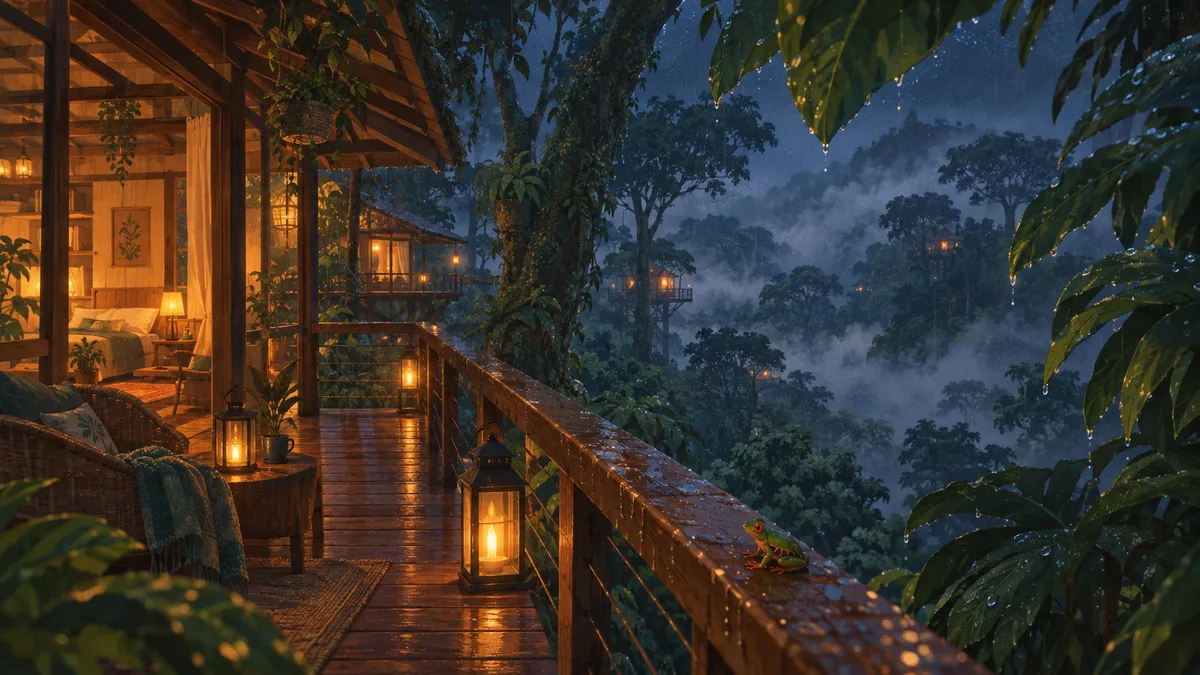
The best rainforest sounds for sleep are led by rain on leaves, with insects humming in the background and maybe a river somewhere out of sight. Mixes full of close bird calls, frog choruses and thunder are wonderful to listen to, but they are busy, and busy sound is more likely to keep you up.
What you hear in a rainforest recording
A rainforest recording is usually several layers at once. Knowing them makes it much easier to pick a good one, because the layers behave very differently once you are trying to sleep.
| Layer | What it sounds like | For sleep |
|---|---|---|
| Rain on broad leaves | A soft, uneven patter with drips underneath | Steady, the best base layer |
| Insects | A constant high hum or buzz from cicadas | Steady, works like a noise layer |
| A river or stream | A low, continuous rush | Steady, good under the rain |
| Frogs | Repeated calls that rise and fall in waves | Eventful, fine kept far back |
| Birds | Single calls and songs, mostly at dawn | Eventful, better for winding down |
| Distant thunder | Low rolls every so often | Eventful, loved by some, not all |
The steady layers are the ones that help. A steady sound covers the noises that wake you, like a door or a car outside, and gives your brain nothing to follow. An eventful sound is the opposite: a frog call or a parrot is interesting, and interesting is what you don't want at 3am.
So a night rainforest recording, mostly rain, insects and frogs, tends to suit sleep better than a daytime one full of birdsong. Rainforest sits under the wider family of nature sounds for sleep, and that guide covers the quieter woodland sounds too.
Choosing rainforest sounds for sleep: calm mixes and busy ones
When you try a new recording, listen for a minute with your eyes closed and notice whether anything jumps out. A sound that grabs you now will grab you at 2am too.
Calm mixes usually have:
- Rain as the loudest layer, from start to finish
- Insects and water kept steady underneath
- Any frogs or birds faint and far away
- No sudden changes in volume
Busy mixes usually have:
- Bird calls close to the microphone
- Frog choruses that start and stop
- Thunder that cracks rather than rolls
- Edits every few minutes where the sound changes
Busy mixes aren't bad. They are lovely for reading in bed or winding down, and then you can switch to something steadier once the light is off. For anyone who loves the drama of a storm, rain and thunder sounds for sleeping goes into how to keep thunder from waking you.
Why steady sound helps at night
The evidence is mostly about steady noise in general, not rainforest recordings in particular. A small 2021 study in Sleep Medicine gave ten New Yorkers who struggled with noise at night a white noise machine for a week. By their own sleep diaries they fell asleep faster, and a wrist tracker showed them spending less time awake after first falling asleep.
That is ten people and a white noise machine, so it is a reason to try it rather than proof. A rain-led rainforest mix does much the same job as white noise, filling the quiet so sudden sounds stand out less. White noise is the steadier of the two, and a rainforest mix is the nicer one to listen to, so it comes down to which one you stop noticing first. For something even steadier, brown noise for sleeping is the deep, smooth end of that family.
None of this treats a sleep problem. Trouble sleeping most nights is worth taking to a doctor.
Where to find long rainforest sounds for sleep
Length matters more than people expect. Every time a track ends, there is a gap or a change, and each one is a small chance to wake. These are the places I would start, beginning with the most adjustable.
myNoise
myNoise has a dedicated Rainforest generator built from field recordings, with sliders for each layer and presets including Amphibians, Lonely Frogs, Insects, Rainy Day, Rainy Season and Jungle Tone.
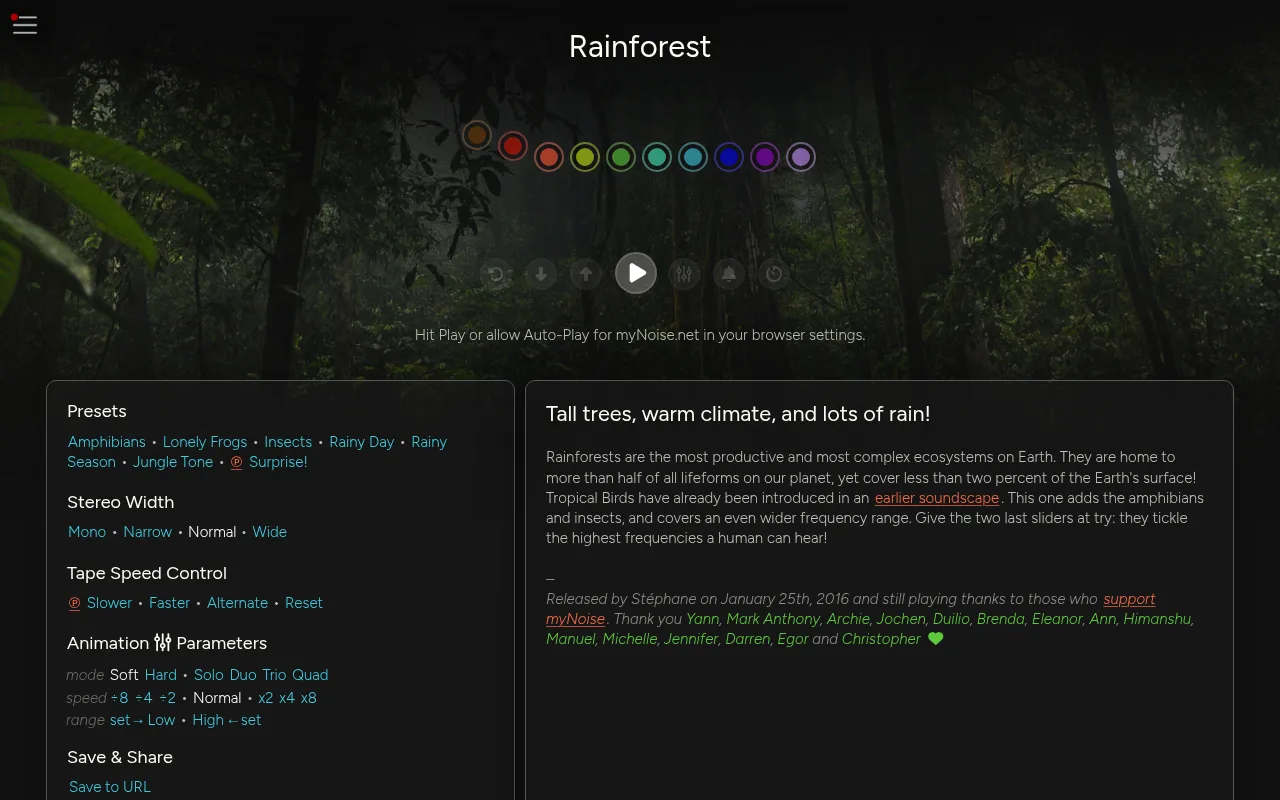
This is the one I'd pick for control. It plays for as long as the tab is open, so there is no track end to wake you, and you can turn down any layer that keeps catching your ear. myNoise says it never uses generative AI for its soundscapes. It runs free in the browser, and a donation of any amount gives you lifetime access to the extras.
YouTube
YouTube is where the very long recordings live. One of the best known is Rainforest Rain Sounds for Sleeping or Studying, a 10-hour video from the Relaxing White Noise channel with over 34 million views.
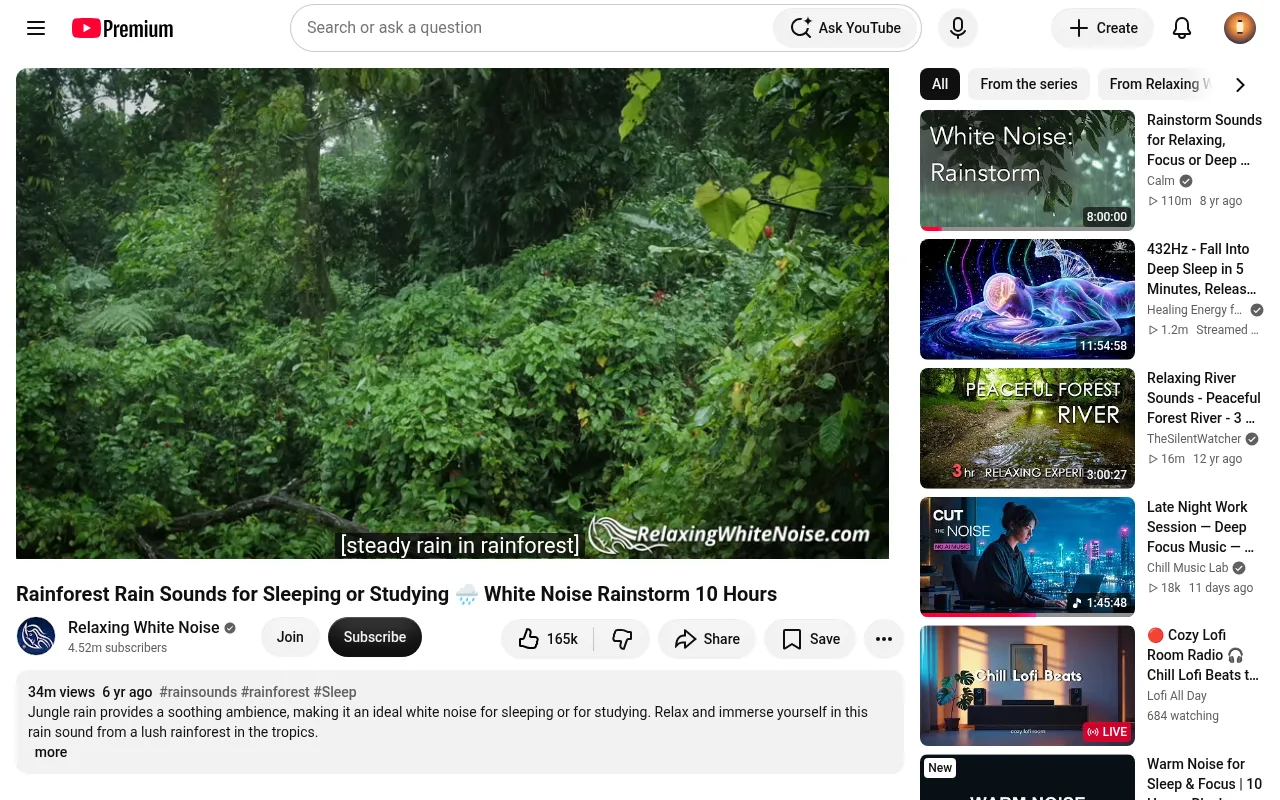
As the title says, it leans on the rain, which makes it one of the steadier options. Search "rainforest sounds for sleep 10 hours" and you'll find plenty more. Turn autoplay off before you settle down, so the next video doesn't start in the middle of the night. My guide to 10-hour rain sounds has more long recordings to choose from.
Spotify
Spotify's own Sleep in the Rainforest playlist is described as "tropical nature sounds for bedtime", with tracks like Hidden Birds of the Jungle, Night Forest and Rain In The Forest.
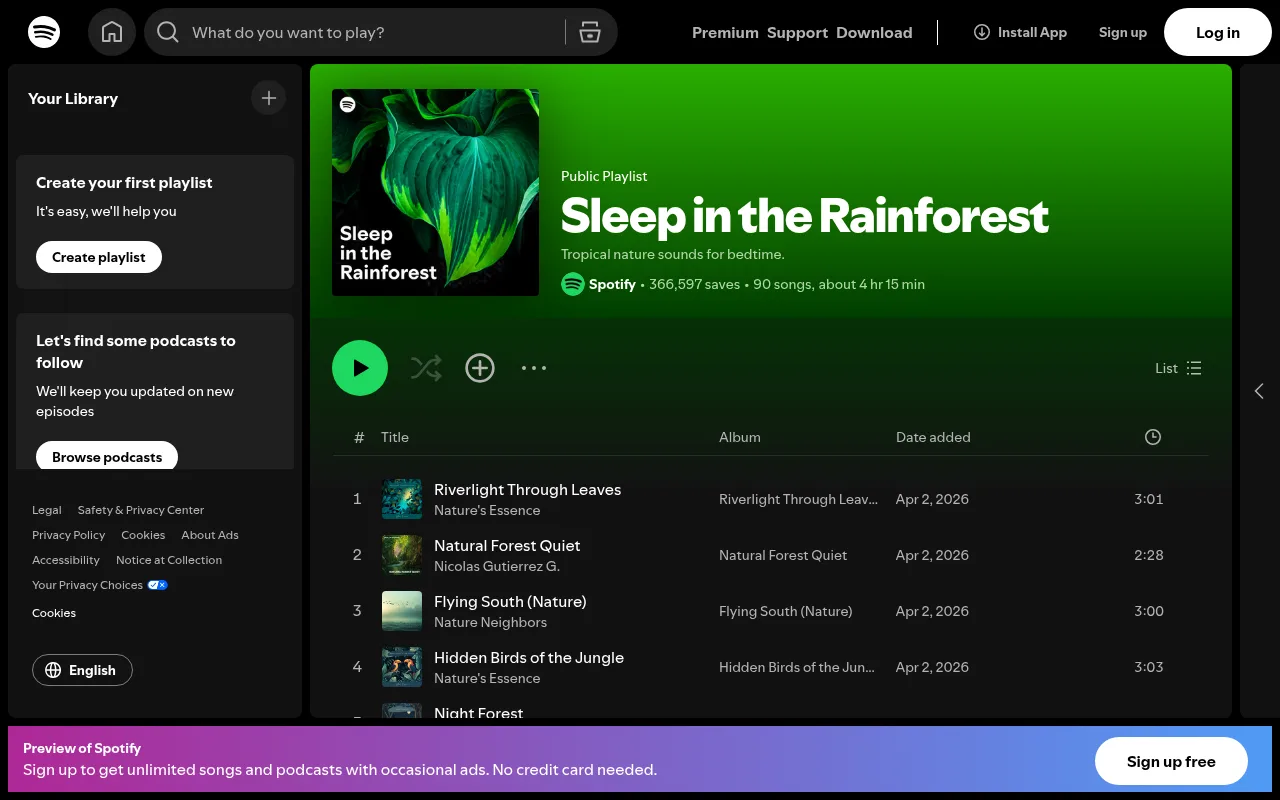
The tracks run about two and a half to three minutes each, so the sound changes every few minutes. That suits winding down more than a whole night. Turning on crossfade in Spotify's playback settings smooths the joins. Apple Music has the same pattern: the album Rainforest Sounds for Sleep (Continuous) has 67 tracks in 2 hours 18 minutes.
Headspace
Headspace's Northwest Rainforest is a sleepcast, a narrated story rather than a plain recording. It runs 45 minutes, opens with a breathing exercise and is set under a canopy of trees with rain falling through the warm night.
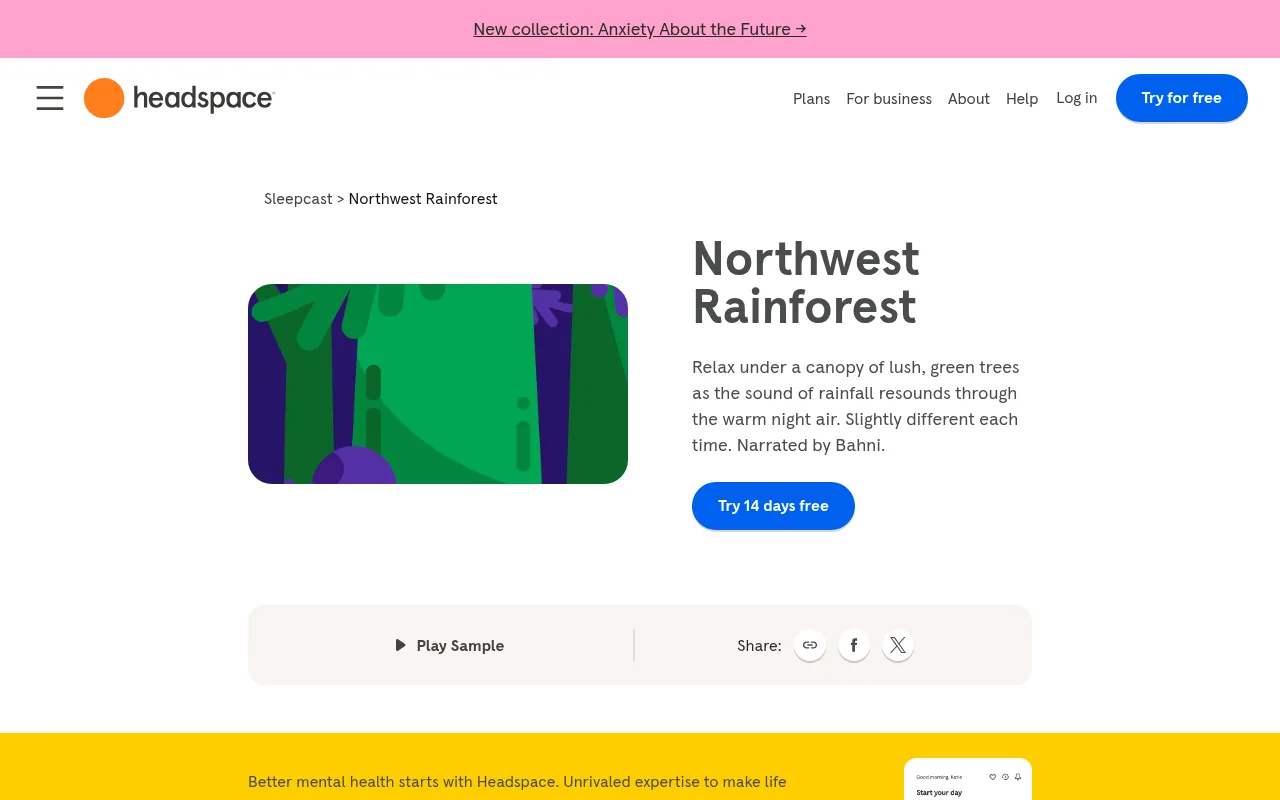
It suits anyone whose mind wanders with rain alone and who settles better to a calm voice. Headspace needs a paid subscription, and the page has a sample you can play first.
Calm
Calm has a Rainforest Rain soundscape, which its own blog recommends for drifting off, and a Rain on Leaves soundscape that sits nicely in the same mood.

Calm makes sense for anyone who also wants Sleep Stories and sleep music in the same app. Some of it is free, and the rest needs a paid subscription.
Setting up for a whole night
A few small choices make a big difference to whether rainforest sound helps or keeps you awake:
- Keep it quiet. BetterSleep's rain sounds guide suggests about 50 to 60 decibels, roughly light conversation. Being able to pick out single drops after ten minutes means it is too loud.
- Put the speaker across the room. A few feet from your head and aimed at a wall sounds more like a real place and less like a device by your ear.
- Pick a timer to match how you sleep. People who stay asleep once they drop off need only a fade-out after 45 to 60 minutes. People who wake in the night do better with sound until morning.
- Download it where possible. A buffering pause in the middle of the night is the most jarring gap of all. Spotify and Apple Music let paying subscribers download playlists and albums to play offline.
- Go easy with headphones. Earbuds are uncomfortable on your side and easy to turn up too loud. Something made for sleep, like a soft headband, is kinder, and a speaker across the room is kinder still.
- Stop when it isn't working. Give a new sound a few nights. Still listening to it at 2am means it is time for a steadier mix or a different sound.
If you're not sure where to begin, start with the myNoise Rainforest generator on its Rainy Season preset, turned down until it sits just under everything else in the room, and give it three nights. For more rain and less forest after that, the rain sounds guide is the next place to look.
Make rainforest sleep videos for YouTube with Chillframe
Long rainforest videos like the 10-hour one above draw big audiences on YouTube, and nature sound for sleep has room for new channels with a look and a feel of their own. My guide to sleep music on YouTube looks at that wider space.

Chillframe makes the whole video, the scene and its sound, and publishes the finished file to your YouTube channel. None of the preset looks is a rainforest, so this one starts with words. Write the scene the way this guide describes a good recording: a rainforest at night, rain on broad leaves, insects humming and a river somewhere out of sight. Set the audio to Ambience only, and you hear that scene with no music laid over it.
From there, a Series turns that one description into a channel. Give it the nights you want, Tuesday, Thursday and Saturday for example, and a time in the early evening, before people settle down for the night. The first video is held for you to check. Approve it with auto-publish on, and Chillframe automatically makes a fresh rainforest night for every slot and uploads it with a title, description and tags, fully hands-off.
The limit that matters for rainforest sleep is length. Every video runs up to 1 hour on every plan, so Chillframe won't make a single 10-hour recording like the one above. A Series of hour-long videos builds a library of them over time, and if you want one long overnight file, join several hours together in an editor before you upload.
On the Starter plan, at $19 a month, Chillframe makes a still rainforest in 4K. Moving scenes, where the leaves move under the rain, start on the Creator plan at $49 a month. It runs three Series, so you can run a storm or campfire channel next to the rainforest one.
Rainforest sounds for sleep FAQ
Are rainforest sounds better than white noise for sleep?
Neither wins for everyone. The one study in this guide tested a white noise machine with ten people, not rainforest recordings. White noise is the steadier of the two, while a rain-led rainforest mix does much the same job and is nicer to listen to, so keep whichever one you stop noticing first.
Should rainforest sounds play all night or on a timer?
It depends on how you sleep. If you stay asleep once you drop off, a fade-out after 45 to 60 minutes is enough. If you wake in the night, keep the sound going until morning, on something with no track ends like the myNoise generator or a 10-hour video.
What can I do if the frogs or thunder keep waking me?
Those are eventful layers, so they are the first thing to turn down. On myNoise each layer has its own slider, so you can lower the frogs and leave the rain alone. Anywhere else, pick a mix where rain stays the loudest sound from start to finish.
Can I listen to rainforest sounds with headphones?
You can, but earbuds are uncomfortable on your side and easy to turn up too loud. A soft sleep headband is kinder. A speaker across the room at around 50 to 60 decibels, about the level of light conversation, is kinder still.
Where can I listen to rainforest sounds offline?
Spotify and Apple Music let paying subscribers download playlists and albums, so there is no buffering pause in the night. The Apple Music album Rainforest Sounds for Sleep (Continuous) runs 2 hours 18 minutes, enough to see you through the first couple of hours.