Listening
528 Hz Music for Sleep: The Solfeggio Story and What Studies Show
Where the 528 Hz tone comes from, what the studies actually measured, and how to try it at bedtime.

528 Hz music for sleep is calm music built around one pitch, 528 Hz, which belongs to a set of tones called the Solfeggio frequencies. It can help you wind down the same way any slow, quiet music can. What it hasn't got yet is a study showing it helps sleep more than other calm music, and the bigger claims about healing and DNA repair have no evidence behind them. So treat it as a sound you might like, pick a steady track, keep it quiet, and see how you sleep.
If you came here from 432 Hz, that's a different idea. My guide to 432 Hz music for sleep covers that tuning, and there's a short comparison further down.
What 528 Hz music for sleep is made of
528 Hz is a pitch: a sound that vibrates 528 times a second. It sits in the middle of what we hear, a little above the C one octave over middle C. In standard tuning that C is about 523 Hz, so 528 Hz is a touch higher.
Tracks sold as 528 Hz music for sleep come in three kinds, and they sound quite different:
- A plain tone. One steady hum at 528 Hz, sometimes for hours. Some people find it soothing, others find it thin or piercing.
- Music with the tone underneath. Soft pads, piano or nature sounds, with a quiet 528 Hz tone layered beneath them. A lot of sleep playlists are this kind.
- Music tuned to 528 Hz. An ordinary piece retuned around 528 Hz in place of standard tuning. The main human study used this kind.
The label on a track often doesn't say which kind it is. A minute of listening tells you.
Where the Solfeggio story comes from
The name borrows from solfège, the do-re-mi syllables singers learn. Those syllables go back to Guido of Arezzo, a Benedictine monk born around 991, who took them from the first syllable of each line of a hymn to John the Baptist, Ut queant laxis.
The frequencies themselves are much newer. According to Science Feedback, they were worked out in the 1970s by Joseph Puleo, a herbalist, from a pattern of verse numbers in the Book of Numbers in the Bible. So the syllables are about a thousand years old, and the numbers are from the 1970s.
528 Hz is the best known of the set. Its fans call it the "love frequency" or the "miracle tone", and many track descriptions say it repairs DNA. Calm's guide to 528 Hz says plainly that the idea it can repair DNA or heal the body at a cellular level has not held up in mainstream research.
None of that stops it being pleasant to fall asleep to. It does mean the reason to choose it is how it sounds to you.
What the 528 Hz studies actually measured
There are two studies people point to, and neither one measured sleep.
Nine adults, five minutes of piano. In a 2018 study in the journal Health, Akimoto and colleagues at Juntendo University played soothing piano music to 9 healthy adults, 8 women and 1 man. Each person heard the same music twice, on different days: once tuned to 528 Hz and once at standard 440 Hz. It played for 5 minutes from a speaker, in the afternoon, and they didn't know which version they were hearing.
After the 528 Hz version, the stress hormone cortisol in their saliva was lower 30 minutes later, the hormone oxytocin went up straight after the music, and their own ratings of tension and anxiety went down. After the 440 Hz version, none of the saliva measures changed significantly.
That's an interesting result, and a very small one. Nine people, a few minutes of daytime listening, and no sleep measured at all.
Cells in a dish. A 2017 study by Babayi and Riazi exposed brain cells grown in a lab and damaged with alcohol to a 528 Hz tone. More of the cells survived, by about 20%. It's a lab result about cells, not about people listening at night.
I couldn't find a published study that tested 528 Hz music on sleep itself. Calm's summary agrees: studies don't clearly show that 528 Hz has a unique sleep benefit compared with other calming music.
What music in general does for sleep
The good news is that the wider research on music and sleep is much stronger, and 528 Hz tracks are music.
A Cochrane review published in August 2022 pulled together 13 studies with 1,007 adults who had symptoms of insomnia. They listened to recorded music every day, for 25 to 50 minutes, over three days to three months. Music improved how well they rated their sleep, and the review rated the evidence for that as moderate.
People already know this. A 2019 paper in Scientific Reports cites a survey of more than 500 patients with sleep disorders in which over half said they used music as a sleep aid.
So if 528 Hz music helps you sleep, the calm, steady music is very likely doing the work. That's a good reason to try it, and a good reason to choose a track you like listening to.
528 Hz vs 432 Hz
These two get mixed up a lot, and they're different ideas.
| 432 Hz | 528 Hz | |
|---|---|---|
| What it is | A tuning standard: the note A is set to 432 Hz instead of 440 Hz | One tone from the Solfeggio set |
| What it does to a track | Every note sits slightly lower | A 528 Hz tone is layered in, or the piece is retuned around it |
| Where the idea comes from | An alternative to standard concert tuning | A 1970s reading of Bible verse numbers |
| Sleep studies | A few small studies | None found |
Both are fine to fall asleep to, and neither is a medical treatment. My 432 Hz music for sleep guide goes into the research on that tuning. Binaural beats are a third thing again: two slightly different tones, one in each ear, which only work through headphones. The binaural beats sleep guide covers those.
How to choose 528 Hz sleep music
The frequency label tells you very little about whether a track will help. These things matter more:
- Slow and steady. The Sleep Foundation suggests music around 60 to 80 beats per minute, the range most sleep studies used. Many 528 Hz tracks have no beat at all, which is fine.
- No sudden changes. Skip tracks that jump in volume or switch tone halfway through. Calm gives the same advice.
- Tone or music. If a bare 528 Hz hum feels sharp, choose music with the tone mixed quietly underneath.
- Long enough. Many 528 Hz sleep tracks run for several hours, so you can pick one that outlasts the time it takes you to drop off.
- Try it in the day. Play a few minutes while you're awake. If it irritates you at 3pm, it will at midnight.
Ignore the promises in the title. Plenty of 528 Hz tracks are named after DNA repair or miracles, and the music under those names is often lovely. Choose by ear.
How to listen safely at bedtime
Start the track once you're lying down with the light off, and keep it quiet. The Sleep Foundation's advice is a volume that is soothing and not disruptive. It's easy to set it too loud while you're still alert.
A small speaker by the bed is better than earbuds for a whole night. The Sleep Foundation warns that headphones and earbuds can damage the ear canal if the volume is too high, and that sleeping in earbuds can lead to a build-up of earwax and a higher risk of ear infections. 528 Hz music works the same through a speaker, so there's no reason to wear them.
If you'd rather the music stopped, use a timer, and set it longer than you think you need. Music cutting out while you're half asleep can wake you again. On YouTube in the Android app, open the video, tap Settings in the player, tap Sleep timer and choose how long it plays (YouTube's steps).
Give it a few nights before you decide. The Sleep Foundation notes that people in studies reported better sleep the more often they made music part of their night. If a track keeps you awake, swap it. If you struggle most nights whatever you play, the guide to the best sleep music for insomnia is a good next read, and a doctor is the right person to talk to.
Where to find 528 Hz music for sleep
Four places to look, each with plenty to choose from.
YouTube
YouTube is where the very long 528 Hz sleep videos are. A search turns up plenty that run 8 to 12 hours.
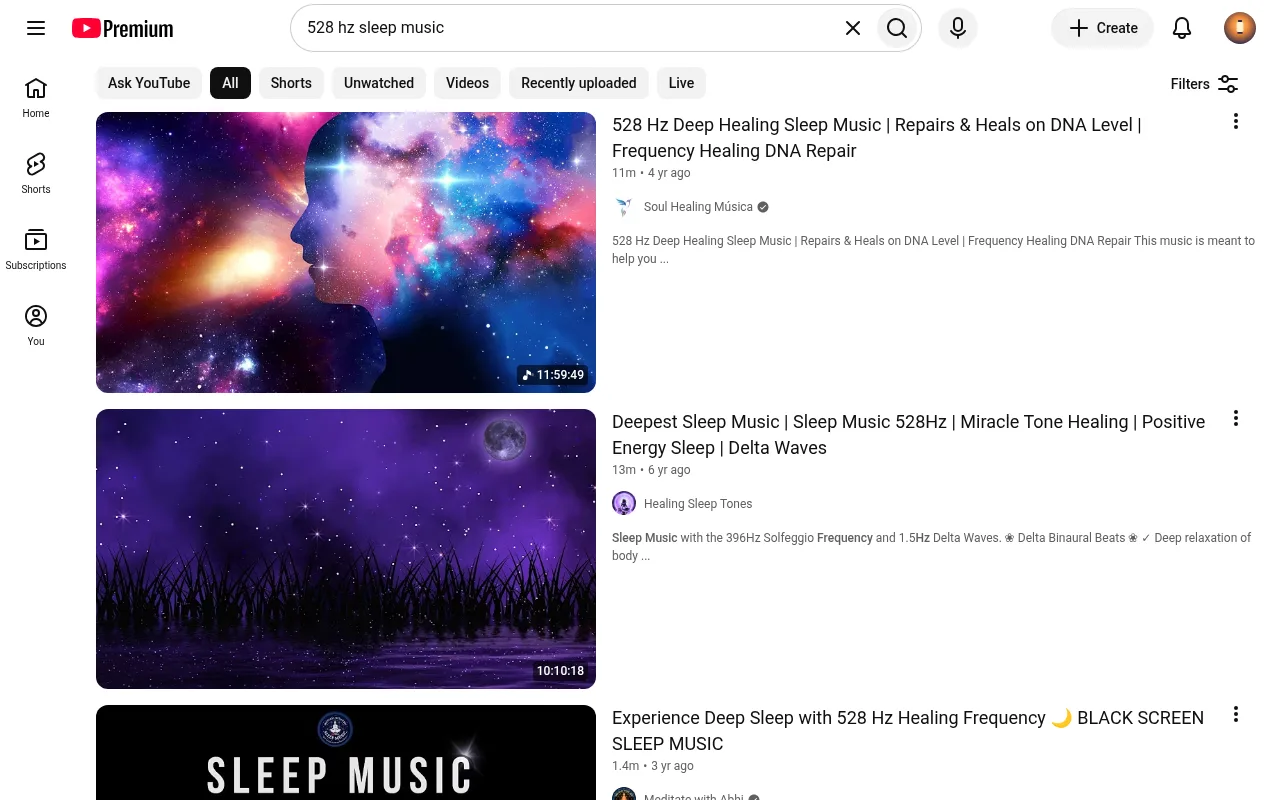
Pick a video with a dark picture so the screen doesn't light up the room, and check the length before you press play. Ads can cut in at a different volume, and YouTube Premium removes them.
Spotify
Spotify has whole playlists of 528 Hz sleep music, like Sleep Music 528 Hz by Soothing Oasis.
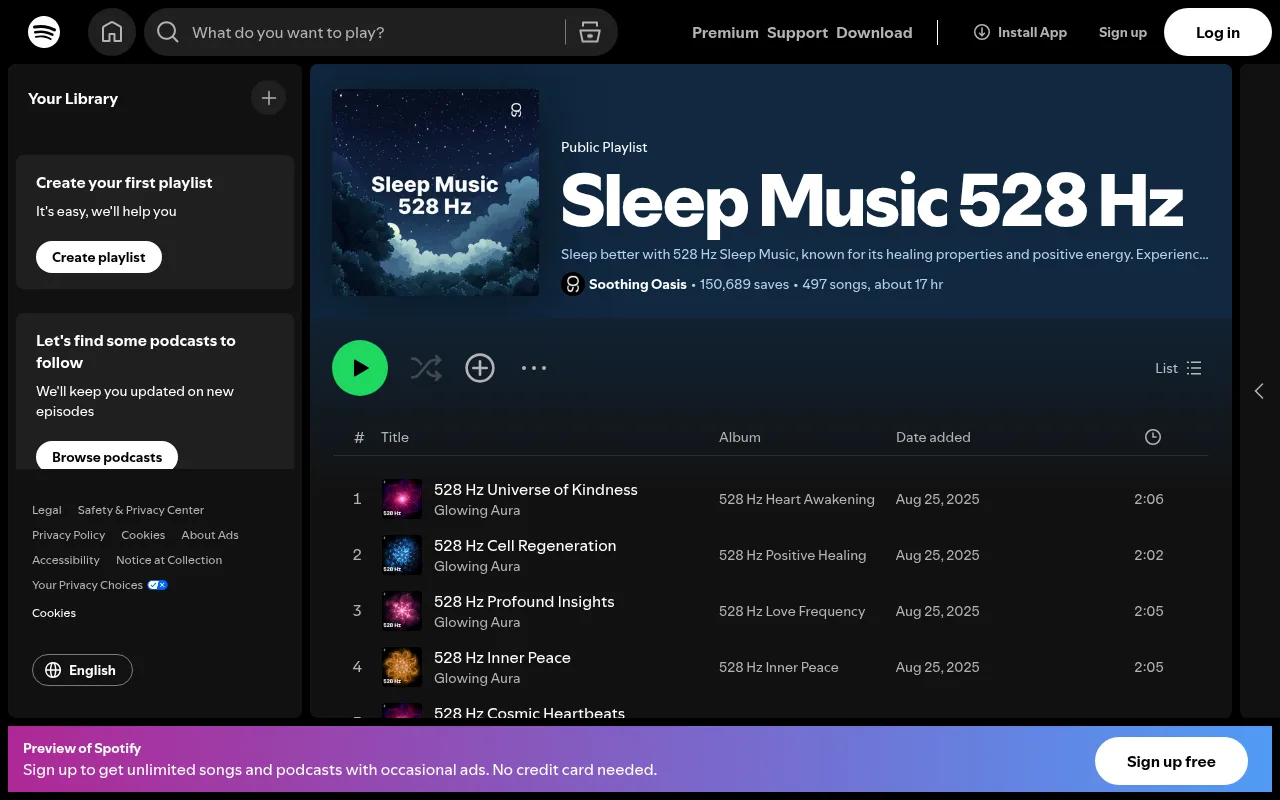
A playlist keeps going from one track to the next, which suits a whole night. Turn shuffle off if the tracks are ordered to wind down, and listen to the first couple of changes between tracks before you settle in.
Apple Music
Search Apple Music for "528 hz sleep" and you get dozens of albums named after the frequency.
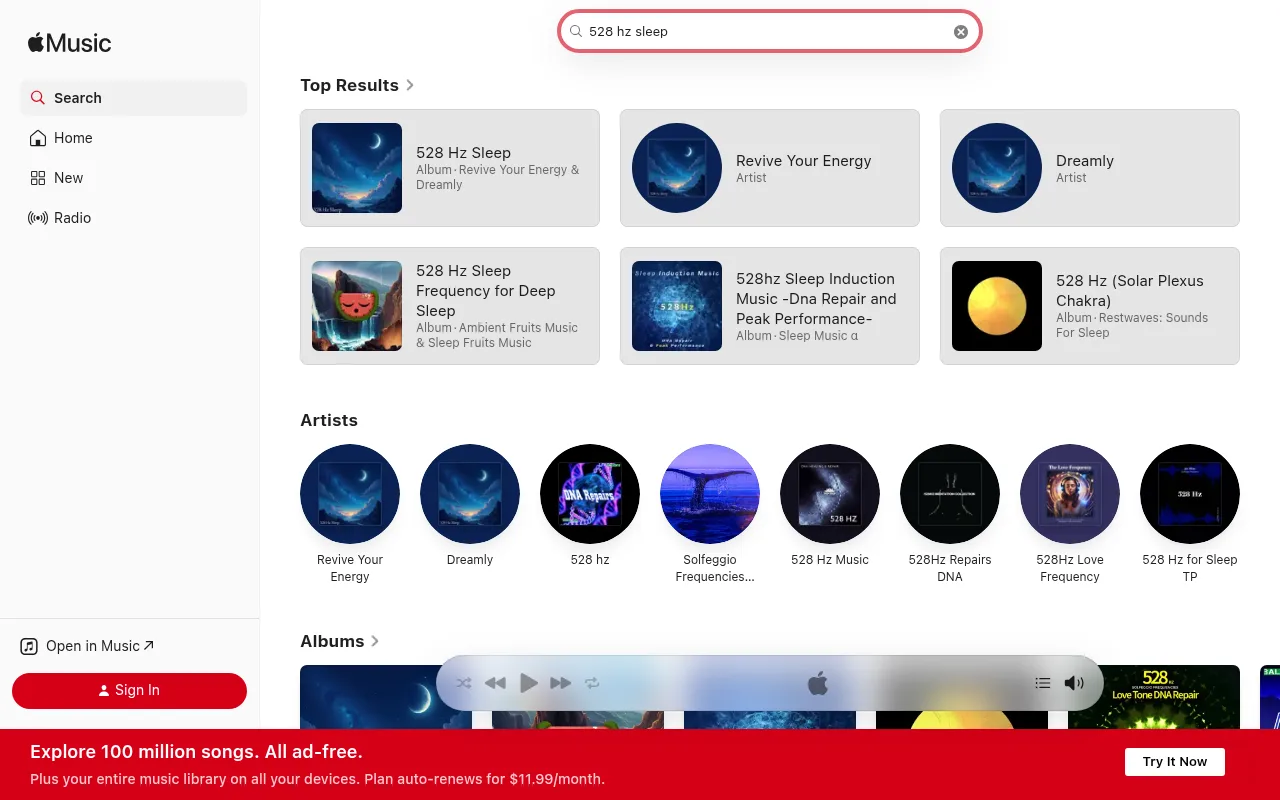
This is where the DNA-repair titles are easiest to spot. Play the first minute of a few albums and keep the one that sounds calm to you, whatever it's called.
Insight Timer
Insight Timer is a meditation app with a big sleep music library, and plenty of 528 Hz tracks in it. One example is Sleep Through The Night, 163 minutes of music with the 528 Hz tone layered softly across the whole track.
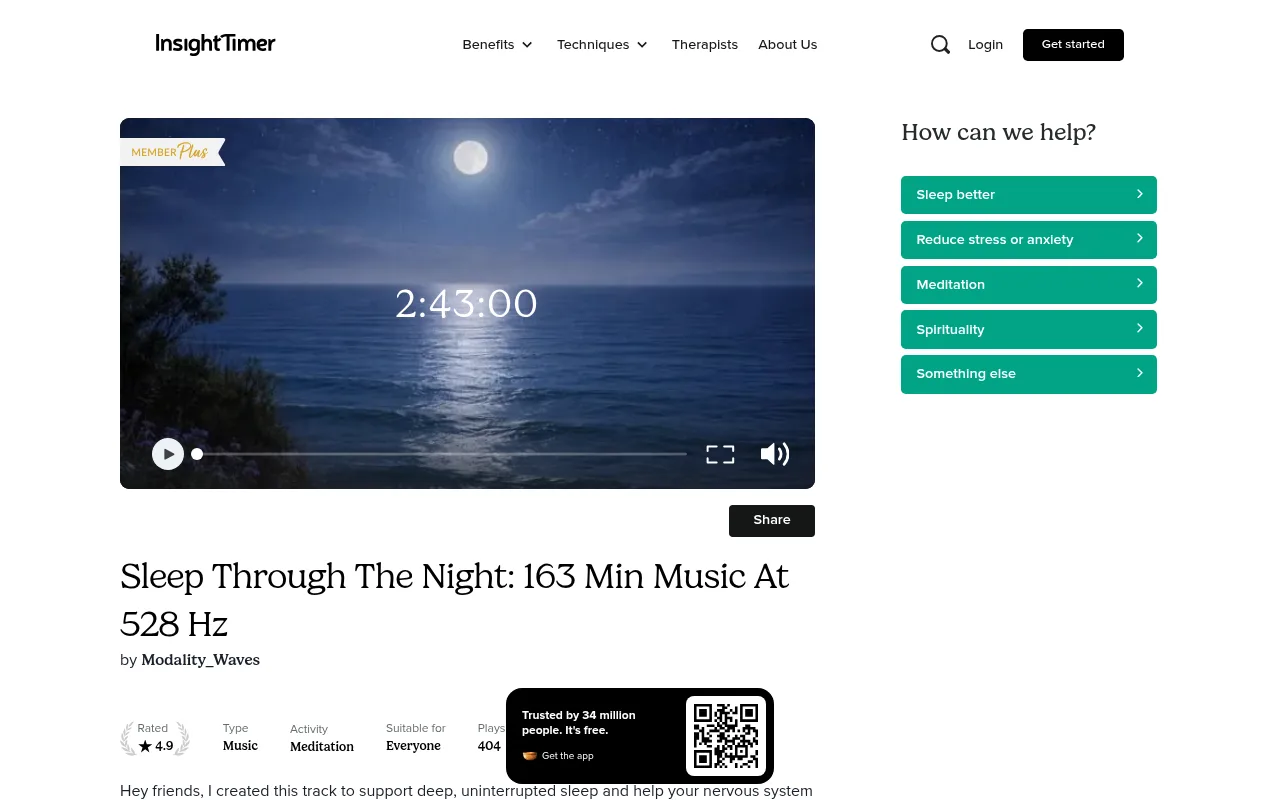
The descriptions are written by each track's creator, so they vary a lot in what they claim. The track lengths are the useful part: you can see straight away whether one will run past the point you fall asleep.
Start a sleep music channel with Chillframe
Those 8 to 12 hour 528 Hz videos come from faceless channels: calm music, a dark scene and no one on camera. Over half of the patients in that sleep-disorder survey already used music to fall asleep, and they need it again every night. That makes it a good niche for a channel that posts every night too.

Chillframe writes original music for each video, makes the scene, puts the two together and publishes the finished video to your YouTube channel on the nights you choose. A nightly sleep channel comes down to four choices:
- The scene. Moonlit Ridge, in the Deep Sleep style, is a near-black night with a full moon low behind a ridgeline, kept dark enough to watch on a phone in a dark bedroom. Or describe your own, like a still lake under stars.
- The sound. Instrumental is the default: slow, original music with no singing. If your listeners would rather fall asleep to rain or surf, choose Ambience only.
- The time. Make a Series that posts 7 days a week at 8pm, so a new hour goes up each evening before bedtime. Videos run up to 1 hour, so over a month the Series builds a library of hours rather than one 8-hour file.
- The first video. Every Series holds its first post for review, and with auto-publish on, approving it is the last thing you do. After that the channel is fully hands-off: each night Chillframe makes the next video and publishes it with a title, description, tags and a thumbnail taken from the video.
The one limit is the tuning. Chillframe has no setting that tunes a track to 528 Hz, so what it makes is the slow, steady music the sleep research above is really about.
As a still scene, Moonlit Ridge is a Lite video. The Starter plan makes Lite videos in 4K, at $19 a month. Lofi for sleeping shows what already works with sleepy listeners.
528 Hz music for sleep FAQ
Is there any proof that 528 Hz music helps you sleep?
Not yet. No published study has tested 528 Hz music on sleep itself, and the one human study measured stress in 9 adults after 5 minutes of daytime piano. What is well supported is that calm music in general helps: a 2022 Cochrane review found it improved how adults with insomnia symptoms rated their sleep.
Can you listen to 528 Hz music every night?
Yes, and it may work better that way. In the studies the Cochrane review pulled together, people listened every day for anywhere from three days to three months. The Sleep Foundation also notes that people reported better sleep the more often they made music part of their night.
Should you use headphones or a speaker for 528 Hz music?
A speaker by the bed is the better choice for a whole night. Unlike binaural beats, 528 Hz music doesn't need headphones to work, and the Sleep Foundation warns that sleeping in earbuds can lead to a build-up of earwax and ear infections. Keep the volume low enough to soothe you without being disruptive.
What should you do if 528 Hz music keeps you awake?
Swap the track. If a bare tone feels sharp, try music with the 528 Hz tone mixed quietly underneath, or slow music with no frequency label at all, since the calm music is very likely what helps. If you sleep badly most nights whatever you play, talk to a doctor.
Is 528 Hz the same as 432 Hz?
No. 432 Hz is a tuning standard that sets every note slightly lower, while 528 Hz is one tone from the Solfeggio set, either layered into a track or used to retune it. Both are fine to fall asleep to, and neither is a medical treatment.