Listening
Tibetan Music for Sleep: Singing Bowls, Flute and Chant at Bedtime
Singing bowls, bamboo flute, monastic chant and overtone singing: what each sounds like with the light off, and where to find recordings worth trusting.

Tibetan music for sleep usually means one of four sounds: singing bowls, a soft bamboo flute, monks chanting, or the deep overtone chant a few monasteries are famous for. For falling asleep, bowls and flute are the easiest place to start, because they're slow, even and have no beat. Chant and overtone singing are strong, low and full of presence, so I'd keep them for the wind-down before bed or for meditation. Whichever you choose, play it quietly and pick something long enough to outlast you.
The four sounds of Tibetan sleep music
Most tracks sold as Tibetan sleep music mix two or three of these. It helps to know each one on its own, because they do different things at bedtime.
Singing bowls
A singing bowl is a metal bowl that rings when you strike it or run a wooden stick around its rim. You hear one clear tone that hums and wavers, then a long fade into silence. Sleep tracks usually layer several bowls, so a new tone starts as the last one dies away.
There's no tune and no rhythm to follow, which is why bowls work so well for sleep. The sound fills the room without asking you to listen.
Bamboo flute
The traditional Tibetan flute is the lingbu, which the music of Tibet entry describes as a flute made from bamboo, or occasionally wood. In sleep music, "Tibetan flute" usually means a slow, breathy melody played over a drone or a bed of bowls.
Flute is warmer than bowls and gentler on a quiet mind, because there is a person in the sound. The catch is that a melody gives you something to follow. If you find yourself waiting for the next phrase, the flute is keeping you up.
Monastic chant
This is monks reciting prayers and ritual texts together, often for long stretches, sometimes with drums, cymbals or long horns between passages. It's steady and repetitive, and the group voice has a weight you feel as much as hear.
It's also a real religious ritual. The tracks on a chant album have names like Mandala Offering and Blessing the Offerings, because that is what they are.
Overtone chant
Some monasteries are known for a deeper style still. The monks of Gyuto Monastery are famous for chordal chanting, in which each singer produces a very low note with a second, higher pitch ringing above it. The effect is a chord from one voice. In this tradition, overtone singing mostly keeps to the low end of the voice.
Heard in a dark room, it's striking. It's also the least likely of the four to let you drift off, because it's so present.
Bowls for sleep, chant for meditation
Here is how I'd use each one.
| Sound | What it's like | Best for |
|---|---|---|
| Singing bowls | Ringing tones that fade, no tune or beat | Falling asleep and staying asleep |
| Bamboo flute | A slow, breathy melody over a drone | Winding down, or sleep if melody doesn't distract you |
| Monastic chant | Steady group recitation, sometimes with drums or horns | Winding down before bed, meditation |
| Overtone chant | Very low voices with a second pitch above | Meditation, focused listening |
A good bedtime pattern uses two of them. Put on chant or flute while you get ready for bed and settle in, then switch to bowls when the light goes off. If you want guided meditation with music instead, my guide to meditation music for sleep covers that side.
Where the "Tibetan" in Tibetan sleep music comes from
The four sounds have quite different stories, and knowing them makes it easier to choose recordings you feel good about.
Singing bowls are a modern tradition. According to the singing bowl entry, historical accounts of Tibetan music are silent about singing bowls, and Buddhist ritual doesn't use bowls in the "singing" way. Bowls sold as Tibetan mostly come from northern India or Nepal. They reached the West in the early 1970s, and Henry Wolff and Nancy Hennings's 1972 album Tibetan Bells is credited with bringing them into music. The singing bowl music sold as "Tibetan music" grew from there, starting in the US. That doesn't make it any less relaxing. It means a bowl track is a modern relaxation sound with Himalayan roots, not a recording of a temple ceremony.
Chant is the real thing. Gyuto Monastery was founded in 1475. After 1959, monks who fled to India re-established it there, and its main monastery now sits near Dharamsala. David Lewiston's 1974 recordings brought the chant to Western listeners, and the monks have recorded and toured widely since.
So when I want chant, I look for recordings with a named monastery or choir on the cover. A generic "monastery mantras" album might be lovely, but you can't tell who is singing. A named album lets you hear the real tradition, and you know whose voices you're listening to.
Where to find Tibetan music for sleep
These four are where I'd look. Each one leans towards a different kind of track.
Spotify
Spotify is the easiest place to build a bedtime playlist, with bowl, flute and chant tracks side by side. Its Tibetan Bowls playlist is a good first stop for falling asleep.
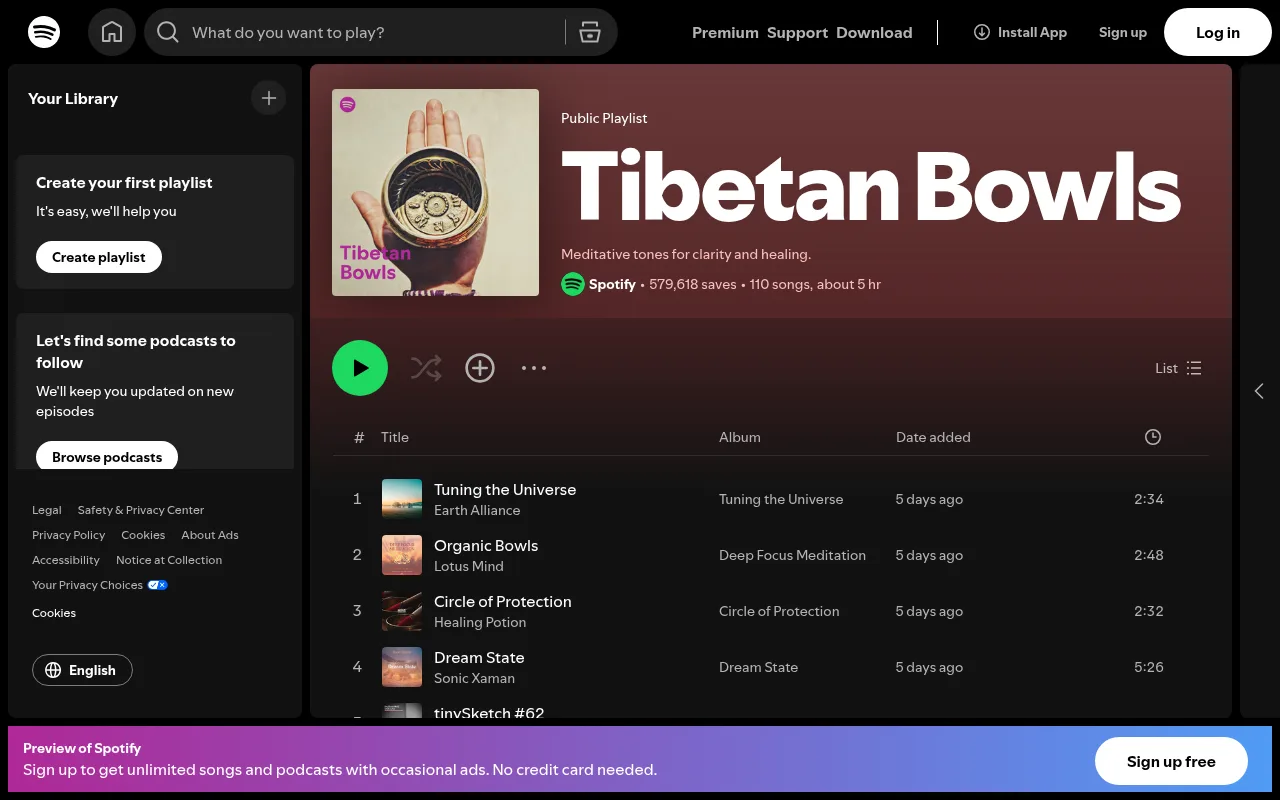
Search "Tibetan flute" or "Tibetan chant" to find the other sounds, and save the tracks you like into one playlist with flute or chant first and bowls after. Spotify Premium removes the ads, which matters at night, and lets you download for offline listening.
Apple Music
Apple Music is where I'd go for chant recordings with the monastery named. Tibetan Chants for World Peace by the Gyuto Monks Tantric Choir runs about 50 minutes over four tracks, the longest of them 24 minutes.
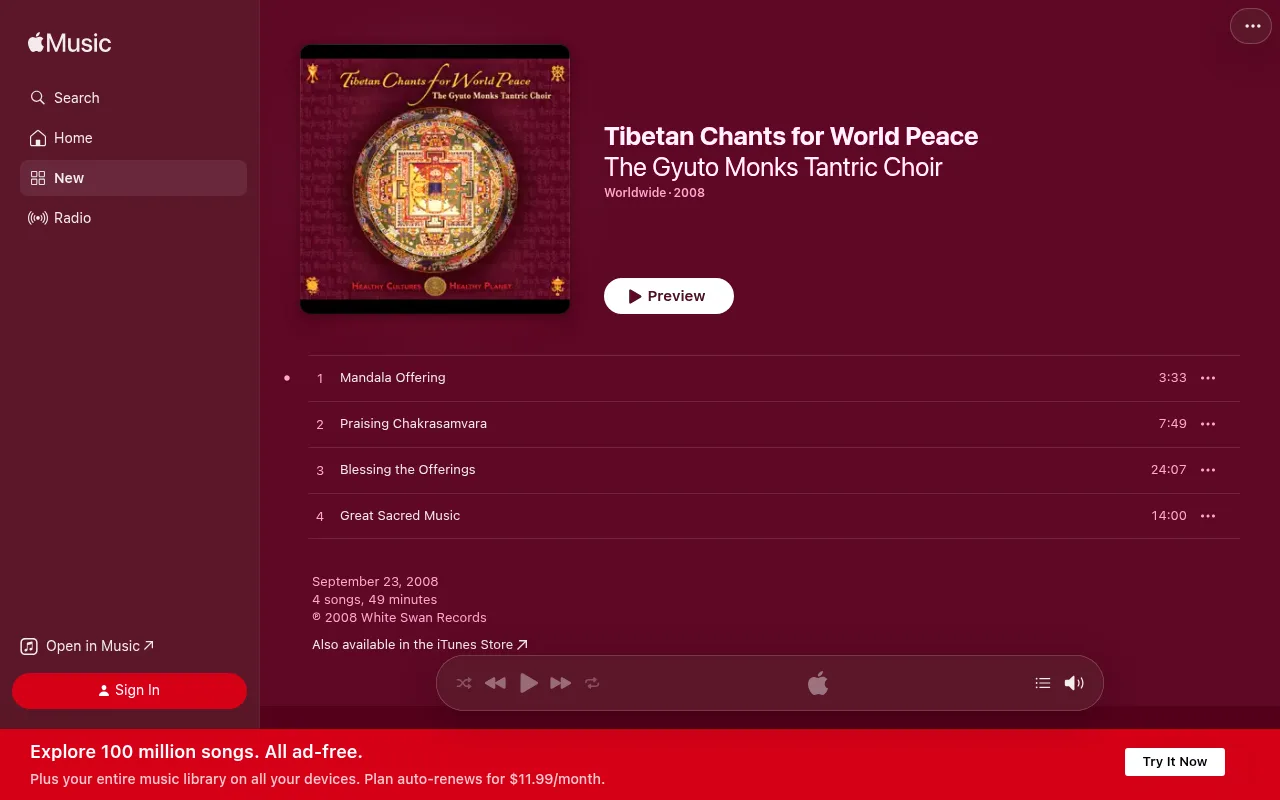
It's a deep, low recording, better for the hour before bed than for falling asleep. Apple Music also has plenty of long singing bowl albums for later in the night. There are no ads on Apple Music.
Insight Timer
Insight Timer is a meditation app with a large free library, and it's good for single long tracks. Tibetan Bowls Meditation Music For Sleep & Anxiety by Healing Vibrations is a sound bath of hand-made bowls that runs 1:06:14. It's rated 4.7 and has been played over 50,000 times.
It was recorded with a binaural technique, and the creator recommends headphones. That is a good way to hear it while you wind down. For the rest of the night, a speaker is kinder to your ears (more on that below).
YouTube
YouTube is where the very long videos live: hours of bowls, flute and chant over a mountain or temple scene. One example is this Tibetan meditation music video from Yellow Brick Cinema, which runs just under 12 hours.
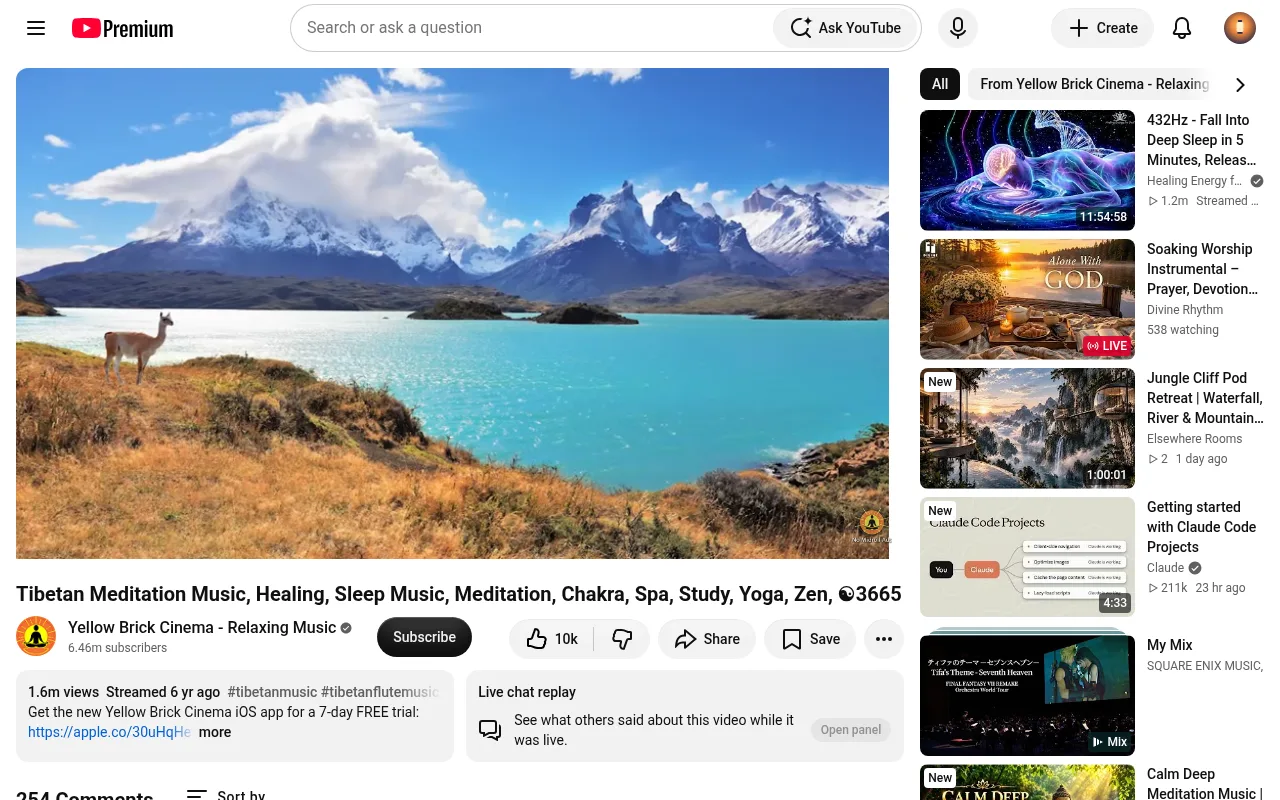
A long video means nothing stops halfway through the night. Two things help: pick a dark scene so the screen doesn't light up the room, and if you only want it while you drift off, use the sleep timer in the YouTube app's player settings. Ads can cut in at a different volume, and YouTube Premium removes them.
Setting up Tibetan music for the night
The music matters less than how you play it. Here's what I'd do.
- Start it at the same point each night. Whether that's while you get ready or when you lie down, keep it the same, so the sound becomes part of going to bed. The Sleep Foundation suggests evening rituals that give the body time to wind down.
- Keep it quiet. Bowls carry a lot of energy in their strike. Set the volume so the loudest strike is still soft, not the gentlest fade.
- Use a speaker for the whole night. The Sleep Foundation warns that headphones and earbuds can damage the ear canal while you sleep if the volume is too high, and that sleeping in earbuds can lead to earwax build-up and ear infections. Use headphones for a binaural track while you wind down, then take them out.
- Pick long or loop it. A track that ends as you fall asleep can wake you. Choose something over an hour, or set the player to repeat.
Binaural recordings, like the Insight Timer bowls, are recorded to sound spatial in headphones. They're not the same as binaural beats, which play two slightly different tones in each ear. My binaural beats sleep guide explains those.
What the research says about Tibetan music
I haven't found a sleep study on Tibetan music itself. There is one useful study on calm.
In a 2018 randomised controlled study in Foggia, Italy, 60 adults waiting for surgery wore headphones for 30 minutes. Half heard Tibetan singing bowl music and half heard silence. In the music group, the anxiety score fell from 60.2 to 39.13. In the silent group it barely moved, from 61.6 to 60.3. Their heart rate variability also moved in the direction linked with relaxation.
That was anxiety before an operation, not sleep, and the authors note that silent headphones might have had their own effect. Still, calming down is most of what falling asleep asks of you, and it's a good reason to try bowls at bedtime. If you struggle to sleep most nights, though, music isn't a treatment, and a doctor is the right person to see.
Run a Tibetan sleep music channel with Chillframe
Many of the long Tibetan sleep videos on YouTube come from faceless channels: calm music over a mountain or monastery scene, with no one on camera. It's a peaceful niche and a growing one, with room for new channels that have their own scenes and sound.

Chillframe makes these videos from start to finish: original music, the scene, the finished video and the upload to your YouTube channel.
A Tibetan channel can run more than one schedule at a time, one per scene. Describe each in plain words: a Himalayan monastery courtyard at dusk with prayer flags lifting in the wind, a still lake below snow peaks, a stone hut in mountain rain. The courtyard and the lake take Instrumental audio, slow music with no singing, written fresh for each video. The hut takes Ambience only, so it's rain and nothing else. Give each scene its own Series and spread them across the week, say the courtyard on Mondays, the lake on Wednesdays and the rain on Saturdays, all at 9pm. Every Series holds its first video for you to check. With auto-publish on, approve it and that Series is fully hands-off, posting each new video with a title, description and tags written for it.
Two limits are worth knowing here. Chillframe writes its own music, so it won't give you a recording of real monastic chant. For that, the albums with a named monastery on the cover are still the place to go, and because the music Chillframe makes is original, you're never borrowing anyone's recording. Each video also runs up to 1 hour, the same on every plan, so for a 12-hour upload you'd join several hours together in an editor first.
Three Series side by side is what the Creator plan holds, at $49 a month, and the Starter plan at $19 runs one if a single schedule is enough. Lofi for sleeping shows what works at night, and my guide to meditation music on YouTube covers the channel side.
Tibetan music for sleep FAQ
Is Tibetan music good for sleep?
It's a good wind-down sound, and singing bowls are the best place to start. I haven't found a sleep study on Tibetan music itself, but in a 2018 study, 30 minutes of singing bowl music lowered anxiety in adults waiting for surgery, while silence barely changed it. Feeling calm is most of what falling asleep asks of you, so it's worth trying for a week.
Are singing bowls or flute better for sleep?
Bowls, for most people. They have no tune or beat, so there's nothing to follow, and each tone fades away without asking you to listen. Flute is warmer and good for winding down, but a melody can keep a busy mind waiting for the next phrase.
How long should Tibetan sleep music be?
Longer than it takes you to fall asleep, so over an hour is a good rule. A track that ends just as you drift off can wake you. The Insight Timer bowls track runs just over an hour, many YouTube videos run for several hours, and a shorter track works fine on repeat.
Can Tibetan music replace treatment for insomnia?
No. It's a relaxation aid, not a treatment, and the study above measured anxiety before surgery, not sleep. If you struggle to sleep most nights, see a doctor, and keep the music as one calm part of your bedtime routine.