Listening
Japan lofi: city pop samples, koto, Tokyo nights and where to listen
Nujabes, city pop, koto plucks and rainy Tokyo streets: where this sound came from and where to hear it.

Japan lofi is lofi hip-hop with a Japanese feel. You get the usual mellow jazz chords, soft swung drums and vinyl crackle, plus something that places it: a sampled city pop guitar, a koto plucked over the beat, the breath of a bamboo flute, or the rain and neon of a Tokyo night. Some of it comes from Japanese producers, and a lot comes from producers elsewhere who love the mood. The quickest way in is Nujabes's album Modal Soul, then Apple Music's Lo-Fi Japan playlist.
What Japan lofi sounds like
Start with the lofi basics. The chords are warm and jazzy, the drums are a little lazy, and the whole thing sits under a layer of hiss and crackle. A piece on Japan's influence on lofi traces part of that sound to early Japanese hip-hop producers working with limited gear. They kept the imperfections, the vinyl crackle and the slightly off drums, and those flaws became part of the style.
On top of that base, Japan lofi adds one or more of these:
- City pop samples: chorused funk guitar, electric piano and a 1980s gloss, slowed down and softened.
- Traditional instruments: a koto figure or a shakuhachi line where you'd normally hear a piano or a trumpet.
- Place sounds: rain on a window, a train on its rails, cicadas in summer, the hum of a vending machine.
It's worth knowing there are two kinds. Some playlists stick to Japanese producers. Others are Japanese-inspired, made by producers from anywhere who use sakura, temple and rain imagery and Japanese track titles. On thebootlegboy's Spotify playlist you'll find tracks like "sakura rain", "Stone Lanterns" and "Where Petals Fall". Both count as Japan lofi, and the playlists further down cover each.
Where it started: Nujabes and Samurai Champloo
The artist to start with is Nujabes. He was a Tokyo producer named Jun Yamada, born in 1974, and he's often called the godfather of lofi hip-hop. He started his own label, Hydeout Productions, in 1998 and released two albums in his lifetime, Metaphorical Music in 2003 and Modal Soul in 2005. He died in 2010 after a traffic collision, and a third album, Spiritual State, came out in 2011.
His music reached most people outside Japan through anime. Nujabes was one of the main contributors to the soundtrack of Samurai Champloo, a 2004 series, and its opening theme "Battlecry" was made with the rapper Shing02. The show made him an international name, where before he'd been virtually unknown in the West. In North America the English dub aired in Adult Swim's late-night slot from 2005, and later on its Toonami block.
Once you've played Modal Soul start to finish, follow the names around him. Shing02, Uyama Hiroto and Haruka Nakamura all worked with him. His production is often compared with that of the American producer J Dilla, and their records pair well.
City pop: the 1980s sound behind the neon
City pop is Japanese pop that emerged in the mid-1970s. It borrowed from American funk, soft rock and boogie, and it peaked in the 1980s alongside Japan's economic boom. Tatsuro Yamashita is sometimes called its king, and Mariya Takeuchi's "Plastic Love" from 1984 is the song many people heard first.
The genre faded after the 1980s and came back online. In 2017 a fan uploaded an eight-minute version of Plastic Love to YouTube, the recommendation algorithm picked it up, and it had over 22 million views by 2019. Miki Matsubara's 1979 song "Mayonaka no Door (Stay with Me)" followed in 2020, reaching number 1 on Spotify's global viral chart.
City pop also fed two newer internet genres. Vaporwave and future funk take most of their samples from 1980s and 1990s city pop records, and future funk pairs them with imagery from 1980s and 1990s anime. That's where a lot of Japan lofi's visual language comes from: balconies over a lit-up skyline, convertibles on coast roads at sunset, a record spinning in a dusky flat.
Koto, shakuhachi and the traditional touches
The other way Japan lofi sounds Japanese is through older instruments.
- The koto is a plucked zither and the national instrument of Japan. The common version has 13 strings over movable bridges. In lofi you'll hear it as a short, bright figure that repeats over the drums.
- The shakuhachi is an end-blown bamboo flute. Monks of the Fuke sect of Zen once played it as a form of meditation. In a lofi track it's usually a soft, breathy line with plenty of air in the notes.
In most tracks the koto or flute is colour: a few notes or one phrase, with the beat doing the rest. Tracks built entirely on koto runs sit closer to a film soundtrack, which suits a quiet evening more than a work session.
Tokyo nights and country summers: picking a mood
Most Japan lofi falls into a handful of moods. Match the mood to what you're doing and the music fits the hour.
| Mood | What you hear | What you see | Good for |
|---|---|---|---|
| Tokyo night | Rhodes, rain, neon hum, a muted trumpet | Rooftops, konbini, the last train | Focus and late study |
| City pop evening | Chorused guitar, electric piano, slap bass | Balconies, skylines, coast roads | Cooking, tidying, the end of a day |
| Country summer | Cicadas, wind chimes, soft guitar | Rice fields, a railway crossing, a long afternoon | Reading, naps, slowing down |
| Temple and garden | Koto, shakuhachi, water | Moss, stone lanterns, sakura | Calm and winding down |
| Rain and snow | Steady rain or silence, slow chords | A window at night, a snowy street | Sleep |
The country summer mood is the easiest to miss, because the city scenes get most of the attention. It's slower than the Tokyo tracks and gives you the sense of a whole afternoon passing, which is a nice thing to have behind a long task.
Why the videos look the way they do
The pictures on Japan lofi videos come from the same history as the music.
The best-known lofi image has Japanese roots. The channel now called Lofi Girl first ran its streams over footage of Shizuku from the 1995 Studio Ghibli film Whisper of the Heart. YouTube removed that stream in 2017, and the channel came back with an original character in the same Ghibli-inspired style, drawn by the artist Juan Pablo Machado. By mid-2026 the channel had 15.8 million subscribers on YouTube.
Add the Samurai Champloo fans and the future funk crowd with their 1980s anime clips, and you can see why so many of these videos are hand-drawn rooms with rain on the window, empty trains at night and neon reflected in puddles.
Where to listen to Japan lofi
YouTube
YouTube is the home of long Japan lofi mixes and 24/7 live streams that run all day. Search "japan lofi" and you'll get a mix of both, many with anime scenes of Tokyo streets, gardens and rainy rooms.
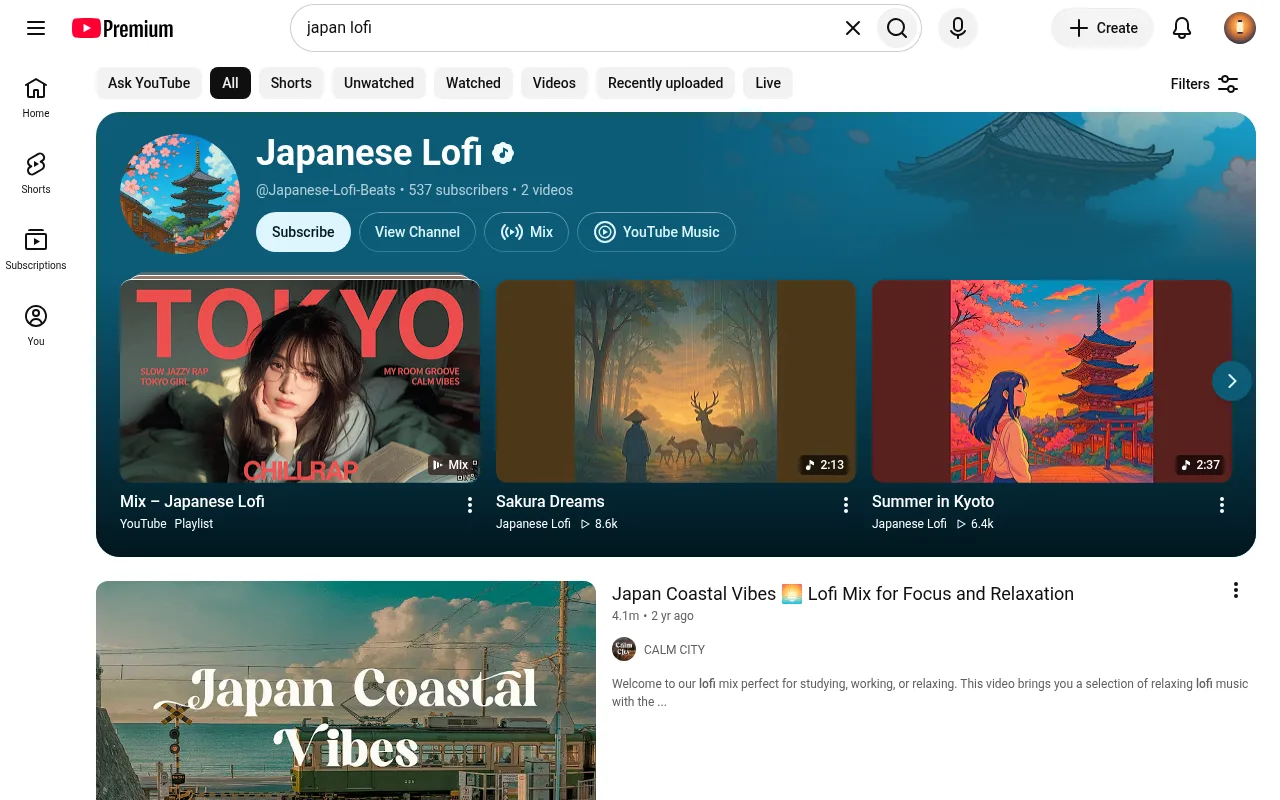
Add a word to narrow it down: "city pop" for the 1980s sound, "koto" or "shakuhachi" for the traditional touches, "rain" for night listening, or "Nujabes" for the jazzier side. A live stream is handy when you want sound for hours without picking anything.
Spotify
Spotify has plenty of Japanese-inspired playlists. A popular one is Japanese Lofi HipHop by thebootlegboy, with more than 230,000 saves. It leans towards the inspired side, with sakura, lotus and lantern titles throughout.
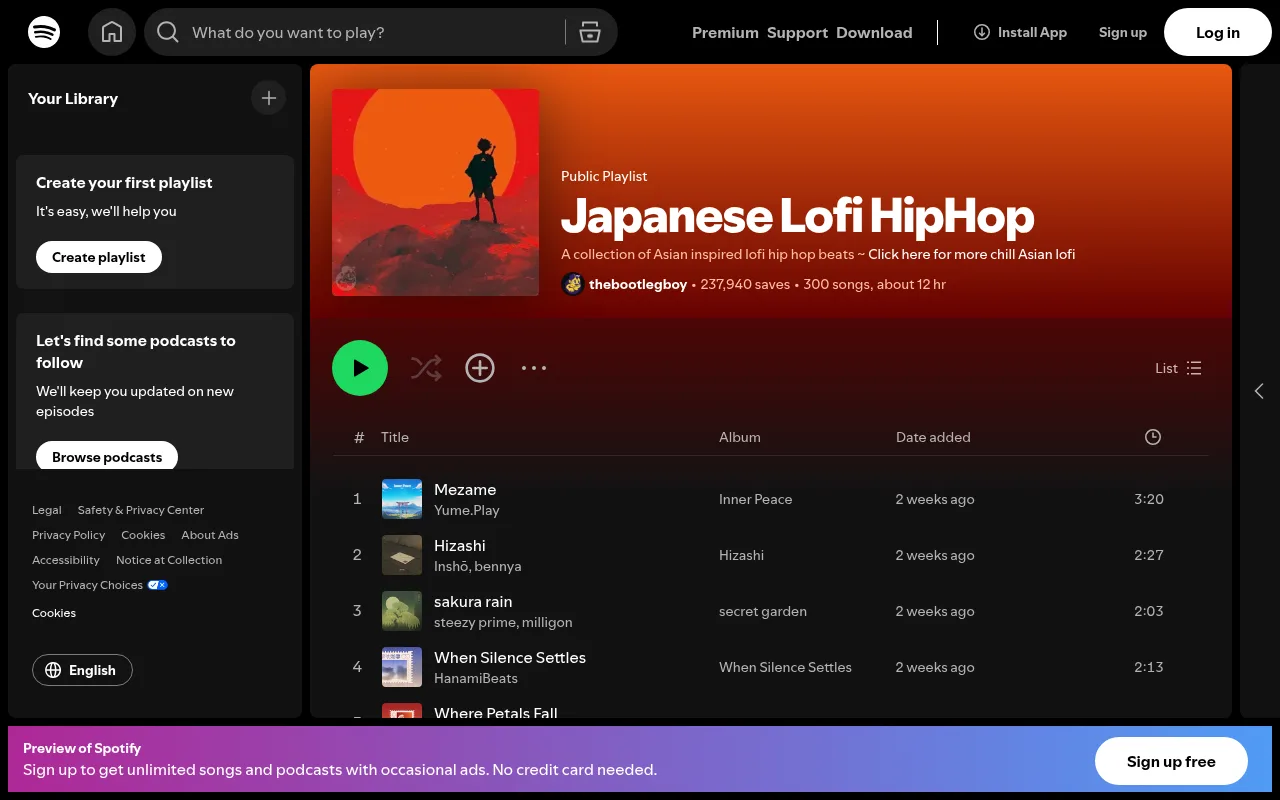
It's a good one to put on shuffle while you work. When a track catches you, open the artist's page and follow the thread from there.
Apple Music
Apple's editors run Lo-Fi Japan, a playlist of nearly 200 songs and over 8 hours of music. They describe it as "fuzzy, mellowed-out Japanese lo-fi to help shape a mood without hijacking too much attention or focus", and they update it regularly.
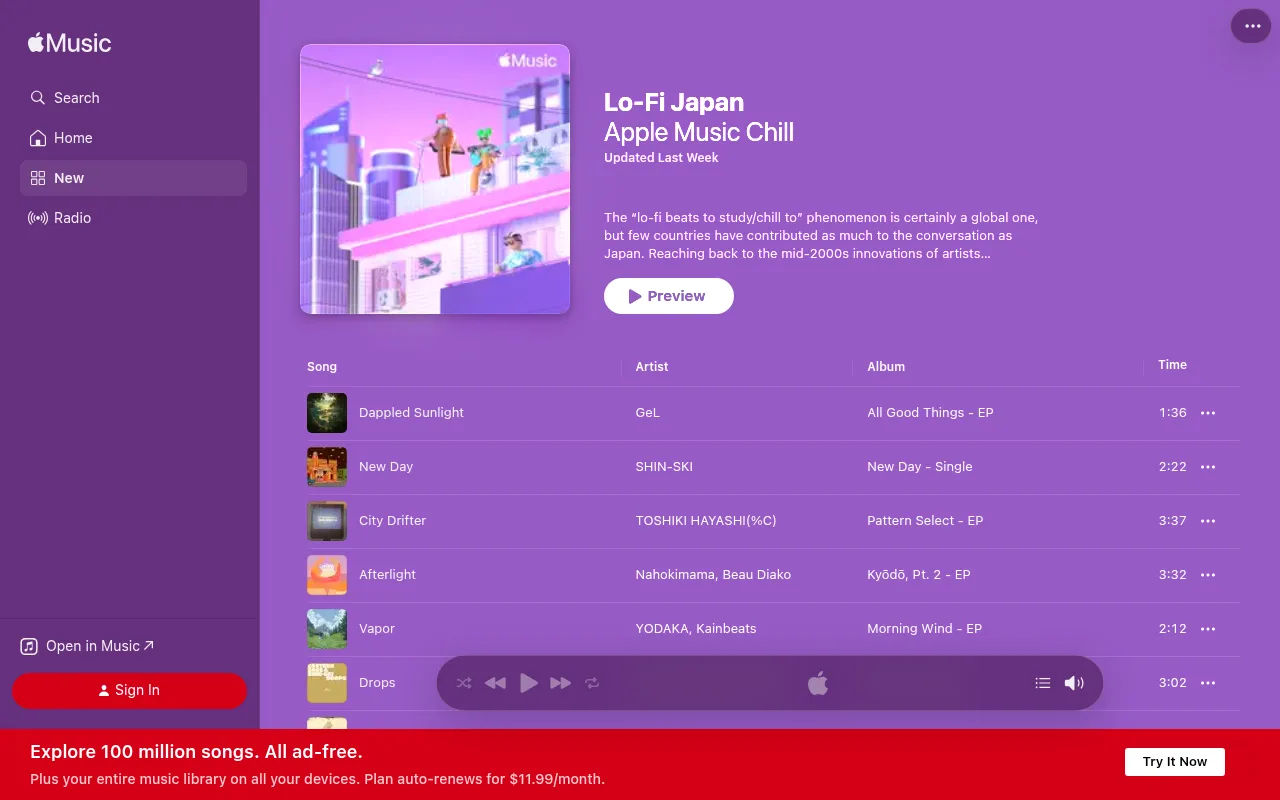
This is the one to pick if you want Japanese producers specifically. Artists on it include SHIN-SKI, GeL, Nahokimama and Komachi.
A Japan lofi listening path
If you're new to it, this order gives you the history and the range without much effort:
- Play Modal Soul by Nujabes from start to finish. It's the jazzy heart of the sound.
- Put on Apple's Lo-Fi Japan while you work. Over eight hours of Japanese producers, and it stays out of your way.
- Try "Plastic Love" and a city pop record in the evening. You'll start hearing where so many samples come from.
- Search YouTube for a koto or shakuhachi mix when you want something calmer.
- Finish with a rainy Tokyo stream at night. Rain and neon make a calm end to the day.
If the jazz side is what grabs you, my guide to lofi jazz goes further, and chillhop beats covers the brighter, more upbeat side of the same family. For using any of this to get work done, lofi for studying has more on what to play and how loud.
Run a Japan lofi channel with Chillframe
A lot of the Japan lofi you'll find on YouTube comes from faceless channels: music, a looping anime scene and no presenter. It's a growing niche, and one where a strong look carries a channel a long way.

Chillframe makes original music fresh for each video, the scene and the finished video, then publishes it to your YouTube channel. Several of its looks come straight out of the history above:
- For Tokyo nights, the Lofi Anime presets Anime Night Train and Konbini Rain, or Rainy Tokyo, a neon rooftop in the rain.
- For a city pop evening, the Citypop Anime style, with City Pop Balcony, City Pop Coast Drive and City Pop Apartment, the same balconies, coast roads and spinning records described above.
- For a country summer or a temple garden, describe your own scene in plain words, like a railway crossing at sunset.
For the sound, Instrumental with no singing suits study listeners, With vocals adds singing, and Ambience only gives you rain with no music for the rain and snow mood.
For the schedule, I'd put a city pop Series on Friday and Saturday evenings. A Series automatically makes a fresh video for each night you pick and publishes it with an optimised title, description and tags. Approve the first one; every one after that is fully hands-off.
One honest limit for this niche: the music is original, so it doesn't sample city pop records the way a lot of Japan lofi does. That's also why it's yours to use, with full commercial rights on every plan.
The Starter plan, at $19 a month, makes these as still scenes. Plus, where the town streams past the train window, starts on the Creator plan at $49 a month. My guides to building an aesthetic YouTube channel and choosing an anime AI video generator cover more of the creator side, and let me know if you'd like a hand with the first video.
Japan lofi FAQ
Is Japan lofi the same as city pop?
No. City pop is Japanese pop from the mid-1970s through the 1980s, with singers and full bands. Japan lofi often samples it, slowed down and softened under a lofi beat. If you like those samples, play the originals by Tatsuro Yamashita and Mariya Takeuchi in full.
Who is called the godfather of lofi hip-hop?
Nujabes, the Tokyo producer Jun Yamada. He made the albums Metaphorical Music and Modal Soul and much of the soundtrack to the 2004 anime Samurai Champloo, which carried his sound to fans outside Japan.
Is Japan lofi good for studying?
Yes, if you pick instrumental tracks. Apple's editors describe their Lo-Fi Japan playlist as music to help shape a mood without hijacking too much attention or focus. Tracks with Japanese vocals or rap can pull at your attention while you read, so save those for breaks.
Where can I listen to Japan lofi for free?
YouTube is the easiest place: search japan lofi for long mixes and 24/7 live streams. Spotify's free tier also plays playlists like Japanese Lofi HipHop, with ads between tracks.