Lofi Use Cases
Lofi for Focus: The Science, Playlists, and Productivity Hacks That Work
Anchor your attention, quiet digital noise, and build an automated channel using the science of low-fidelity audio.

Whether you are preparing for a difficult exam, writing lines of code, or trying to tune out a noisy office, finding the right background audio is a common challenge. Using lofi for focus has transitioned from a niche internet subculture into a scientifically documented productivity tool.
Historically, the term lo-fi refers to low-fidelity music, which intentionally embraces recording imperfections such as tape hiss, vinyl crackle, and soft textures. The roots of the genre trace back to 1950s jazz tape culture, later refined by underground hip-hop producers like Nujabes and J Dilla. Today, the genre is synonymous with massive digital communities. For instance, Lofi Girl is among the largest music-focused YouTube channels in the world, boasting 15.8 million YouTube subscribers and 420 videos as of June 2026. This massive audience grew rapidly during the study-from-home era, with the channel surpassing 10 million YouTube subscribers in 2022.
For the purposes of this guide, we define the scope of lofi for focus as instrumental lo-fi hip-hop, jazz lo-fi, and ambient study beats. Understanding how lofi music is made helps explain why these specific tracks are so effective at keeping listeners engaged. While some listeners prefer the punchier drums of chillhop vs lofi, both styles share the same core elements that quiet the mind and sustain attention. For broader context on the genre, see our complete lofi music guide.
Start your channel with any of these presets
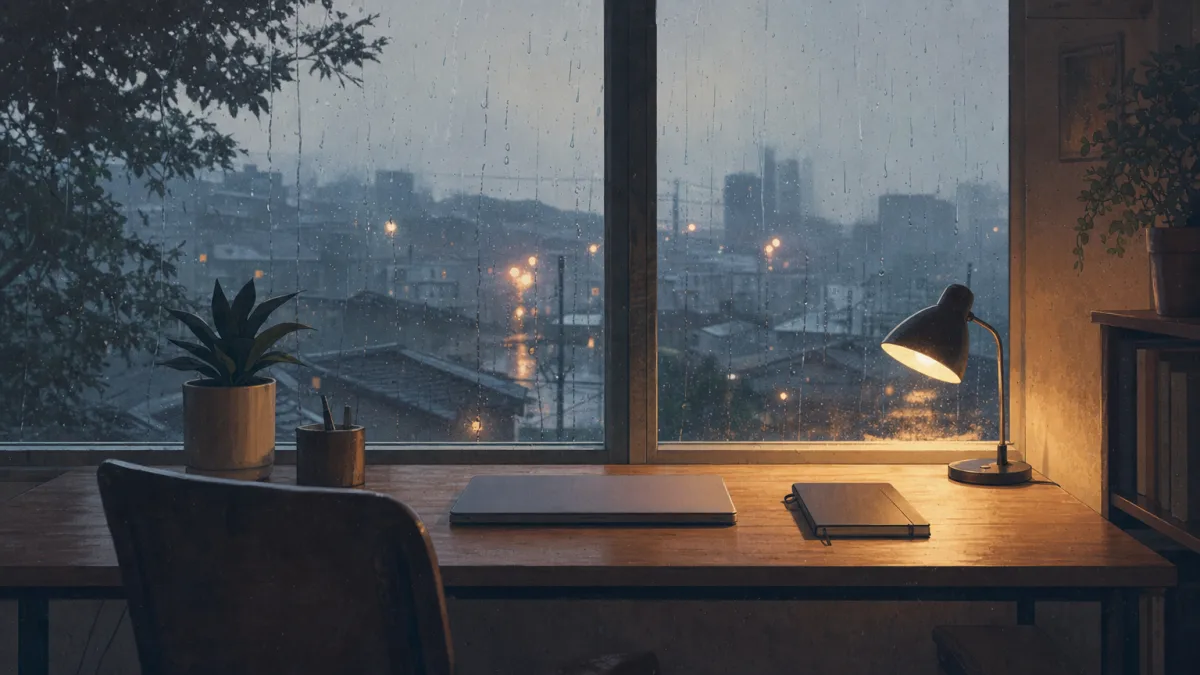 Single-task calm
Minimal desk, rain  Timed deep work
Pomodoro corner  Pooled lamplight
Night study lamp  Walled-in quiet
Library carrel  Grey-sky flow
Rainy loft deep work
What does 'lofi' actually mean (and why does it dominate focus playlists?)
At its core, lo-fi music is defined by its aesthetic flaws. In traditional music production, engineers spend thousands of dollars to eliminate background noise, hiss, and distortion. In contrast, lo-fi artists introduce these elements on purpose. They use bitcrushers, low-pass filters, and tape saturation to make digital tracks sound like they were recorded on an old cassette deck or vinyl turntable.
These acoustic imperfections serve a practical purpose. The continuous, low-level frequencies of tape hiss and vinyl crackle act as a form of auditory masking. This predictable soundscape fills the silence without demanding your active attention. Unlike pop, rock, or electronic dance music, which feature sudden dynamic shifts and dramatic build-ups, lo-fi remains remarkably flat. There are no sudden snare cracks, screeching synth solos, or unexpected vocal drops to pull your brain away from your work.
This structural predictability is why lo-fi dominates productivity streams. It provides a comfortable, rhythmic background that keeps the brain stimulated just enough to prevent daydreaming, but not enough to cause distraction. It works like digital wallpaper, designed to be felt rather than actively heard.
The science behind why lo-fi may boost focus
The psychological appeal of lo-fi music is not merely subjective. Researchers have identified several cognitive mechanisms that explain why these repetitive, low-fidelity beats help individuals stay on task.
First, the attention-division framework suggests that lo-fi beats help manage cognitive load. In a 2020 study published in the SAGE Open 2025 review, participants listening to lo-fi scored higher on divided-attention tests. The music provides a gentle, non-intrusive stream of stimulation that satisfies the brain's subconscious need for distraction, leaving the conscious mind free to focus on the primary task.
Second, lo-fi music has a direct impact on physiological stress. A pilot study cited by the Journal of Youth and Adolescence demonstrated that lo-fi significantly reduced state anxiety among listeners. This is closely linked to tempo. The typical lo-fi tempo window of 60 to 90 beats per minute aligns with the human resting heart rate. By matching this physiological rhythm, the music helps slow down a racing mind. Furthermore, a 2025 review in the Oxford Scientist notes that slow-tempo songs reduce cortisol levels, physically lowering stress hormones in the body.
Finally, the acoustic properties of lo-fi create a powerful masking effect. The intentional inclusion of low-level environmental sounds, such as rain or vinyl crackle, acts as a blanket of pink noise. This predictable soundscape dampens unpredictable environmental noises, such as traffic or office chatter, which would otherwise break your concentration. To understand how this compares to other auditory tools, you can read our comparison of lofi vs white noise for focus.
What the research actually says (and where it is mixed)
While the benefits of lo-fi are widely celebrated, empirical research presents a more nuanced picture. It is a common misconception that lo-fi music directly increases raw intelligence or cognitive capacity. Instead, the scientific consensus suggests that lo-fi is primarily an emotional and attention-management tool.
Several recent studies highlight the limitations of lo-fi. For example, a 2023 study from the University of Porto found that instrumental lo-fi did not credibly improve verbal memory, visual memory, or reading comprehension when compared to silence. Similarly, a 2025 Georgetown University study discovered that listening to popular Spotify deep focus lo-fi playlists did not positively impact mood or cognitive performance during difficult, high-stress tasks.
Furthermore, a 2024 study published in Communications Biology by the Northeastern MIND Lab revealed that targeted amplitude-modulated functional music outperformed standard lo-fi tracks on EEG attentional coupling measures. This indicates that while lo-fi is excellent for helping you get into the zone and reducing anxiety, it does not mechanically boost your brain's processing power. Its primary value lies in its ability to block external distractions and create a calm, predictable working environment.
The exact characteristics that actually matter
Not all lo-fi tracks are created equal. To optimize your study or work sessions, you must select audio that exhibits specific structural characteristics.
- Tempo: The ideal tempo for desk work falls between 70 and 85 beats per minute (BPM). For repetitive or administrative tasks, a slightly faster tempo of 80 to 90 BPM can help maintain momentum. In general, producers of the genre state that lo-fi typically falls between 65 and 95 BPM, which mirrors a relaxed cardiovascular state.
- Instrumental-only: Vocal tracks are highly disruptive to verbal processing. A 2010 study from the University of Wales demonstrated that lyrics reduce serial-recall performance because the brain naturally attempts to process the spoken words. For maximum focus, choose tracks that are entirely instrumental and avoid lo-fi with rap verses or sung choruses.
- Volume: The music must remain at a low, background level. Setting the volume too high triggers equal-loudness contour effects, where bass and treble frequencies become dominant and distracting.
- Loop length: Look for tracks built on 2-bar or 4-bar jazz or hip-hop loops. These short, predictable loops minimize cognitive surprise, allowing the music to fade completely into the background.
For creators who want to leverage these exact characteristics to build their own focus-oriented content, Chillframe provides an automated way to launch a channel. Chillframe turns a theme into a finished, schedulable lofi video. It generates original music and matching visuals, assembled and published to your YouTube channel on the cadence you set. This allows you to build a faceless channel that runs itself, generating hands-off publishing and watch-time that compounds.
The tool generates original, studio-quality lofi tracks made for your channel. When a video has multiple tracks, they blend into one gapless, continuous soundtrack. You can choose from seven themes, including study-boombap, rainy-tokyo, jazzhop, ambient-sleep, synthwave, future-garage, and citypop. Several themes carry a matched ambient texture: rain in rainy-tokyo and future-garage, a cafe hum in jazzhop, or a soft fire in ambient-sleep.
For visuals, Chillframe creates looping lofi visuals tuned to your chosen theme. The Lite tier provides static image loops, while the Plus and Ultra tiers add motion visuals, with resolutions up to 1080p and even 4K on the Ultra tier.
You can connect your YouTube channel in a single click and line up each episode's title, description, visibility, and release date on the schedule you set. The Series feature keeps your channel fed by generating fresh videos on a cadence of 1 to 7 per week. Starter supports 1 Series, Creator supports 3, while Pro and Max support unlimited Series.
A subscription model provides monthly credits (Starter has 76, Creator has 196, Pro has 396, and Max has 796). Every tier generates videos of up to 1 hour, so runtime is uniform across plans rather than a reason to upgrade. You can also start with a card-required-upfront 3-day trial with $0 due today, which offers 45 credits, Lite-only visuals, a 30-minute maximum runtime, one video, and 2 track re-rolls.
As your channel grows, Chillframe keeps widening what you can generate with expanded tiers and runtimes. The Series runs the whole channel end to end by theming, generating, scheduling, and publishing each episode on cadence. It even generates an optimized thumbnail and title for each episode, and shows you how each episode and the channel are performing through creator analytics, so you can see what is working without leaving the dashboard.
Lofi for focus by use case (persona-segmented)
To get the most out of lo-fi, you should tailor your listening habits to your specific workflow.
Students and Exam Prep
If you are studying for exams, pair lo-fi with the Pomodoro technique. This workflow typically defaults to a 25-minute focus block followed by a 5-minute break. During the focus blocks, stream a continuous, low-intensity mix to block out library noise. You can find more tailored advice in our guide on lofi music for studying.
Programmers and Software Engineers
Software development requires long periods of deep, uninterrupted logical thinking. Programmers benefit most from longer, 50-minute focus blocks paired with a slightly faster, driving tempo like synthwave or future-garage. These subgenres provide a steady, forward-moving rhythm that helps maintain coding momentum. Explore our recommendations for lofi for coding to build your ideal development soundtrack.
ADHD and Neurodivergent Focus
For individuals with ADHD, the standard advice of working in pure silence can often lead to under-stimulation and distraction. A steady lo-fi beat provides the baseline stimulation the brain requires to stay on task. If you have ADHD, prioritize tracks with a highly consistent, predictable tempo and strictly avoid any songs with unexpected vocal samples or abrupt beat switches. Learn more about optimizing your environment in our guide on lofi for ADHD.
Writers and Creative Professionals
Writing and content creation require heavy use of the brain's language processing centers. Because of this, writers must avoid any auditory input that competes for verbal working memory. Lighter jazz-lofi mixes featuring soft piano or acoustic guitar chords are ideal, as they provide emotional warmth without the heavy, repetitive percussion of traditional hip-hop beats. To explore other options, read our analysis of the best focus music of 2026.
Open-Office Workers
Working in an open office presents a constant barrage of unpredictable sounds, from keyboard clicks to distant conversations. For this environment, a lofi-nature-sound hybrid is highly effective. Combining low-fidelity beats with an ambient layer of rain or cafe sounds creates a dense acoustic barrier that masks nearby chatter.
The best lo-fi streams, playlists, and apps in 2026 (with engagement stats)
The lo-fi genre has grown tremendously over the last several years. On Spotify, there has been a 340% growth in lo-fi playlist followers since 2020. Furthermore, lo-fi listeners exhibit exceptional engagement, with a 48-minute average listening session compared to the 25-minute platform average.
The table below highlights the top-performing lo-fi streams, playlists, and applications available today:
| Stream, Playlist, or App | Platform | Key Metric or Feature | Source |
|---|---|---|---|
| Lofi Girl "beats to relax/study to" | YouTube | 20,000+ concurrent viewers on top 24/7 lo-fi channels | Water & Music |
| Chill Village "Deep Focus Lofi Mix" | YouTube | 1,485,400 views and 90.7K subscribers | YouTube Channel |
| Spotify "Lofi Study 2025" by Lofi Girl | Spotify | 428,193 saves, 237 songs (~10 hours) | Spotify |
| Pomodoro Lofi | Web App | Defaults to 25/5/15 cycle | Pomodoro Lofi |
For a curated selection of the top tracks and channels to add to your rotation, check out our guide to the best lo-fi playlists on Spotify.
When lo-fi doesn't help (limitations and edge cases)
Despite its popularity, lo-fi music is not a universal solution for productivity. There are specific scenarios and edge cases where listening to lo-fi can actually hinder your performance.
For highly complex verbal tasks, such as writing a technical essay, solving advanced mathematical proofs, or memorizing vocabulary, any form of background music can introduce cognitive interference. In these moments, the brain's phonological loop is fully occupied, and even instrumental beats can compete for limited working memory resources.
Additionally, the repetitive nature of the genre can lead to mental fatigue over long periods. As noted in the Calm Blog, which outlines the documented benefits of lo-fi music, the continuous looping of simple chord progressions can eventually become monotonous and drain your energy rather than sustain it.
Volume control is another common pitfall. If the volume is set too high, the low-frequency bass notes can cause physical fatigue and headaches, flipping the music from a helpful tool into a direct distraction. Finally, some individuals simply perform better in complete silence or with unstructured auditory inputs like pink noise.
Frequently Asked Questions
What BPM is best for focus with lofi? The ideal tempo for lofi for focus is between 70 and 85 beats per minute (BPM). This tempo range aligns closely with the human resting heart rate, helping to lower stress levels and create a calm, steady working environment. For repetitive or administrative tasks, a slightly faster tempo of 80 to 90 BPM can help maintain your momentum.
Is lofi good for ADHD focus? Yes, lo-fi music is highly effective for individuals with ADHD. The consistent, predictable rhythm provides a gentle baseline of stimulation that satisfies the brain's search for distraction without overwhelming it. To maximize focus, individuals with ADHD should select strictly instrumental tracks with highly consistent tempos and avoid songs with sudden beat drops or unexpected vocal samples.
How long should I listen to lofi while studying? It is best to align your lo-fi listening sessions with structured productivity intervals, such as the Pomodoro technique. This method typically utilizes 25-minute focus blocks followed by a 5-minute break, or 50-minute deep work sessions followed by a 10-minute break. Taking regular breaks prevents mental fatigue and keeps the repetitive music from becoming monotonous.
Do lyrics hurt focus with lofi? Yes. Academic research shows that lyrics significantly impair focus and verbal memory. When you listen to music with spoken words, your brain naturally attempts to process the language, which directly competes with reading, writing, or logical thinking tasks. For optimal cognitive performance, always choose instrumental-only tracks.
Is lo-fi music actually relaxing or is that a placebo? The relaxing effects of lo-fi music are grounded in real physiological responses. The slow tempo of 60 to 90 BPM has been shown to reduce cortisol levels and lower heart rates. Additionally, the predictable structure of the loops and the presence of ambient background textures, like vinyl crackle, help mask unpredictable environmental noises, reducing anxiety and creating a sense of safety.
Finding the right auditory setup is a personal process of trial and error. By understanding the structural characteristics that make lo-fi effective, you can build a highly customized productivity routine that keeps you calm, clear, and consistently in the zone.