Lofi Use Cases
The Science of Productivity: Finding the Best Lofi for Working
Skip the playlist hunt and build a consistent, low-arousal audio backdrop that keeps your desk work on track.

The modern remote workday is filled with digital noise, notifications, and open-plan distractions. To combat this cognitive overload, millions of knowledge workers are turning to a specific auditory tool: lofi for working. According to data from Gitnux, 40% of users stream lo-fi tracks specifically during daytime work hours between 8:00 AM and 6:00 PM. This shift is particularly pronounced among young professionals, with 65% of lo-fi listeners falling into the 18 to 24 age bracket globally. But what makes this aesthetic blend of dusty drum loops and warm Rhodes chords so effective for professional execution?
Understanding the mechanics behind this musical genre reveals how its tempo and texture steer attention rather than simply filling silence. By dissecting the acoustic properties of these tracks, professionals can design a personalized workday soundtrack that maintains executive function without causing cognitive fatigue.
Start your channel with any of these presets
 Bright morning start
Home-office morning  Café hum
Café laptop afternoon  Midday productivity
Standing-desk loft  Evening push
Dusk deadline 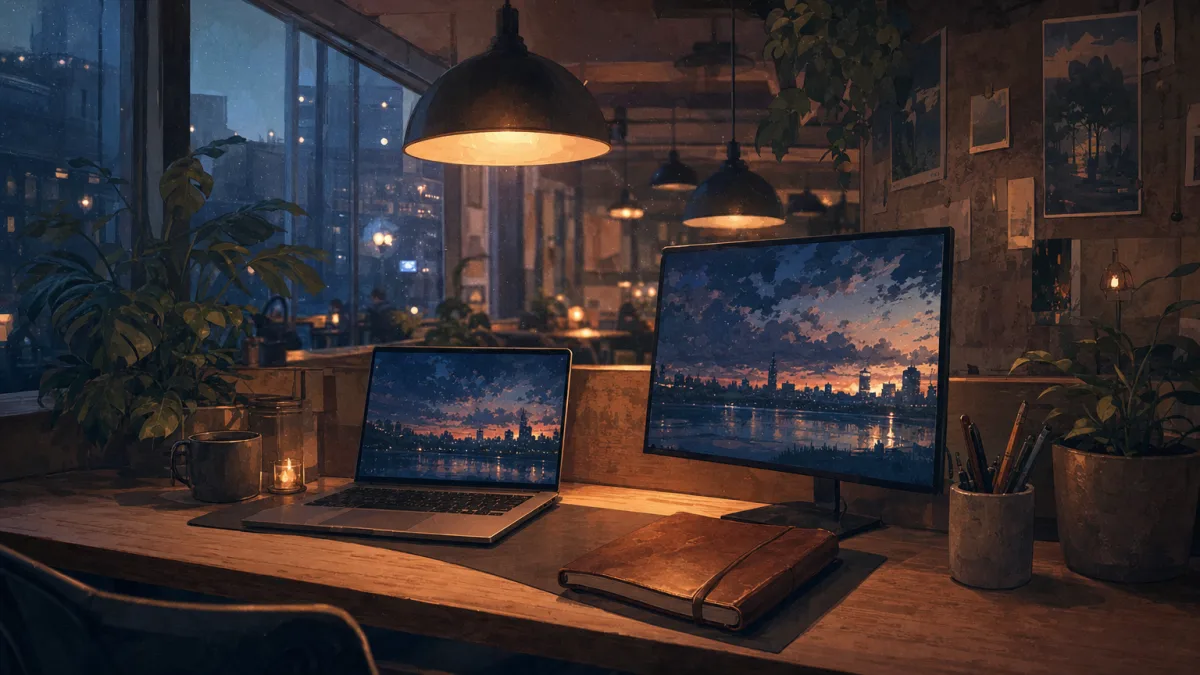 Shared-space calm
Co-working corner
Why lofi for working became its own category in 2026
For years, background instrumental music was grouped into a single bucket. However, the demands of remote work have split the genre. While students might seek out music to help them absorb textbooks, professional knowledge work requires a different cognitive profile. Listening to lofi for studying often focuses on memory retention, whereas professional tasks require sustained attention and low emotional load to prevent monotony-induced drowsiness.
During a typical eight-hour workday, a software engineer or copywriter must transition between high-intensity coding, answering emails, and attending virtual meetings. Standard commercial pop music introduces sudden changes in volume and lyrical narratives that hijack the brain's attention systems. In contrast, specialized work-focused lofi maintains a predictable, steady structure. For instance, backend developers often thrive on consistent loops at 75 Beats Per Minute (BPM), while designers doing creative layout work benefit from a wider dynamic range at 60 to 70 BPM. This task-specific taxonomy ensures that your audio background supports your immediate cognitive load instead of fighting against it.
The science: why lo-fi helps you work (and what hurts)
The effectiveness of lofi music is not a placebo effect. It is rooted in how the human auditory cortex processes sound. Lofi tracks typically sit in a tempo sweet spot of 70-90 BPM, which closely matches the resting heart rate of a healthy adult. A study published in PLOS ONE in 2017 found that music in the 60-80 BPM range produced the highest sustained attention scores among test subjects.
The absence of vocals is another critical factor. When music contains speech, the brain's phonological loop automatically attempts to decode the words. This creates direct competition for your verbal working memory. Research from the University of Wales in 2010 demonstrated that listening to lyrics reduces serial recall performance by 12-15% compared to listening to purely instrumental tracks.
Furthermore, the signature elements of lofi (such as vinyl crackle, tape hiss, and ambient environmental hums) function as auditory masking. This low-level white noise covers sudden environmental sounds, like a slamming door or a car horn outside, preventing the startle reflex from triggering cortisol spikes. According to a peer-reviewed study in SAGE Open by Dsouza et al. lo-fi consumption may intensify positive affect, accelerate goal attainment, and improve health and performance, while demonstrating that listening to lo-fi during learning tasks can reduce academic stress even more than silence. This is supported by clinical findings in the Journal of Adolescence, where participants listening to lofi experienced significant reductions in state anxiety, creating a calm mental environment optimized for focused execution.
Best lo-fi for deep focus work (the 80-BPM sweet spot)
When you need to block out the world for a multi-hour sprint, your music needs to be highly predictable. The ideal tempo for this state is 80 BPM, which provides enough rhythmic drive to keep the brain alert without inducing anxiety.
For these deep sessions, the classic Lofi Girl channel remains a staple. As of June 30, 2026, the channel has accumulated over 15.84M subscribers and 2.63B total views. Their curated Spotify editorial playlist, Lofi Study 2026, has reached over 566,962 saves and offers an excellent catalog of tracks that maintain a steady 80-BPM tempo.
If you prefer a highly visual, low-friction interface on your desktop, lofi.cafe provides dedicated virtual rooms designed specifically for remote workers. For those who want curated catalog depth without the social chat features of YouTube, Sid's Lofi and Chill Beats playlist on Spotify is a reliable option. If you want a strict, tempo-locked experience, the Spotify playlist LoFi Hyperfocus and Relax (80 BPM) keeps every single track locked to that exact frequency, preventing any sudden shift in your focus. To explore more options, see our guide to lofi for focus.
Build a self-publishing channel that grows while you work
The steady daytime demand for lofi for working has opened a clear opportunity for digital creators. With millions of professionals streaming these tracks every single day, building a dedicated lofi channel can establish a valuable digital asset. Chillframe provides the exact tools needed to build a faceless channel that runs itself, completely hands-off.
Instead of spending hours in complex editing timelines or trying to learn music production, Chillframe allows creators to set up a recurring series that keeps their channel fed with fresh content automatically. The platform generates original, studio-quality lofi tracks that blend into one gapless, continuous soundtrack. It also creates matching, looping lofi visuals tuned to seven distinct themes, including study-boombap, rainy-tokyo, jazzhop, ambient-sleep, synthwave, future-garage, and citypop. Several of these themes carry a matched ambient texture: rain in rainy-tokyo, a cafe hum in jazzhop, or a soft crackling fire in ambient-sleep.
The system delivers one finished, ready-to-publish video that loops cleanly to your chosen runtime. Users can generate videos of up to 1 hour on every tier, since video length is uniform across plans rather than a paid upgrade. These videos are delivered in crisp 1080p resolution across all tiers, with 4K resolution available on the Ultra visual tier.
To automate your channel growth, you can connect your YouTube channel in a single click. Chillframe automatically publishes each finished episode straight to your connected channel on the exact schedule you set. The platform also generates an optimized thumbnail and title for each video, ensuring your content is click-ready without any manual design work. Once published, you can monitor your watch-time and growth signals directly from the integrated creator dashboard to see exactly what is working.
For creators who want to test the workflow, Chillframe offers a card-required-upfront 3-day trial, with $0 due today, that includes 45 credits, 2 track re-rolls, Lite-only visual generation, a 30-minute maximum video runtime, and a single video export. This lets you see how automated publishing builds a channel over time before committing to a full monthly subscription tier.
Best lo-fi for meetings, email and low-attention work
Not all professional tasks require deep, isolated concentration. Administrative work, such as clearing out an inbox, organizing spreadsheets, or preparing for routine status meetings, requires a lighter, more upbeat backdrop.
For these tasks, look for lofi tracks that introduce slightly faster tempos of 80 to 90 BPM with soft drum patterns. Playlists like Klangspot Recordings' Lofi Music for Work Productivity on SoundCloud or the productive work lofi playlist on Spotify provide a cheerful, steady rhythm that keeps energy levels high.
However, if you are drafting important emails or reviewing contracts, it is vital to keep vocal tracks completely off. Even faint, whispered vocals can trigger cognitive interference, pulling your attention away from the text on your screen. If you find yourself hitting a wall of boredom during repetitive tasks after 90 minutes, try swapping your standard lofi for a livelier jazzhop blend. The inclusion of jazz piano chords and brass motifs provides just enough novelty to stave off drowsiness without breaking your workflow.
Best lo-fi for coding and analytical work
Software engineering and complex data analysis demand high levels of working memory. In these fields, the right background audio can directly impact performance.
A classic study by Lesiuk in 2005, published in the Psychology of Music, found that when developers listened to music, their task completion time and work quality improved. This positive effect was particularly strong during routine implementation phases. For developers, the ideal soundtrack consists of tracks in the 70 to 75 BPM range with highly consistent, predictable loops. This narrow dynamic range prevents sudden attention resets, allowing you to maintain a deep state of flow while writing code.
However, senior engineers should note a key caveat: when performing highly complex, non-routine tasks (such as deep debugging or refactoring a legacy system), any auditory input can occasionally overload working memory. In those specific scenarios, switching to silence or very low-frequency ambient sounds may be necessary to free up maximum cognitive capacity. For a deeper look at this specific use case, read our guide on lofi for coding.
Best lo-fi for writing and creative work
Creative writing, copywriting, and strategic planning require a different mental state than analytical debugging. To generate original ideas, the brain needs to access a state of relaxed alertness, which is associated with alpha brainwave activity.
To encourage this state, creative professionals should look for lofi tracks in the 60 to 70 BPM range that feature a wider dynamic range and richer melodic motifs. This tempo matches the classic Baroque cadence. A study published in the Journal of the Royal Society of Medicine in 2007 showed that listening to 60 BPM Baroque music increased alpha brainwave power by an average of 6%.
While lofi is highly effective, a 2023 study cited by Mubert revealed that students listening to classical music scored approximately 2.75% higher on comprehension and math assessments than those listening to lofi, though both groups vastly outperformed those working in complete silence. For writing sessions that require intense verbal comprehension, try blending your lofi playlist with occasional classical movements to maximize your creative output.
Best lo-fi if you work from home with ADHD
For remote workers with Attention Deficit Hyperactivity Disorder (ADHD), maintaining focus in an unstructured home environment is a constant challenge. Standard commercial music or talk radio can easily cause distractions.
A clinical review by Dr. Chris Mosunic for Calm in November 2025 highlights that lo-fi is highly beneficial because it skips the lyrics and focuses on rhythm. Because it lacks abrupt changes or lyrics, it can be less distracting than other music genres. This consistent, predictable rhythm acts as an anchor for an under-stimulated ADHD brain, providing a steady stream of low-level dopamine without hijacking executive control.
To minimize distraction, remote workers with ADHD should avoid active playlist management. Constantly skipping tracks on Spotify or searching for new videos on YouTube can quickly lead to procrastination. Using a minimalist web application like lofi.cafe, or setting up a single, long-duration stream, removes the temptation to fiddle with controls. This allows you to set your audio once at the start of the day and let it run undisturbed.
Where to listen: YouTube vs Spotify vs lofi.cafe vs apps
Choosing the right platform for your workday depends on your hardware setup, your need for visual aesthetics, and your internet connection. The lo-fi ecosystem is split across several major platforms, each offering distinct advantages for different working styles.
According to industry statistics from Gitnux, YouTube is the dominant force in the market, hosting 80% of lo-fi content globally, with 70% of those views occurring on mobile devices. Spotify represents approximately 20% of lo-fi streams but supports an ecosystem of 40 million playlist followers, making it the preferred choice for offline listening during commutes or in areas with limited bandwidth.
| Platform | Primary Audience Share | Best Use Case | Key Source |
|---|---|---|---|
| YouTube | 80% global lo-fi market | Visual-aesthetic desktop focus | Gitnux |
| Spotify | 20% global lo-fi market | Offline listening and mobile commutes | Gitnux |
| Lofi.cafe | Specialized niche | Low-friction browser playback | lofi.cafe |
Verdict: If you work with multiple monitors and enjoy having a relaxing, looping visual on one screen, YouTube is the clear winner. For those who want high-quality audio without any video bandwidth requirements, Spotify's editorial playlists offer the best curation. If you want a zero-click, beautifully designed web app that starts playing music the moment you open it, lofi.cafe is the ideal choice for a busy workday.
Frequently Asked Questions
What BPM is best for working with lo-fi? The optimal tempo for professional focus is between 70 and 90 BPM. For highly analytical tasks like coding, a slightly slower and highly consistent tempo of 70 to 75 BPM is ideal to prevent cognitive distraction. For creative writing or brainstorming, a tempo of 60 to 70 BPM helps encourage alpha brainwave activity, while a steady 80 BPM is highly recommended for individuals with ADHD who need a consistent rhythm to stay anchored.
Does lo-fi actually help productivity? Yes, peer-reviewed research supports this. A 2025 study published in SAGE Open by Dsouza et al. found that listening to lo-fi can reduce stress even more than silence while intensifying positive affect and accelerating goal attainment. The predictable rhythm and lack of vocals allow the brain to maintain high levels of sustained attention without cognitive fatigue.
Is lo-fi for working the same as lo-fi for studying? While they share a similar acoustic aesthetic, they serve different cognitive functions. Studying often requires high levels of verbal memory retention, making completely instrumental tracks essential. Working often involves a mix of administrative tasks and deep focus, meaning professionals can benefit from slightly more energetic tempos, like jazzhop or synthwave, to prevent drowsiness during long, repetitive workdays.
Is there a downside to listening to lo-fi while working? The primary downside is monotony-induced drowsiness. Because lofi is highly predictable, listening to it for more than 90 consecutive minutes can cause your brain to habituate to the sound, leading to a drop in alertness. To avoid this, it is recommended to take short breaks or temporarily switch to a genre with a wider dynamic range, such as classical music or upbeat jazz, before returning to your focus playlist.
Designing your ultimate focus environment
Designing the perfect auditory environment is one of the easiest ways to upgrade your daily productivity. By aligning your background music with the specific cognitive demands of your tasks, you can sustain deep focus, reduce stress, and make your working hours far more enjoyable. Whether you are tuning into a classic 80-BPM playlist on Spotify or building your own automated, self-publishing lofi channel to share your favorite sounds with the world, the science is clear: matching tempo to the task steadies your attention across the workday.