Lofi Use Cases
The Science of Lofi for Coding: How Low-Fidelity Beats Optimize Developer Focus
Discover the best programming soundtracks and learn how to build your own automated channel to capture passive developer traffic.
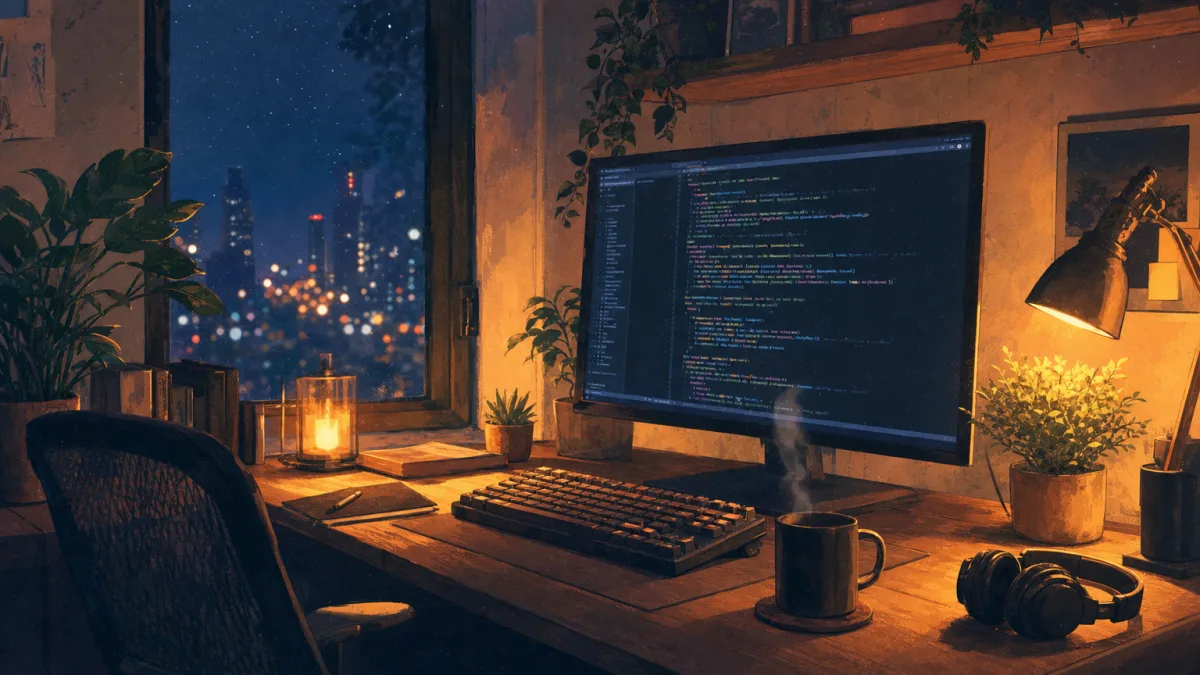
Start your channel with any of these presets
 Deep-night flow
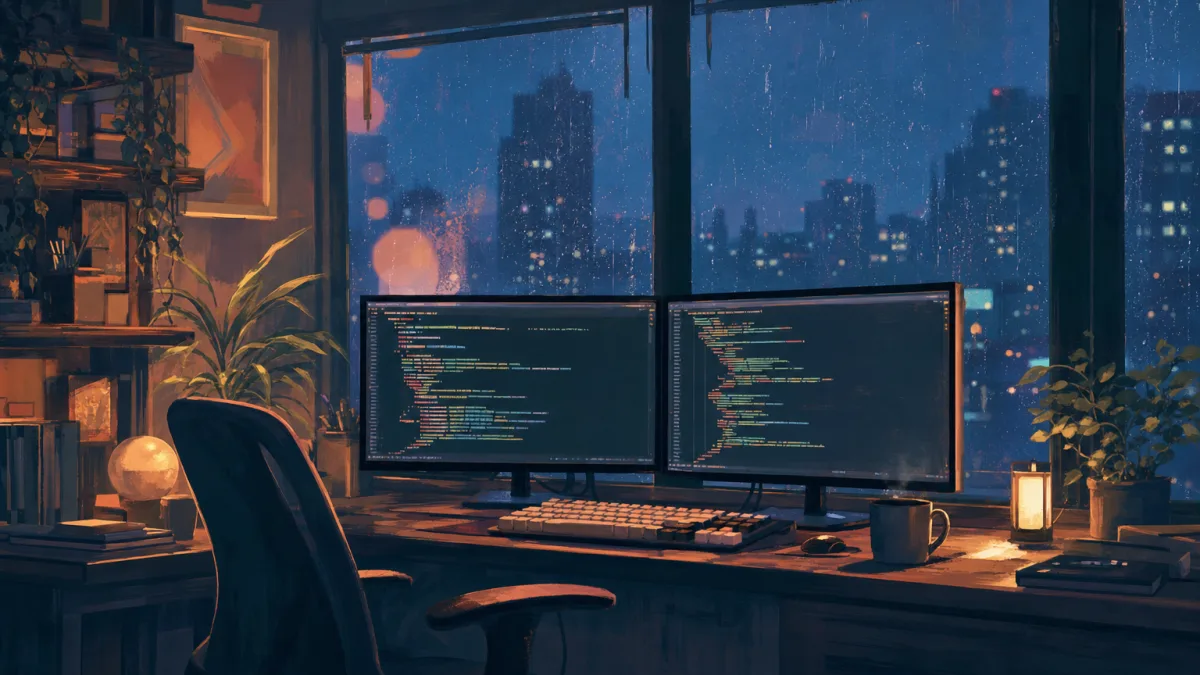
Dual-monitor midnight 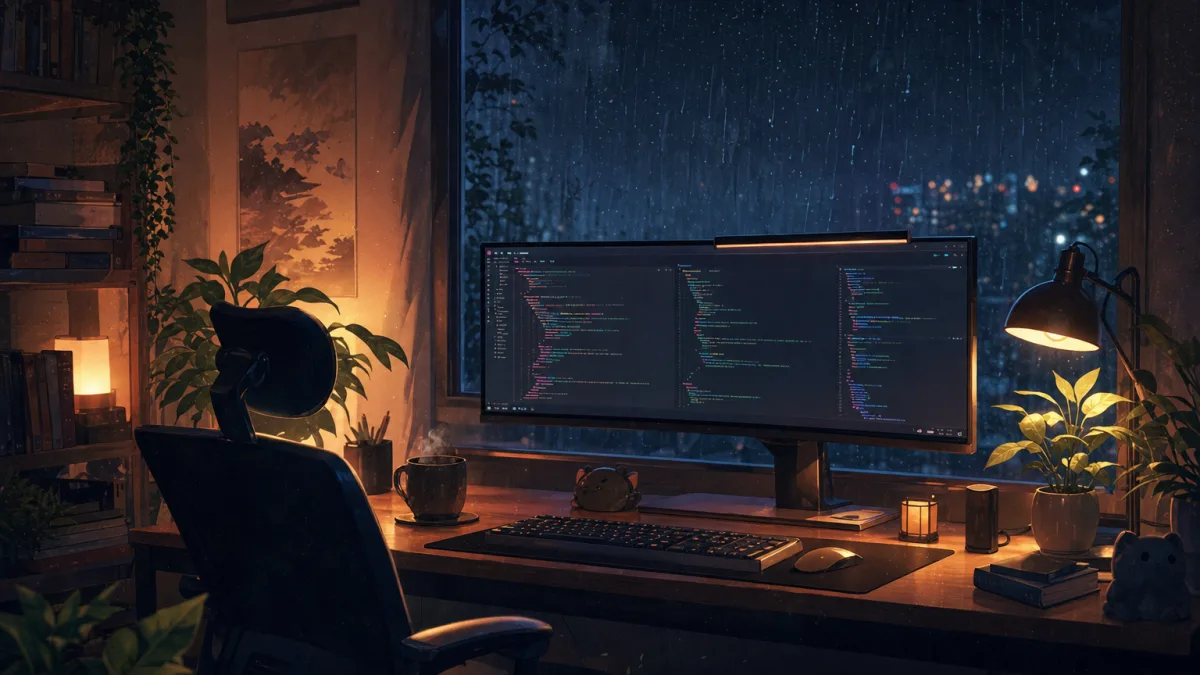 Rain on the glass
Rainy IDE glow 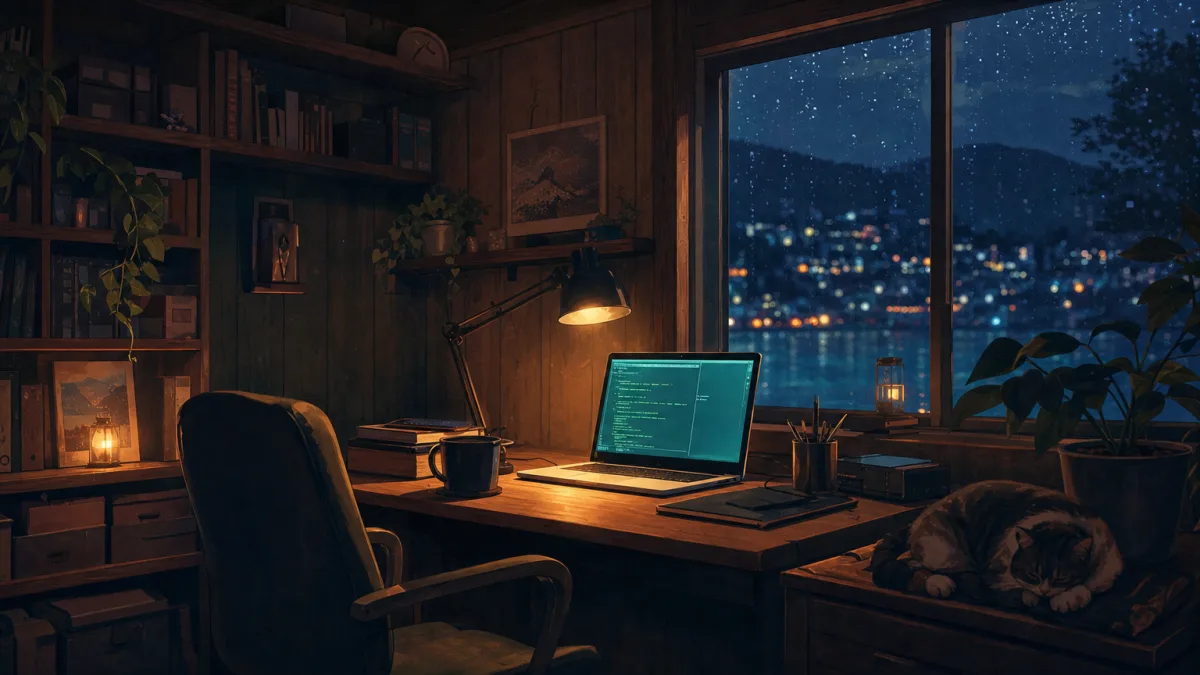 Wood + teal
Terminal cabin 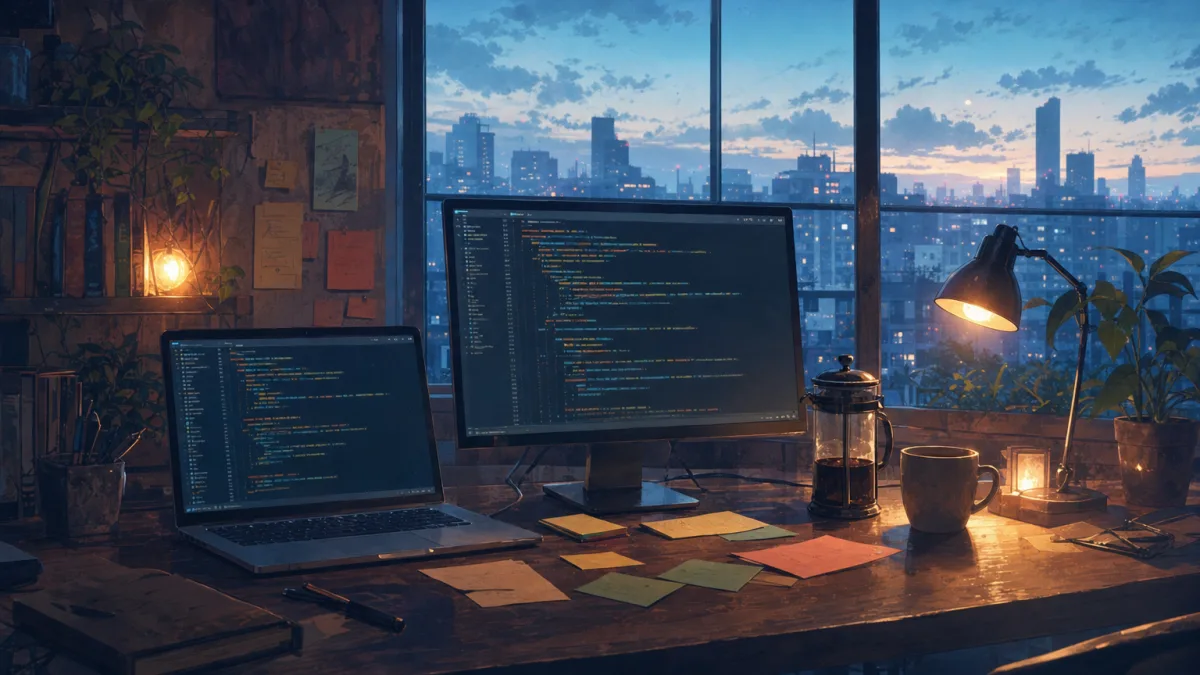 Cool first light
Dawn loft build 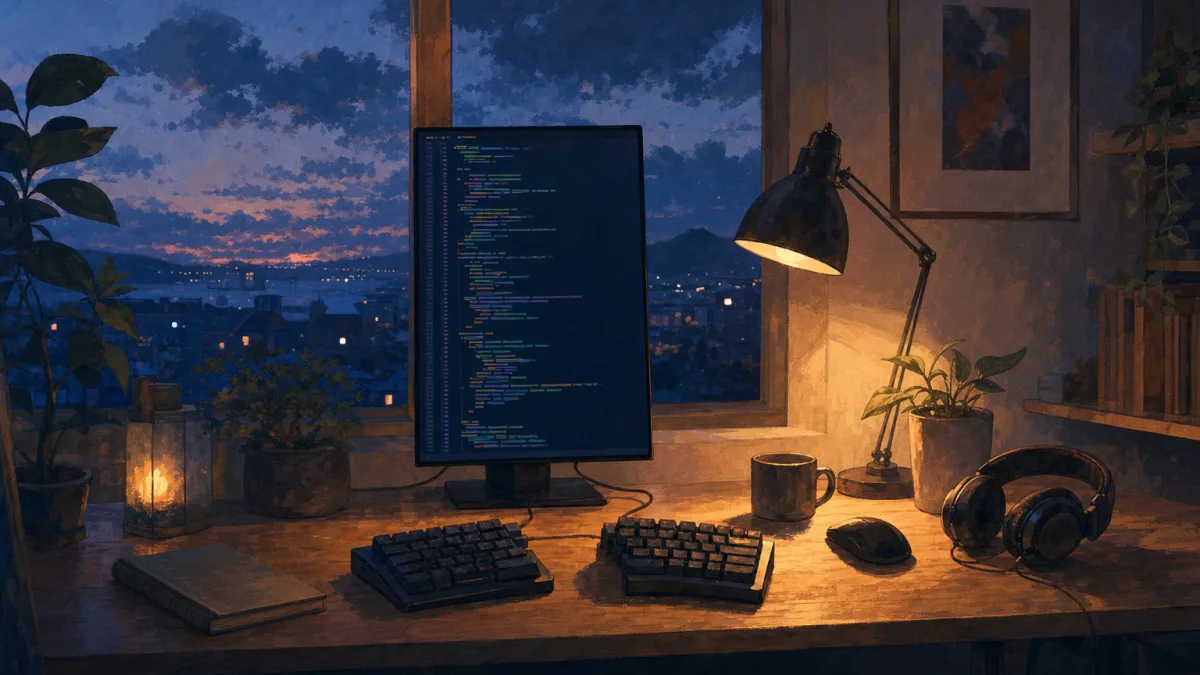 Evening session
Split-keys dusk
What Is Lo-fi Hip Hop (and Why It Became the Developer's Soundtrack)
Software developers frequently turn to lofi for coding to block out office noise and maintain cognitive endurance during long terminal sessions. To understand this phenomenon, one must distinguish between general low-fidelity (lo-fi) recording and the modern lo-fi hip hop genre. Classic lo-fi refers to any music where technical imperfections, such as tape hiss, environmental noise, or vinyl crackle, remain audible. Lo-fi hip hop, however, pairs these vintage textures with relaxed, hip-hop-derived drum patterns operating strictly between 60 and 90 beats per minute (BPM).
This specific auditory aesthetic traces its lineage back to the French YouTube channel ChilledCow, which launched in 2017 and rebranded to Lofi Girl in 2021. Featuring the iconic anime mascot Jade studying at her desk, this channel pioneered the 24/7 "beats to study/relax to" livestream format. As of June 2026, the Lofi Girl channel alone has 15.8 million YouTube subscribers and over 2.608 billion cumulative views. The broader lo-fi genre generates approximately $100 million in yearly revenue across streaming royalties, physical merchandise, and digital advertising.
Why Lo-fi Works for Coding, The Lesiuk (2005) Study Explained
The preference for background music during software development is not merely a cultural trend; it is supported by empirical evidence. A foundational study by Teresa Lesiuk, titled "The effect of music listening on work performance" and published in the journal Psychology of Music, examined how background audio influences professional output.
The methodology of the Lesiuk 2005 study tracked 56 software developers (41 male, 15 female) from 4 companies across 2 Canadian cities over a continuous five-week period in their actual office environments. Lesiuk measured state positive affect, work quality, and time spent on tasks under varying music conditions.
The research yielded several critical findings regarding developer productivity:
- State positive affect and quality-of-work were lowest when no music was provided.
- The longest time-on-task occurred when music was removed, indicating that music helped developers complete tasks faster.
- The strongest productivity lift occurred during routine implementation tasks, where repetition and moderate cognitive load dominated.
- Developers voluntarily abandoned music during hard logic work, choosing silence when solving complex, novel problems.
For software engineers, these findings offer a clear operational blueprint. Lo-fi hip hop earns its place during standard Create, Read, Update, and Delete (CRUD) operations, basic refactoring, and repetitive typing stretches. When the task shifts to debugging a highly complex, unfamiliar algorithm or designing a system architecture from scratch, developers should switch to absolute silence or non-rhythmic ambient drone to free up maximum working memory.
The Anatomy of a Perfect Coding Lo-fi Track
Not all lo-fi music is optimized for software engineering. A track must meet specific structural criteria to serve as a concentration aid rather than a cognitive distraction.
First, the tempo must remain strictly within the mid-tempo range of 60 to 90 BPM. This tempo range aligns with a relaxed resting heart rate and matches a steady, non-frenzied typing cadence. Beats that exceed 100 BPM can induce physical restlessness, while beats below 50 BPM can induce drowsiness.
Second, the mix density must remain exceptionally stable. A perfect coding track utilizes a repetitive chord loop, often repeating a simple two-to-five chord progression, such as a jazz-derived ii-V-I sequence. Melodic movement must be minimal, preventing the brain from tracking a complex narrative arc.
Third, the auditory texture must rely on instrumental arrangements. The track should feature soft drum patterns, such as dampened kick drums and brushed snares, layered over intentional tape hiss and vinyl crackle. Crucially, vocal lines and lyrics must be entirely absent, as human speech actively competes for the verbal working memory needed to parse code syntax.
Finally, the dynamic range must remain narrow and gentle. There should be no sudden volume spikes, loud choruses, or unexpected bass drops. Because developers naturally abandon music during cognitive spikes, any sudden auditory shift will break the flow state and force a manual context switch.
12 Best Lofi Channels, Playlists & Stations for Coding (Playable)
Here is a curated selection of twelve highly rated lofi channels, playlists, and stations favored by software engineers worldwide.
- Lofi Girl - beats to relax/study to: The genre's reference channel, available as a 24/7 YouTube stream, a mirrored Spotify playlist, and a 12-hour, 300-song Apple Music playlist.
- Code-Fi by The AMP Channel: A widely shared YouTube mix published on April 24, 2020, with over 8.95 million views and 129,000 likes from developers.
- Code-Fi #2 by The AMP Channel: The direct follow-up mix, offering a slightly darker, late-night coding aesthetic.
- Chillhop Music - beats to code to: A dedicated playlist curated by the Chill Station profile on Spotify, focusing on jazzy hip-hop loops.
- Perfect Lo-Fi playlist for coding and programming: A highly saved Spotify playlist (ID: 56OXD5Azh5g9q4bZTQh1el) specifically compiled for software development.
- Lofi Coding | Focus & Deep Work (Instrumental): A Spotify compilation designed to maintain concentration during long sprint cycles.
- Joma Tech - Code and Chill: A popular developer-vouched playlist curated by tech creator Joma Tech, designed specifically for software engineers.
- Chill Playlister - Lo-Fi Coding, Code-Fi: A popular, continuous set hosted on SoundCloud for browser-based listening.
- 90s Chill Lofi: A retro-focused playlist featuring heavy tape saturation and boom-bap drum patterns, popular for legacy system maintenance.
- Super Mario Lofi HipHop: A nostalgic, game-inspired playlist that blends classic Nintendo melodies with soft lofi drums.
- Disney Lofi Mix: A collection of familiar childhood melodies re-imagined as instrumental lofi beats, helpful for low-stress administrative tasks.
- Animal Crossing + Rain: A niche favorite combining the relaxing soundtracks of Animal Crossing with a continuous ambient rain generator.
To help you select the ideal auditory environment for your next sprint, the table below compares the leading lo-fi formats based on platform, primary style, and cognitive fit.
| Source / Channel | Platform | Primary Style | Cognitive Fit | Source / Reference |
|---|---|---|---|---|
| Lofi Girl | YouTube / Spotify | Jazzy / Boom-Bap | Moderate focus, routine coding | Wikipedia (2026) |
| Code-Fi (AMP Channel) | YouTube | Late-night / Synth | Deep work, terminal sprints | AMP Channel (2020) |
| Joma Tech | Spotify | Chill / Minimalist | General programming, debugging | Nicole Tirado (2023) |
| r/LofiHipHop Recs | VS Code Extension | Mixed Instrumental | Lightweight, integrated focus | r/LofiHipHop Community |
Verdict: For general coding sessions, the continuous nature of the Lofi Girl 24/7 stream provides the most reliable, interruption-free background. However, for late-night terminal work or intense debugging, the dark, synthesized tones of Code-Fi by The AMP Channel offer a more focused, immersive atmosphere.
To build your own custom environment, you can configure your IDE alongside a laptop music playlist to manage your audio without interrupting your terminal workspace.
Launching Your Own Lofi Channel with Chillframe
If you are a developer looking to reach this audience, your own faceless lofi channel is a low-maintenance way to build steady, compounding watch-time. With Chillframe, you can launch a faceless YouTube channel that runs itself. Instead of spending hours in video editing software or managing complex rendering timelines, Chillframe handles the entire process. It generates original, studio-quality lofi music and matches it with looping visuals tailored to your chosen aesthetic, delivering a finished video directly to your connected YouTube channel on a schedule you define.
You can organize your channel using a Series, which keeps your channel fed by generating fresh videos automatically. A Series runs on a recurring cadence, publishing completed episodes straight to your YouTube channel. To make each upload click-ready, Chillframe generates an optimized thumbnail and title for each episode, and you can monitor your growth signals directly through creator analytics in the dashboard.
Every tier generates videos of up to 1 hour of continuous music, so runtime never depends on what you pay. Chillframe scales to match your channel through Series count and visual fidelity instead. You can choose from seven distinct themes, including study-boombap, rainy-tokyo, jazzhop, ambient-sleep, synthwave, future-garage, and citypop. Several themes carry a matched ambient texture: rain in rainy-tokyo and future-garage, a cafe hum in jazzhop, or a soft fire in ambient-sleep. All tiers deliver crisp 1080p resolution, with 4K resolution available on the Ultra visual tier. Anyone can start with a card-required-upfront 3-day trial, $0 due today, which provides 45 credits and 2 track re-rolls to generate a single, Lite-only visual loop with a 30-minute maximum runtime.
When Lofi HELPS vs When It HURTS Your Code
Using background music is a tactical choice that must adapt to the specific task you are executing.
When Lofi HELPS
Lofi music is highly beneficial during tasks that require steady, repetitive execution with moderate cognitive load.
- Routine Implementation and CRUD Operations: Writing standard boilerplate, setting up database schemas, and writing basic endpoints.
- Refactoring and Linting: Cleaning up code structure, resolving simple compiler warnings, and running formatters.
- Writing Unit Tests: Creating standard test assertions and mocking dependencies.
- Documentation and Code Reviews: Reviewing pull requests and writing markdown documentation, which fit the "moderate cognitive load" conditions identified in the Lesiuk 2005 study.
To structure these productive periods, you can pair your music with a pomodoro coding music routine to establish highly focused typing intervals.
When Lofi HURTS
Conversely, lofi music can actively degrade performance during tasks that require high-intensity logical reasoning.
- Novel Algorithm Design: Writing complex logic, optimizing performance bottlenecks, or solving whiteboard-style problems.
- Debugging Unfamiliar Codebases: Stepping through a complex stack trace or diagnosing a race condition in a legacy system.
- Reading Unfamiliar Code: Reading through a foreign codebase for the first time to understand its architecture.
During these high-intensity phases, developers typically abandon music voluntarily to prevent cognitive overload.
Red Flags to Avoid
If you choose to keep music playing, watch out for these focus-disrupting elements:
- Vocal Tracks and Lyrics: Human speech consumes the verbal working memory needed to process code syntax.
- Tempo Shifts: Any tempo change greater than 15 BPM mid-track will break physical typing momentum.
- Sudden Drops or Dynamic Spikes: Loud drops or unexpected instrument entries force a cognitive context switch.
- High-Familiarity Pop Tracks: Songs you compulsively sing along to will pull your attention away from the terminal.
Lofi for Coding FAQ
What is the best volume for coding? The ideal volume for coding is quiet enough to remain subliminal, typically between -23 and -27 LUFS. It should sit comfortably below the loudness of conversational speech. This ensures that system alerts, such as a Slack ping or a terminal error sound, can easily cut through the background audio without requiring you to turn down the music.
Should I use headphones, speakers, or open-back headphones? Your choice of hardware should match your immediate environment. Use open-back headphones or a single-ear setup when working in collaborative office environments where you need to remain aware of your team. Use closed-back headphones for deep-work blocks in noisy environments to isolate your auditory field. Use desktop speakers for low-stakes administrative coding in a private home office.
How long should a lo-fi coding block be? Your lo-fi listening blocks should align with your natural typing bursts. A standard Pomodoro block of 25, 50, or 90 minutes works best. When you take a break, turn off the music completely. This period of silence allows your brain to reset and prevents the cognitive fatigue that comes from continuous auditory stimulation.
What is the best lo-fi for ADHD coding? Developers with ADHD benefit most from rhythmic consistency and a complete lack of lyrics. The ADHD Coding Focus Lofi playlist, which has amassed approximately 1,300 saves, is highly recommended by the community. You can combine these playlists with online body-doubling streams to help maintain attention during long development tasks. For a deeper look at managing attention, explore our guide on music for ADHD coding.
Beyond Lo-fi: 4 Other Genres That Code Well
If lo-fi hip hop does not fit your current workflow, several alternative genres offer excellent cognitive support.
First, chillhop and jazzy hip hop provide a slightly more energetic alternative. Curated catalogs like Chillhop Music offer a brighter, more acoustic feel with prominent saxophones and Rhodes pianos, which works well for mid-day coding tasks. You can read a complete breakdown of these styles in our comparison of chillhop vs lofi girls.
Second, ambient and drone music represents the ultimate tool for deep focus. Pioneered by artists like Brian Eno, this genre features long, evolving synth pads without any rhythmic percussion. It is highly effective when you need to free up maximum working memory for complex algorithm design.
Third, classical music remains a popular choice for software engineers. While the popular "Mozart effect" is often debated, Wikipedia highlights that personal musical preference is far more important than the genre itself. If you enjoy classical compositions, Baroque-era tracks with highly structured tempos can help organize your thoughts.
Fourth, video-game soundtracks are specifically designed to keep players engaged without distracting them. Soundtracks from games like The Legend of Zelda, Pokemon, or Animal Crossing are widely recommended on communities like r/gamemusic because they provide an active, adventurous backdrop that keeps you moving forward.
To optimize your setup, consider designing deep work environments that combine physical comfort with tailored audio. We recommend experimenting with a two-week rotation of these different genres. The only coding soundtrack that works is the one you actually look forward to pressing play on every morning.
For a broader view of your options, check out our comprehensive guide on the best music for coding or learn more about study music for developers.